
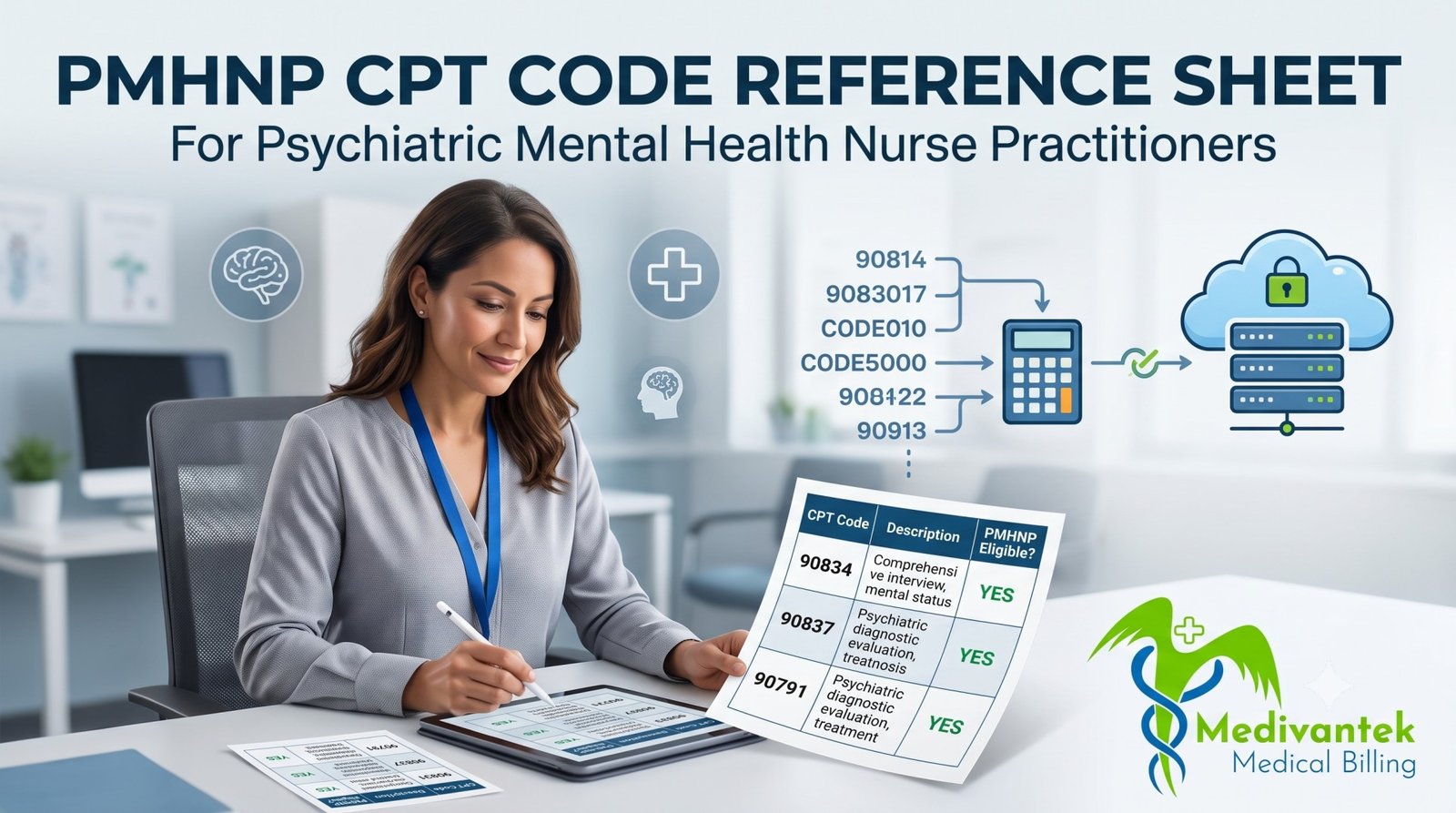
If there is one thing that trips up new Psychiatric Mental Health Nurse Practitioners more than anything else, it is billing.
You spent years learning psychopharmacology and therapy techniques. Nobody taught you how to pick between 90834 and 90837, or what in the world a modifier -25 is for.
This PMHNP CPT Code Reference Sheet covers the codes you will use, document them, and the traps that get practices in trouble.
PMHNP CPT Code Reference Sheet
The CPT codes you will use most fall into a few families. The psychiatry section runs from 90785 to 90899, but about 90% of your claims will use maybe ten codes.
Diagnostic Evaluations (The Initial Visit)
These are the foundation codes. You use them for the first encounter with a patient—the one where you figure out what is going on.
| CPT Code | Description | What It Covers | PMHNP Eligible? |
| 90791 | Psychiatric diagnostic evaluation (no medical services) | Comprehensive interview, mental status exam, history, diagnosis, treatment planning. Does not include medical exam. | YES |
| 90792 | Psychiatric diagnostic evaluation (with medical services) | Same as 90791, but includes a physical exam component. | YES |
Key differences:
- 90791 is for when you are doing a full psychiatric workup—history, MSE, collateral, etc.
- 90792 is for when you also perform a physical exam. For most PMHNPs, this is less common unless you are in a primary care or inpatient setting.
These are not time-based codes. You do not bill based on minutes spent. You bill based on the service itself. This is different from psychotherapy codes, which are strictly time-based.
What to document:
- Chief complaint and history of present illness
- Psychiatric history (including past diagnoses, treatments, hospitalizations)
- Substance use history
- Social and family history
- Mental status examination
- Risk assessment (suicide, violence, self-harm)
- Diagnosis (ICD-10 codes, typically F-codes for mental health conditions)
- Treatment plan
Most payers allow one psychiatric diagnostic interview exam per client, per provider, per calendar year. If you are seeing a patient for an initial evaluation, this is your code. You cannot bill another one later that year just because the patient has a new problem.
Individual Psychotherapy (Time-Based Codes)
These are your follow-up visit codes. The bread and butter of ongoing treatment.
| CPT Code | Time Range | What It Covers | PMHNP Eligible? |
| 90832 | 16–37 minutes | Psychotherapy, usually for brief check-ins or patients who do not need a full session | YES |
| 90834 | 38–52 minutes | Standard 45-minute psychotherapy session | YES |
| 90837 | 53+ minutes | Extended 60-minute psychotherapy session | YES |
These codes are strictly time-based. If you bill 90837, you must document at least 53 minutes of face-to-face time. Not 52. 53.
Imagine you have a patient who is stable on medication and needs a brief check-in and refill. You spend 20 minutes with them. Bill 90832. You have a patient in crisis who needs significant therapeutic intervention and medication adjustment. You spend 55 minutes. Bill 90837.
Always document the total time spent face-to-face with the patient. Start time and end time are best practice. Just writing “60 minutes” without detail is an invitation for a denial.
Psychotherapy with Evaluation and Management (Medical Providers Only)
This is where it gets tricky. These codes are specifically for prescribing providers psychiatrists, PMHNPs, and other medical professionals who can both prescribe medication and provide psychotherapy.
| CPT Code | Time Requirement | What It Covers | PMHNP Eligible? |
| 90833 | 30 minutes of psychotherapy | Psychotherapy + E/M service (medication management, etc.) | YES |
| 90836 | 45 minutes of psychotherapy | Psychotherapy + E/M service | YES |
| 90838 | 60 minutes of psychotherapy | Psychotherapy + E/M service | YES |
These codes are used when you are doing both medication management and psychotherapy in the same session. You are not just checking in and refilling—you are actually doing therapeutic work.
When you bill these codes, you must append modifier -25 to the E/M code to indicate a separate, significant, and identifiable service. The combination is billed on one line: the E/M code with -25, and the psychotherapy code separately.
When to use vs. psychotherapy codes:
- Use 90832/90834/90837 if you are providing psychotherapy only (no medication management)
- Use 90833/90836/90838 if you are providing psychotherapy + medication management in the same session
If a patient comes in for a 45-minute session, you spend 30 minutes doing cognitive behavioral therapy and 15 minutes adjusting their SSRI dose and reviewing side effects—you bill 90836. If you only adjusted the medication and did a brief check-in, you bill an E/M code (99213/99214) based on medical decision-making, not a psychotherapy add-on.
Psychological Testing & Evaluation (The Underutilized Code)
Most PMHNPs leave money on the table here. CPT 96130 covers the clinical interpretation and feedback when you review a comprehensive psychological assessment with your patient.
| CPT Code | Description | Minimum Time | PMHNP Eligible? |
| 96130 | Psychological testing evaluation, first hour | 31 minutes | YES |
| 96131 | Each additional hour (add-on) | Each additional hour | YES |
This covers reviewing test results, integrating patient data, interpreting standardized test scores, clinical decision-making, treatment planning, documentation and report writing, and providing feedback to the patient or family.
You do not need to spend 31 minutes face-to-face. Prep time counts. If you spend 15 minutes reviewing a MindMetrix report before the visit and 20 minutes discussing results with the patient, you have met the 31-minute threshold.
Billing with an E/M code: When you use 96130 alongside an E/M code, your documentation needs to distinguish the services. Use modifier -25 on the E/M code and modifier -59 on 96130.
Many PMHNPs either do not know the code exists, or they assume it is only for psychologists. It is not. You are a qualified healthcare professional (QHP) and can bill this code.
If a payer denies 96130, CPT 96127 is an alternative for brief assessments using standardized instruments. Lower reimbursement ($7–$12 per unit), but widely accepted.
Family and Group Therapy
These codes are for when you are not seeing the patient individually.
| CPT Code | Description | PMHNP Eligible? |
| 90846 | Family psychotherapy (without patient present), 50 minutes | YES |
| 90847 | Family psychotherapy (with patient present), 50 minutes | YES |
| 90853 | Group psychotherapy (not time-based, per member) | YES |
When to use 90846 vs. 90847:
- 90846: You are seeing family members without the patient. These might be collateral sessions for a patient who is too ill to participate, or family sessions for a minor whose parents need support and guidance.
- 90847: You are seeing the patient with family members. This is the standard family therapy session.
For family therapy, document who was present, the session duration, and the therapeutic focus.
Crisis Intervention
These codes are for urgent, high-risk situations requiring immediate therapeutic attention. Not routine sessions.
| CPT Code | Description | PMHNP Eligible? |
| 90839 | Psychotherapy for crisis, first 60 minutes (30–74 minutes) | YES |
| 90840 | Psychotherapy for crisis, each additional 30 minutes | YES |
The patient is in acute psychological distress—suicidal ideation, self-harm, intense trauma response, panic attack requiring intervention, acute psychosis requiring de-escalation.
You must document the clinical crisis and the therapeutic strategies used to de-escalate the situation. A note that just says “patient was anxious” does not justify a crisis code.
Telehealth Modifiers: The Rules Keep Changing
If you are doing telehealth (and most of us are), you need to know the modifiers.
| Modifier | Meaning | When to Use |
| 95 | Telehealth (synchronous, audio-video) | Use on the CPT code line for telehealth visits |
| 93 | Telephone (audio-only) | Use for telephone encounters, not video |
CMS has made several mental health codes permanently eligible for telehealth:
- 90791, 90792 (diagnostic evaluations)
- 90832, 90834, 90837 (psychotherapy)
- 90833, 90836, 90838 (psychotherapy with E/M)
- 90839, 90840 (crisis)
- 90846, 90847 (family therapy)
- 90853 (group therapy)
Audio-only: Medicare and many commercial payers have allowed audio-only (telephone) services during public health emergencies. Check your specific payer’s policy, as these rules are not permanent.
E/M Codes for Medication Management (When No Therapy)
Sometimes you are just doing medication management. No psychotherapy. This is a straight medical evaluation.
| CPT Code | MDM Level | Typical Use |
| 99213 | Low complexity | Stable patient, routine medication refill |
| 99214 | Moderate complexity | Patient with some changes, mild side effects, or co-morbid conditions |
| 99215 | High complexity | Complex patient, multiple medications, severe side effects, significant changes |
These are billed based on medical decision-making (MDM) OR time. You can choose whichever is more favorable.
Medical decision-making factors:
- Number and complexity of problems
- Amount and complexity of data reviewed
- Risk of complications or morbidity
Using time for E/M: If you spend more time on the encounter than the MDM level supports, you can bill based on time. Total time includes pre- and post-service work on the day of the visit.
Established patient time thresholds:
- 99213: 20–29 minutes
- 99214: 30–39 minutes
- 99215: 40–54 minutes
New patient time thresholds:
- 99203: 30–44 minutes
- 99204: 45–59 minutes
- 99205: 60–74 minutes
For established patients, if you exceed 54 minutes, you can add +99417 for each additional 15 minutes beyond the threshold. This requires direct patient contact.
Interactive Complexity (The Billing Hack)
You might not know about this one.
| CPT Code | Description | PMHNP Eligible? |
| 90785 | Psychotherapy with interactive complexity | YES |
This is an add-on code for psychotherapy sessions when you are dealing with communication difficulties, such as an emotionally volatile patient, a patient with cognitive deficits that require extra effort to communicate, or a patient who requires the involvement of a third party (interpreter, caregiver).
Use this code when you are providing psychotherapy (90834/90837) and the session is made significantly more complex by patient factors requiring extra work.
Your note must explain why the interaction was complex. “Patient was tearful and difficult to engage” is not enough. Specify the barrier and the strategies used to overcome it.
Here is a Quick Reference Summary Sheet
| Code | Service | Time/Minutes | PMHNP? |
| 90791 | Psychiatric evaluation (no medical) | Not time-based | YES |
| 90792 | Psychiatric evaluation (with medical) | Not time-based | YES |
| 90832 | Psychotherapy | 16–37 min | YES |
| 90834 | Psychotherapy | 38–52 min | YES |
| 90837 | Psychotherapy | 53+ min | YES |
| 90833 | Psychotherapy + E/M | 30 min therapy | YES |
| 90836 | Psychotherapy + E/M | 45 min therapy | YES |
| 90838 | Psychotherapy + E/M | 60 min therapy | YES |
| 90846 | Family therapy (no patient) | 50 min | YES |
| 90847 | Family therapy (with patient) | 50 min | YES |
| 90853 | Group therapy | Not time-based | YES |
| 90839 | Crisis, first hour | 30–74 min | YES |
| 90840 | Crisis, additional 30 min | Each 30 min | YES |
| 96130 | Psychological testing evaluation | 31+ min | YES |
| 90785 | Interactive complexity add-on | N/A | YES |
| 99213 | E/M, low complexity | 20–29 min (est) | YES |
| 99214 | E/M, moderate complexity | 30–39 min (est) | YES |
| 99215 | E/M, high complexity | 40–54 min (est) | YES |
Common Billing Errors to Avoid
Let’s walk through the most common billing errors, what the denial codes mean, and how to avoid them.
The Information Errors (Front-End Mistakes)
These are the small details that cause the biggest headaches.
A simple typo in a name, an incorrect date of birth, or an outdated insurance policy number can cause a claim to be rejected at the door. This is where the domino effect starts. As one expert put it, “A typo in a name, an outdated insurance policy, or a missing address can lead to claim rejections.”
The corresponding remittance code you might see is 31: “Patient cannot be identified as our insured.”
How to Fix It:
- Double-check everything at the front desk: Create a dedicated, distraction-free space for checking in patients and entering their information.
- Real-time insurance verification: Verify eligibility before the visit, not after. It’s the single most important step to avoid this issue.
Billing the Wrong Payer
This is more common than you’d think. A patient might hand you a Medicare card, but their actual coverage is through a Blue Cross plan. You submit the claim, and it’s rejected. You’ll get a rejection code like 109: “Claim not covered by this payer/contractor. You must send the claim to the correct payer/contractor.”
How to Fix It:
- Always verify insurance at every visit: Policies change, and patients aren’t always aware of the updates. This simple step prevents a mountain of problems.
The Coding Errors (Mid-Cycle Mistakes)
The world of CPT, ICD-10, and HCPCS codes is complex and ever-changing. Even a tiny misstep can stop a claim in its tracks.
Modifiers are like an instruction manual for your claim. They tell the payer a specific detail, like “this was a bilateral procedure” or “this service was distinct from the primary one.” Using the wrong modifier, or failing to use one at all, is one of the most common reasons claims are denied. This can lead to a vague denial like 16: “Claim/service lacks information or has submission/billing error(s).”
How to Fix It:
- Focus your training: Don’t try to teach your staff every possible modifier. Train them on the modifiers you use the most for your specific practice. This targeted training is far more effective.
- Use technology: Modern EHR and billing systems often flag when a modifier is expected or used incorrectly.
Upcoding and Downcoding
These are two sides of the same coin.
- Upcoding is billing for a more expensive service than was actually provided. This is a serious compliance risk and can lead to fraud investigations.
- Downcoding is billing for a less expensive service. This is a lost revenue opportunity.
How to Fix It:
- Regular auditing: Conduct internal or external audits to catch these patterns before they become systemic issues.
- Proper documentation: The service you bill must always match the documentation in the medical record.
Duplicate Billing
Submitting the same claim more than once is a fast track to a denial and can even trigger compliance concerns. You’ll see a clear code for this: 18: “Duplicate claim/service.” In fact, duplicate denials account for almost 20% of denials in some clinical and molecular segments.
How to Fix It:
- Clear tracking systems: Ensure your medical billing team has a clear process for tracking submitted claims so they don’t resubmit them unnecessarily
Timely Filing Issues
Every payer has a strict deadline for submitting a claim. If you miss it, the claim is dead. You’ll get a denial code 29: “The time limit for filing has expired.”
How to Fix It:
- Automate reminders: Use your practice management software to set alerts for upcoming filing deadlines.
- Create a workflow: Submit claims ASAP, and make it a rule to appeal any denials immediately to preserve your window.
Service Not Covered (Medical Necessity)
This is a common one, especially with Medicare. You might see a code like 50: “This decision was based on an LCD.” An LCD (Local Coverage Determination) is a policy that outlines what Medicare will cover in your area. A common reason for this denial is the missing a required order or a specific modifier to show that the service was medically necessary.
How to Fix It:
- Know the rules: Familiarize yourself with the LCDs for your most common procedures.
- Document and prepare: Ensure you have all necessary documentation (such as a physician’s order) and proper modifiers (such as the KX modifier for DME) before submitting the claim.
Final Takeaway
Billing is not clinical work, but it affects your ability to do clinical work. If you are not getting paid, you cannot stay open. And if you cannot stay open, you cannot help patients.
The codes are not complicated once you understand the logic:
- 90791/90792 for the first visit
- 90832/90834/90837 for therapy-only follow-ups
- 90833/90836/90838 for therapy + med management
- 99213/99214 for medication-only visits
- 96130 for psychological testing evaluation
- Telehealth modifiers when appropriate
Document time, use modifiers correctly, and keep your ICD-10 codes straight.
Stop Losing Revenue to Billing You Did Not Sign Up For
| You trained to treat patients, not to argue with payers about modifier -25 or chase a 96130 denial. Medivantek runs mental health billing for psychiatric practices and PMHNPs, so the coding, the claims, and the denials are handled while you stay in the chart. Our team knows psychiatric coding cold. The 90833 to 90838 add-on rules, the time thresholds that separate 90834 from 90837, the 96130 modifier logic that trips up most practices, the G2211 add-on most PMHNPs never capture, and the telehealth rules that keep moving. We code it right the first time, work your denials by root cause, and keep your filing windows tracked so nothing ages out. If undercoded visits are costing you, or your denial rate is climbing, let us take billing off your plate. Request a free billing review, and we will review a sample of your claims and show you exactly where revenue is leaking and how much you can recover. |
