
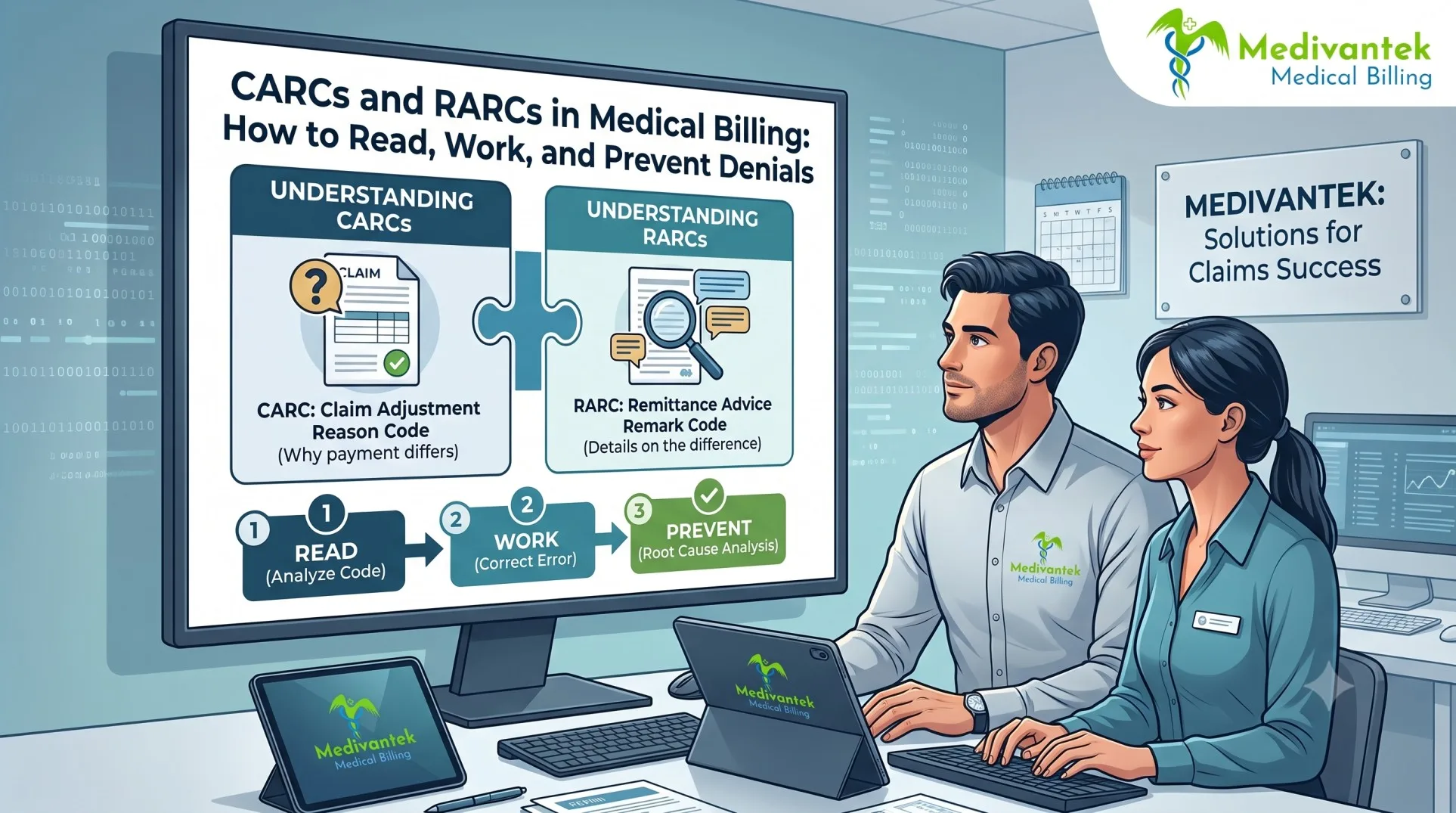
If you have been in medical billing for more than a week, you have already stared at a remittance advice and seen a string of numbers and letters next to a denied or adjusted claim that made zero sense at first glance.
That is where CARCs and RARCs live. They are the language payers use to communicate claim decisions.
Once you know how to read them, your ability to work denials, correct errors, and prevent future claim problems improves dramatically.
Most billing teams treat CARCs and RARCs as denial codes to look up in a spreadsheet and then act on without really understanding the logic behind them. That reactive approach keeps denial rates stuck.
The practices that consistently run denial rates below 5% tend to be those where billing staff understands CARCs and RARCs not just as lookup codes but as a diagnostic system that tells them exactly what went wrong and what to do next.
There are currently 358 CARCs and 1,185 RARCs in use across the U.S. healthcare system. You do not need to memorize all of them. But you absolutely need to understand how the system works and how the most common ones should drive your workflow.
This guide explains CARCs and RARCs, how they differ, how the group code system assigns financial responsibility before you make a single decision about billing or writing off, the most common codes your team deals with daily, and the specific workflows that turn remittance advice from paperwork into action.
What Are CARCs? The Core Framework
CARC stands for Claim Adjustment Reason Code.
A CARC is a standardized numeric code that a payer attaches to a claim or service line to explain why the payment amount differs from what the provider billed.
The only time a claim comes back without a CARC is when the payer paid exactly what you billed. In every other case, a CARC tells you why the numbers do not match.
CARCs are HIPAA-mandated. That means every payer in the United States, from Medicare to Medicaid to commercial insurers to workers’ compensation carriers, is required to use the same standardized CARC list.
CARC 45 means the same thing at Aetna as it does at Blue Cross and Medicare. That standardization is what makes CARCs such a powerful tool once you learn the system. You learn the codes once, and they apply everywhere.
CARCs appear on your Electronic Remittance Advice, which is the 835-transaction file your practice receives after claim adjudication.
They sit within what the 835 format calls the CAS segment, which stands for claim adjustment segment, at either the claim or service line level. When working a denial, always check the service line-level CAS segment first.
The claim-level adjustment may provide a summary, but the service line CARCs show what happened for each specific procedure code you billed.
CARCs are maintained by X12, the standards organization that governs HIPAA electronic transaction standards, in cooperation with CMS.
The code list is updated periodically, and CMS publishes notices when codes are added, changed, or retired. As of the February 12, 2026 posting, the complete CARC and RARC list reflects the most current set of codes in use.
What Are RARCs? The Supporting Layer
RARC stands for Remittance Advice Remark Code. Where a CARC tells you the primary reason for a claim adjustment, a RARC adds the supporting detail that a CARC alone cannot convey.
Think of the CARC as the headline and the RARC as the explanation underneath it.
RARCs appear on the same 835 ERA transaction as CARCs. They are alphanumeric codes, meaning they combine letters and numbers, like N30, MA130, or M20. RARCs come in two types.
Supplemental RARCs provide additional explanation for an adjustment that a CARC has already identified.
They answer the question of what specifically is wrong. For example, CARC 16 tells you the claim has a submission error or missing information.
That code by itself tells you almost nothing actionable.
But the RARC paired with it, say M51 for missing or invalid procedure code, or N119 for missing or invalid NDC, tells your billing team what to fix. Without reading the RARC, you are guessing about the next step. With the RARC, the correction path is clear.
Alert RARCs convey informational messages that are not adjustments themselves.
They might tell you that a claim was forwarded to another payer, that certain information is needed for processing, or that a specific policy applies to the claim. Alert RARCs do not always require action, but they always deserve a read.
CMS created RARCs as a proprietary code list.
They became an industry-wide standard under HIPAA. As of 2026, there are 1,185 active RARCs, and payers use them alongside CARCs to provide a complete explanation of every adjudication decision.
CARC vs RARC: Key Differences
People use the two terms together so often that they blur, but they do different jobs. A CARC carries the reason for an adjustment. A RARC carries the detail behind that reason. Every adjustment needs a CARC. Not every adjustment needs a RARC, though many carry one or more so the CARC becomes something your team can actually act on.
The table below keeps the distinction in front of your staff.
| Attribute | CARC | RARC |
|---|---|---|
| Full name | Claim Adjustment Reason Code | Remittance Advice Remark Code |
| Format | Numeric, such as 45, 97, 16 | Alphanumeric, such as N30, M51, MA130 |
| Its job | States why payment differs from what you billed | Adds the specific detail behind the CARC |
| Always present? | Yes, on any adjustment | Often present, sometimes informational |
| Maintained by | X12 Claim Adjustment Status Code Maintenance Committee | CMS |
| Assigns who pays? | Yes, through its paired group code | No |
A specific CARC like 45 can stand on its own. A generic CARC like 16 or 96 tells you very little until you read the RARC sitting next to it. That pairing is the whole reason both code sets exist.
How CARCs and RARCs Differ From Other Codes You See
Billing staff run into several code systems that look alike and get lumped together as denial codes. They are not the same thing, and confusing them sends a claim down the wrong path.
Denial code is a casual term, not an official code set. When someone on your team asks what the denial code is, they usually mean the CARC, and often the CARC and RARC read together. There is no separate master list called denial codes.
Payer proprietary codes appear on paper EOBs and in some portals. A plan may print its own internal reason code, often called an EX code, next to or instead of the standardized CARC. These are not standardized, so an EX code from one payer means nothing to another. When you work from a paper EOB, map the proprietary code back to the CARC and RARC on the 835 before you act.
Claim status codes answer a different question. The 277CA and its claim status category and status codes tell you where a claim sits in the payer’s pipeline, whether it was accepted, rejected at the front door, or is still pending. They appear before adjudication. CARCs and RARCs appear after adjudication, on the remittance. A claim that rejected at the clearinghouse never reached adjudication, so it never gets a CARC. Knowing which one you are looking at tells you whether to send a fresh claim or correct and appeal an adjudicated one.
NCPDP Reject Codes belong to pharmacy. Retail pharmacy claims run through the NCPDP standard, not the medical 835, and carry their own reject codes. If your organization bills both medical and pharmacy, keep the two systems separate in your denial reporting.
Keep these straight and your team stops appealing claims that should be resubmitted, and resubmitting claims that should be appealed.
The Group Code System: Who Pays the Balance
Before you look at a CARC number, you need to read the attached group code. The group code is a two-letter prefix that appears with every CARC on the remittance.
It tells you who is financially responsible for the adjusted amount.
Reading the group code first is not optional. It determines your entire next action.
Getting this wrong means either improperly billing a patient for an amount they do not owe, or writing off money the practice is entitled to collect.
There are five group codes in use.
- CO stands for Contractual Obligation. A CO adjustment means the provider is responsible for the difference between the billed amount and the allowed amount. This is typically a contractual write-off tied to your participation agreement with the payer. CO-45, which indicates the charge exceeds the fee schedule or the maximum allowable amount, is the most common CARC in medical billing and almost always carries a CO group code. A CO-45 adjustment is not a denial in the traditional sense. It is the payer applying your contracted rate and requiring you to write off the difference. You cannot bill the patient for a CO adjustment. However, not all CO adjustments are simple write-offs. CO-16, a claim with a submission error, is technically a CO, but it is correctable. Read the RARC with any CO before deciding whether to write off or correct and resubmit.
- PR stands for Patient Responsibility. A PR adjustment means the balance falls on the patient, not the provider, and not the payer. PR-1 means the patient owes a deductible. PR-2 means the patient owes coinsurance. PR-3 means the patient owes a copay. These are the amounts you collect from the patient at the front desk or through your billing cycle. You do not write these off, nor do you appeal them to the payer. You bill the patient.
- OA stands for Other Adjustment. OA adjustments cover situations that do not fit cleanly into CO or PR categories. Medicare Secondary Payer situations often carry OA group codes. Coordination of benefits adjustments where a primary payer has already paid something frequently show up as OA. OA adjustments warrant investigation because the appropriate response varies with the specific CARC and your claim circumstances.
- PI stands for Payer-Initiated Reduction. A PI adjustment means the payer reduced the payment for a reason unrelated to your contract terms or the patient’s cost-sharing. PI adjustments can sometimes be disputed if they do not align with your contract terms or if the payer applied a reduction incorrectly.
- CR stands for Correction and Reversal. CR adjustments are made when a payer corrects a previously processed claim. They typically accompany a reversal of a prior payment and a reprocessed claim.
The rule is simple and non-negotiable. Always read the group code before deciding what to do with a CARC.
Soft Denials vs Hard Denials
Before anyone works a denial, sort it into one of two buckets, because the bucket decides the play.
A soft denial is correctable. The payer is not refusing the service in principle. It is telling you that something on the claim is wrong, missing, or out of sequence. CARC 16 for missing information, CARC 4 for a modifier problem, and CARC 18 for a duplicate are soft. You fix the underlying issue and resubmit, usually without a formal appeal. Soft denials hold most of your recoverable revenue, and they cost the least to resolve when you catch them fast.
A hard denial is a refusal. The payer has made a coverage or eligibility decision and will not pay unless you change its mind through appeal, or the loss becomes a write off. CARC 29 for timely filing, CARC 50 for medical necessity, and CARC 96 for non covered charges often land here. These take documentation, policy citation, and time, so they belong with a staffer who can build an appeal, not in a resubmission queue.
The same CARC can be soft or hard depending on the RARC and the situation, which is one more reason to read the pair together before you decide.
The Most Common CARCs Your Billing Team Sees Every Day
Understanding the most frequently encountered CARCs and the correct action for each one is the foundation of effective denial management. Here is a detailed breakdown of the ones that matter most.
CARC 45: Charge Exceeds Fee Schedule or Maximum Allowable
CARC 45 is the single most common CARC in medical billing. It means the amount you billed exceeds the payer’s fee schedule or the maximum allowable charge for that service.
The adjustment reduces payment to the allowed amount.
This almost always carries a CO group code, making it a contractual write-off.
In most cases, CARC 45 is not a denial. Your contracted rate is being applied.
The correct action is to verify that the allowed amount matches your contract, post the contractual adjustment, and move on.
If the allowed amount does not match your contracted fee schedule, that is a contract underpayment dispute, not a routine write-off.
Flag it for your contracting team.
CARC 97: Service Bundled into Another Payment
CARC 97 means the payer considers the service billed to be included in the payment already made for a different service on the same claim. This is the primary NCCI bundling code. When you see CO-97, it means an NCCI Procedure-to-Procedure edit bundled one of your codes into another.
The question with CARC 97 is always whether a modifier would appropriately break the bundle.
If you billed two separately performed, non-overlapping procedures that were bundled, a modifier such as 59 or one of the X-modifiers may allow separate payment when documentation supports distinct services.
If the services were performed as described, add the modifier and resubmit. If the services were part of a single procedure and the bundle is correct, post the write-off.
CARC 4: The procedure code is inconsistent with the modifier used, or a required modifier is missing
CARC 4 indicates that the payer’s system found a mismatch between the procedure code you billed and the diagnosis code on the claim.
This is a coding logic error. Your ICD-10 diagnosis code does not support medical necessity for the procedure you billed, according to the payer’s coverage policy logic.
The action depends on whether the mismatch is a coding error or a documentation gap. If you submitted the wrong diagnosis code, correct it and resubmit.
If the diagnosis code is accurate but the clinical documentation supporting it is thin, the problem is in the chart.
Review the documentation, determine whether a more specific or supportive diagnosis code accurately reflects the clinical picture, and resubmit with the corrected diagnosis.
Do not change the diagnosis to something unsupported by the documentation just to get the claim paid. That is fraud.
CARC 16: Claim Lacks Information or Has a Submission Error
CARC 16 is one of the most important codes to understand because it is generic. It simply says the claim has a submission error or is missing required information.
Without the paired RARC, you do not know what to fix.
Always, without exception, look at the RARC or RARCs paired with CARC 16 before doing anything.
The RARCs paired with CARC 16 might say M51 for missing or invalid procedure code, N119 for missing or invalid NDC, MA130 for incomplete or invalid information, or any number of other specific missing elements.
Each RARC points to a specific field or data element that needs correction.
Fix the identified element and resubmit the claim. Do not appeal CARC 16 denials. They are submission errors, not coverage disputes.
CARC 50: Service Not Deemed Medically Necessary
CARC 50 means the payer reviewed the claim and determined that the service does not meet its medical-necessity criteria.
This is a true denial and one of the most common targets for appeal in billing. When CO-50 appears, the payer is saying the documentation does not support that the service was clinically appropriate for this patient under their coverage policy.
The correct action is to pull the payer’s medical policy for the procedure, review the clinical documentation against each coverage criterion listed in that policy, and build an appeal that addresses each criterion specifically using evidence from the patient’s chart.
Generic appeal letters that simply restate the service do not win CO-50 appeals. Specific appeals that cite the policy by name and section, match the documentation to each criterion, and include relevant clinical literature when available tend to win significantly more often.
If the payer’s denial is based on a Local Coverage Determination, which Medicare and some commercial payers use to define medical necessity for specific services, cite the LCD by number in your appeal and walk through how the patient’s documentation meets each criterion the LCD describes.
CARC 29: Timely Filing
CARC 29 means the claim was received outside the payer’s timely filing window. This is the denial you cannot fix by correcting the claim.
Medicare’s timely filing window is 12 months from the date of service. Most commercial payers are shorter, commonly 90 to 180 days. Once the window closes, the claim is typically unrecoverable regardless of clinical accuracy.
However, CARC 29 denials are sometimes issued incorrectly. If you have proof of timely original submission, such as a clearinghouse confirmation report with a timestamp showing the claim was sent within the filing window, you can appeal CARC 29 denials.
The appeal needs to include that documented proof of timely submission. If the claim was genuinely filed late, the denial stands, and the loss is a write-off.
Prevention is the only real solution for CARC 29. Build your billing workflow around getting claims out within 30 days of service.
That buffer keeps you well inside any payer’s timely filing window even if you have to correct and resubmit once.
CARC 96: Non-Covered Charges
CARC 96 means the service is not covered under the patient’s benefit plan. Like CARC 16, it is a generic code that requires a RARC to be actionable.
The RARC will tell you whether the service is excluded from the plan entirely, not covered in this setting, requires prior authorization that was not obtained, or falls outside coverage for another specific reason.
If a valid ABN was issued before the service, the group code may shift to PR, and you can bill the patient.
If no ABN was in place and the service is genuinely not covered, the adjustment is a write-off with a CO group code. Never balance-bill a Medicare patient for a non-covered service without a valid, pre-service ABN.
CARC 18: Duplicate Claim
CARC 18 means the payer believes this is a duplicate of a claim that has already been processed. Legitimate duplicates, where you accidentally submitted the same claim twice, should be identified and corrected internally.
But CARC 18 also fires incorrectly when a claim is resubmitted after a denial, and the payer’s system matches it to the original denied claim instead of processing it as a corrected submission.
If you resubmitted a corrected claim and received a CARC 18 duplicate denial, verify that the resubmission included the original claim number reference and the appropriate submission type indicator on the claim.
If the resubmission was coded correctly and still came back as a duplicate, contact the payer directly.
A CARC 18 on a legitimately corrected claim requires payer follow-up, not just resubmission.
CARC 22: Coordination of Benefits
CARC 22 means the payer believes another insurance carrier is the primary for this patient and that the claim must be processed first.
This comes up when COB information on file with the payer is outdated or when the patient has multiple active insurance plans.
The correct response is to verify the patient’s current insurance priority with them directly, update the COB information with the payer if it has changed, and route the claim appropriately. Bill primary first, then secondary with the primary EOB attached.
More CARCs Your Team Will See
These sit alongside the high-frequency codes already covered above and round out the set your staff meets daily.
CARC 11: Diagnosis Inconsistent With Procedure
The official text is “The diagnosis is inconsistent with the procedure.” This is the code people often expect when they see a procedure that does not match the diagnosis, and it is a different denial from CARC 4. The ICD-10 code on the claim does not support the procedure under the payer’s edits or coverage logic. Decide whether the diagnosis was simply coded wrong, in which case correct it and resubmit, or whether the chart supports a more specific code that does establish medical necessity. Never swap in a diagnosis the documentation does not support just to get the claim paid.
CARC 4: Procedure Inconsistent With Modifier
The official text is “The procedure code is inconsistent with the modifier used, or a required modifier is missing.” The procedure and the modifier do not agree, or a modifier the payer expects is not there. Common triggers are a modifier applied to a code that does not accept it, a required modifier left off a bilateral or component service, or an NCCI associated modifier missing where one was needed. Confirm what happened in the encounter, attach or correct the modifier when the documentation supports it, and resubmit. If the modifier was right and the edit fired anyway, appeal with the operative note and the NCCI reference.
CARC 197: Authorization or Precertification Absent
The payer required prior authorization, notification, or precertification, and it was not obtained or is not on file. First check whether an authorization exists and was simply left off the claim or keyed wrong, then correct and resubmit. If no authorization was obtained, request a retroactive authorization where the payer allows it, and document any clinical urgency that prevented getting one in advance. Track which payers and procedures drive these, because CARC 197 is a front end process problem more than a billing problem.
CARC 204: Not Covered Under the Patient’s Plan
The service falls outside what this specific plan covers. Verify the benefit before you write anything off, since a plan change or the wrong plan on file can produce a false 204. If the service is genuinely excluded and a valid ABN was issued in advance, you can bill the patient. Without an ABN on a Medicare patient, an excluded service is a write off.
CARC 109: Claim Sent to the Wrong Payer
The claim went to a payer that is not responsible for it, which usually means coverage ended, the patient switched plans, or coordination of benefits is out of date. Verify current coverage with the patient, update the payer on file, and route the claim to the correct one. The claim may have been forwarded automatically, so read the RARC for a forwarding message before you resubmit and create a duplicate.
CARC 236: NCCI Procedure or Modifier Conflict
This is the NCCI code that points at the procedure or modifier combination specifically, which separates it from CARC 97. When the edit allows it, meaning the procedure to procedure modifier indicator is 1, and the services were genuinely distinct, an NCCI associated modifier on the correct code in the pair, backed by documentation, can resolve it. When the indicator is 0, no modifier overrides the edit and the second service is not separately payable.
The Most Important RARCs and What They Tell You
RARCs function as the detail layer under CARCs. Here is a table of the most commonly encountered RARCs in practice billing.
| RARC | What It Means | Action |
| N30 | Missing or incomplete operative report | Obtain and attach operative report, resubmit |
| N290 | Claim submitted to incorrect payer | Route claim to correct payer |
| N126 | Service not covered in this setting | Verify setting requirements, may need to re-route |
| M20 | Missing or invalid HCPCS or CPT code | Correct procedure code, resubmit |
| M51 | Missing or invalid procedure code | Supply correct procedure code |
| M119 | Missing or invalid NDC | Add correct NDC for drug claim |
| MA130 | Incomplete or invalid information | Review claim fields for completeness |
| N56 | Authorization/referral absent | Obtain retroactive auth if possible, or appeal |
| N130 | Consult plan procedures, call payer | Contact payer to understand issue |
| N265 | Missing or invalid ordering provider | Add or correct ordering provider information |
| N522 | Patient not enrolled on date of service | Verify enrollment, check eligibility at DOS |
| M76 | Missing or incomplete discharge summary | Obtain and submit discharge documentation |
| N479 | Missing or invalid place of service | Correct POS code |
| N31 | Missing or invalid prescribing date | Add valid prescribing date |
The RARCs in this table represent the most frequent supplemental explanations accompanying the most common CARCs. When you train your billing team, teach them to read CARC and RARC together as a unit, not as separate pieces of information.
Where the Codes Live in the 835: CAS, MIA, and MOA
The remittance you receive electronically is the 835, the version 5010 transaction your clearinghouse delivers after the payer adjudicates. Knowing where each code sits in that file tells your team where to look when they post and when they work denials.
The CAS segment, short for Claim Adjustment Segment, is the home of group codes, CARCs, and the adjusted amounts. It appears at two levels. The claim level CAS summarizes adjustments for the whole claim. The service line level CAS breaks them down by individual procedure. Work the service line CAS first, because that is where you see exactly what happened to each CPT code you billed.
Two more segments matter on Medicare remittances. The MIA segment, Medicare Inpatient Adjudication, carries inpatient information and remark codes on institutional inpatient claims. The MOA segment, Medicare Outpatient Adjudication, does the same for outpatient and professional claims. Medicare often places its RARCs in MIA or MOA rather than alongside the CARC, so staff working Medicare denials need to read those segments, not just the CAS.
Reading RARC Prefixes
RARCs are not random. The first character tells you something about where the code came from.
- M codes are the original Medicare remark codes, the oldest set and still in heavy use, such as M51 and M76.
- MA codes are Medicare-specific remark codes from the same lineage, such as MA130 and MA112.
- N codes are the newer additions, created as the list grew and broadened beyond Medicare, such as N30, N265, and N522.
The prefix does not change how you act on the code, but it helps staff recognize patterns. It also explains why a Medicare heavy remittance leans on M and MA codes while commercial remittances lean on N codes.
How to Build a CARC and RARC Workflow?
Most practices handle CARCs and RARCs reactively. A denial comes in, someone looks up the code, takes an action on that specific claim, and moves on. That claim-by-claim approach is one of the main reasons denial rates stay elevated. Here is a better structure.
Categorize first, work second.
When your ERA comes in, run a report that groups denied and adjusted claims by CARC category before anyone starts working individual claims.
The categories that most denial management systems use are administrative errors such as CARC 16 and 18, clinical and medical necessity issues such as CARC 50 and 11, bundling and coding issues such as CARC 97 and 4, coverage and coordination issues such as CARC 22 and 96, and patient responsibility shifts such as PR group codes.
When you see that 40% of this week’s denials are CARC 16 submission errors, that tells you there is a systemic problem in how claims are going out.
Fixing the systemic problem prevents hundreds of future denials. Working each CARC 16 claim individually without addressing the root cause just keeps you running on a treadmill.
Triage by group code.
Before any denial gets worked, the group code tells you whether the account needs action. PR group codes go to the patient billing workflow, not the insurance denial workflow.
CO group codes that reflect correct contractual adjustments get posted as write-offs.
CO group codes on correctable errors like CARC 16, OA adjustments with investigation flags, and PI adjustments that may be incorrectly applied go to your AR follow-up queue.
Mixing these up creates unnecessary work and sometimes results in improper patient billing.
Read RARC before acting on CARC.
Make this a non-negotiable step in your team’s workflow.
For any CARC that requires action, the RARC identifies what specifically needs to be corrected or what additional information is needed.
Acting on the CARC without reading the RARC often means resubmitting with the same error or filing an appeal that does not address the payer’s actual objection.
Track denials by root cause at the monthly level.
Your denial-tracking dashboard should show you the top 10 CARCs by volume and dollar amount each month, with trends over time.
Volume tells you which errors are happening most often. Dollar amount tells you which errors are costing the most. Those are sometimes different, and both matter.
A CARC 50 medical necessity denial that fires three times a month on a $5,000 procedure is more financially urgent than a CARC 16 submission error that fires fifty times a month on $80 claims.
Set timely filing alerts well before the window closes.
For every payer in your system, know the timely filing window and set internal alerts at 50% and 75% of the window.
If Medicare has 12 months, your team should be alerted on any unpaid or unresolved claim at 6 months and again at 9 months.
For commercial payers with 90-day windows, set alerts at 45 days and 60 days.
The CARC 29 timely filing denial is 100% preventable with proper tracking.
Stopping Denials at the Front End
Working denials well is necessary, but the cheapest denial is the one that never posts. Most of the high volume CARCs trace back to something that could have been caught before the claim went out.
Eligibility and benefits verification stops a large share of CARC 22, 27, 109, and 204 denials. Check coverage, plan, and coordination of benefits at scheduling and again on the date of service, not after the remittance comes back.
Claim scrubbing catches the CARC 16, 4, and 11 family before submission. A clearinghouse or billing system that runs claims against payer edits flags missing data, modifier conflicts, and diagnosis to procedure mismatches while you can still fix them for free.
Authorization tracking prevents CARC 197. If a procedure needs prior authorization, the authorization number belongs on the claim before it leaves, with a process that confirms it rather than assuming it.
Front door acknowledgments tell you a claim was accepted before you wait on payment. The 999 and 277CA confirm the payer received and accepted the claim. A claim that rejected at the front door never reached adjudication, so chasing its denial on the remittance is wasted effort. Watch the acknowledgments and you catch those the same day.
The Medicare Appeals Process: Five Levels
When a Medicare fee for service denial is wrong and the service was payable, you escalate through five levels. Each level has its own deadline, and the higher levels have a dollar threshold the claim has to clear. Build these into your AR workflow so nothing ages out before you act.
| Level | Name | Decided by | File within | 2026 threshold |
|---|---|---|---|---|
| 1 | Redetermination | Medicare Administrative Contractor | 120 days of the remittance | None |
| 2 | Reconsideration | Qualified Independent Contractor | 180 days of the redetermination | None |
| 3 | ALJ hearing | Office of Medicare Hearings and Appeals | 60 days of the reconsideration | $200 |
| 4 | Appeals Council review | Medicare Appeals Council | 60 days of the ALJ decision | None |
| 5 | Judicial review | Federal District Court | 60 days of the Council decision | $1,960 |
The thresholds at levels 3 and 5 are the amount in controversy, recalculated every year. For 2026 they are $200 for an ALJ hearing and $1,960 for federal court, and you can sometimes combine claims to reach the federal court figure. Most denials never travel past level 1 or 2, which is where a well documented redetermination wins back the most money for the least effort.
Who Maintains CARCs and RARCs
No single payer owns these code sets, which is exactly why CARC 45 means the same thing everywhere. Several bodies keep the system running, and knowing who does what helps when you need to verify a code or understand why a description changed.
X12, through its Claim Adjustment Status Code Maintenance Committee, maintains the CARC list. CMS maintains the RARC list. The group codes, properly called Claim Adjustment Group Codes, are part of the X12 835 standard. There are four of them in the version 5010 835: CO, PR, PI, and OA. You may still see references to an old fifth value, CR, in legacy material, but it is not a current group code and should not appear on a compliant 835.
All three code sets are published on the Washington Publishing Company website, and they update three times a year. That cadence is why a description you relied on last year can read differently today, and it is why your code lookup tables need a refresh schedule rather than a one time import.
One more layer explains why payers cannot pair codes any way they like. Under the Affordable Care Act, CAQH CORE publishes operating rules for electronic remittance, including the rule on uniform use of CARCs and RARCs, often called CORE 360. That rule defines an approved set of CARC, RARC, and group code combinations for common business scenarios, so the same situation produces the same combination across payers. When you build automated posting logic, you build it against those CORE code combinations, not against the raw lists alone.
CARC and RARC Updates in 2026
The CARC and RARC list was updated on February 12, 2026. The update added new codes, retired several codes that were no longer in active use, and modified the descriptions of a handful of existing codes.
The CY 2026 ALJ hearing threshold for Medicare appeals increased to $200 from $190, and the Federal District Court threshold increased to $1,960 from $1,880.
These thresholds matter because they determine when a Medicare claim denial can be escalated to each of the five levels in the appeals process.
CMS also updated the Medicare Claims Processing Manual guidance on CARC and RARC reporting obligations in Chapter 22, which covers CAS, MIA, and MOA segment rules and group code requirements.
If your billing team handles Medicare fee-for-service in volume, reviewing Chapter 22 of the Medicare Claims Processing Manual is worth the time.
It is the authoritative source for how CARCs and RARCs must be reported on Medicare remittance advice and how billing staff should interpret them.
Frequently Asked Questions
What is the difference between a CARC and a RARC?
A CARC states the reason a payment was adjusted. A RARC adds the specific detail behind that reason. Every adjustment carries a CARC, and many also carry one or more RARCs that tell you exactly what to fix.
Is a CARC the same as a denial code?
Denial code is an informal term, not an official code set. When people say denial code they usually mean the CARC, and often the CARC and RARC read together.
How many claim adjustment group codes are there?
Four in the current version 5010 835: CO for contractual obligation, PR for patient responsibility, PI for payer initiated reduction, and OA for other adjustment.
Can you bill the patient for a CO adjustment?
No. A CO group code means the provider absorbs the difference as a contractual write off. The balance only moves to the patient under a PR group code, or under PR after a valid ABN.
What is the Medicare timely filing limit?
Twelve months from the date of service for Medicare fee for service. Most commercial payers are shorter, commonly 90 to 180 days.
How often do CARC and RARC codes change?
Three times a year. The lists are published on the Washington Publishing Company website, and CAQH CORE updates its approved code combinations to match.
What is the difference between CARC 4 and CARC 11?
CARC 4 is a problem with the modifier. CARC 11 is a mismatch between the diagnosis and the procedure. They are different denials with different fixes.
Turn Your Remittance Data Into Recovered Revenue
| Reading CARCs and RARCs correctly is the first step. Doing it at scale, across every payer, every week, without claims aging out, is where most practices lose ground. That is the work Medivantek Medical Billing does.Our denial management team treats your remittance advice as the diagnostic system this guide describes. We group denials by root cause, fix the systemic problems feeding your CARC 16 and CARC 4 volume, build documented appeals on your CARC 50 and CARC 29 denials, and keep every timely filing window tracked so recoverable money never slips away.If your denial rate is sitting above 5%, or your AR is aging while your team works claims one at a time, let us show you what a root cause approach recovers. Request a free denials review. We will analyze a sample of your remittances and show you exactly where revenue is leaking and how much of it you can get back. |
