
Depression does not have one universal ICD-10-CM code. The correct code depends on the diagnosis documented by the treating provider, including whether the patient has unspecified depression, a single major depressive episode, recurrent major depressive disorder (MDD), a specified severity level, or a condition in remission. Behavioral health providers and medical billers must distinguish these diagnoses before submitting claims.
The primary ICD-10-CM code families for depressive disorders include F32 and F33. However, related conditions such as persistent depressive disorder, adjustment disorder with depressed mood, postpartum depression, and bipolar disorder with a depressive episode fall under different categories.
This guide explains the ICD-10 codes for depression for FY 2027, including F32.A, F32.9, F33.9, severity-specific codes, remission codes, related diagnoses, documentation requirements, and behavioral health billing considerations. It also explains how to avoid common coding errors that can lead to inaccurate claims, medical record inconsistencies, and payer denials.
What Is the ICD-10-CM Code for Depression?
The ICD-10-CM code for depression depends on the diagnosis established and documented by the healthcare provider.
For general depression documentation without a more specific diagnosis, F32.A (Depression, unspecified) may apply. When the provider documents major depressive disorder, the code selection depends on whether the condition involves a single episode or recurrent episodes.
The two main MDD categories are:
- F32.-: Major depressive disorder, single episode.
- F33.-: Major depressive disorder, recurrent.
The final characters identify additional details, including severity, psychotic features, and remission status.
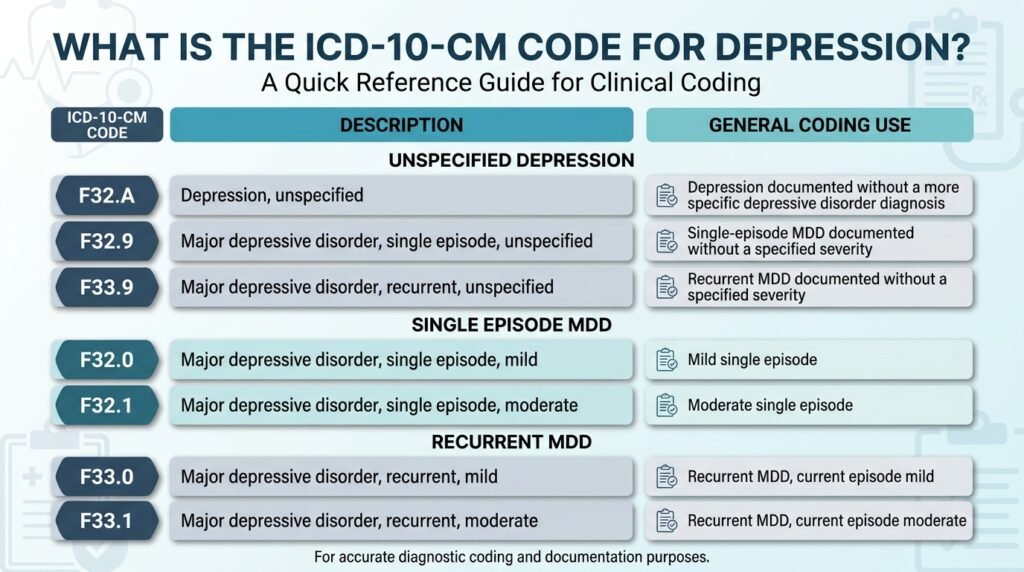
Coding reminder: F32.A, F32.9, and F33.9 do not describe the same condition. F32.A represents unspecified depression, F32.9 represents single-episode MDD with unspecified severity, and F33.9 represents recurrent MDD with unspecified severity
Providers should select the code that reflects the documented diagnosis. A coder should not turn a general reference to depression into a diagnosis of major depressive disorder without appropriate provider documentation.
Complete ICD-10-CM Codes for Depression
The F32 and F33 categories contain several codes that distinguish depressive episodes by clinical classification and documented status. Providers should review the full code description rather than select a code based only on the word “depression.”
F32 Codes: Major Depressive Disorder, Single Episode
The F32 category includes single-episode MDD codes and other specified depressive conditions. The appropriate code depends on the documented diagnosis and any applicable classification details.
| ICD-10-CM code | Official description | Documentation direction |
| F32.0 | Major depressive disorder, single episode, mild | Single episode with mild severity |
| F32.1 | Major depressive disorder, single episode, moderate | Single episode with moderate severity |
| F32.2 | Major depressive disorder, single episode, severe without psychotic features | Severe single episode without psychotic features |
| F32.3 | Major depressive disorder, single episode, severe with psychotic features | Severe single episode with psychotic features |
| F32.4 | Major depressive disorder, single episode, in partial remission | Single episode MDD in partial remission |
| F32.5 | Major depressive disorder, single episode, in full remission | Single episode MDD in full remission |
| F32.81 | Premenstrual dysphoric disorder | Premenstrual dysphoric disorder documented |
| F32.89 | Other specified depressive episodes | A specified depressive episode that does not have a more specific listed code |
| F32.9 | Major depressive disorder, single episode, unspecified | Single-episode MDD without specified severity or other required detail |
| F32.A | Depression, unspecified | Depression documented without a more specific diagnosis |
The F32 category is not limited to conventional single-episode MDD codes. For example, F32.81 identifies premenstrual dysphoric disorder, while F32.89 identifies other specified depressive episodes. These codes should not be treated as interchangeable with the single-episode MDD codes.
F32.0: Major Depressive Disorder, Single Episode, Mild
Use F32.0 when the provider documents MDD as a single episode and identifies the current severity as mild.
The medical record should support the diagnosis and the provider’s severity assessment. A mild symptom score alone does not authorize a coder to assign F32.0 if the provider has not documented the diagnosis and relevant clinical assessment.
F32.1: Major Depressive Disorder, Single Episode, Moderate
F32.1 applies when the provider documents a single episode of MDD with moderate severity.
The clinical record should establish the diagnosis and include the assessment supporting the severity designation. The provider may document symptoms, functional effects, treatment response, and other relevant findings.
F32.2: Major Depressive Disorder, Single Episode, Severe Without Psychotic Features
F32.2 applies to a severe single episode of MDD without psychotic features.
The provider must document the severe episode and the absence of psychotic features as appropriate to the clinical assessment. Do not assign this code merely because a patient reports significant depressive symptoms.
F32.3: Major Depressive Disorder, Single Episode, Severe With Psychotic Features
F32.3 identifies severe single-episode MDD with psychotic features.
The medical record must support both the severity and psychotic features. Relevant clinical findings may include documented delusions or hallucinations associated with the depressive episode.
Do not infer psychotic features from a patient’s general description of unusual thoughts or distress. The diagnosis must come from the provider’s assessment.
F32.4 and F32.5: Single-Episode MDD in Remission
These codes distinguish between partial and full remission:
- F32.4: Major depressive disorder, single episode, in partial remission.
- F32.5: Major depressive disorder, single episode, in full remission.
The provider should document the remission status and the history of the single depressive episode. A patient who reports feeling better at one appointment should not automatically receive a remission code.
F32.A: Depression, Unspecified
F32.A applies when the provider documents depression without establishing a more specific depressive disorder.
Examples of documentation that may support review for F32.A include:
- Depression, unspecified
- Depressive disorder, unspecified
- Depression without further diagnostic classification
The coder should not assume that every unspecified depression diagnosis represents MDD. If the clinical record establishes a more specific diagnosis, the more appropriate code should be considered.
F32.9: Major Depressive Disorder, Single Episode, Unspecified
F32.9 applies when the provider documents major depressive disorder as a single episode but does not specify the severity.
The key distinction is the documented MDD diagnosis and single-episode classification. It is not a general replacement for F32.A.
F33 Codes: Recurrent Major Depressive Disorder
The F33 category identifies recurrent MDD. It includes codes for different severity levels and remission statuses.
| ICD-10-CM code | Official description | Documentation direction |
| F33.0 | Major depressive disorder, recurrent, mild | Recurrent MDD, current episode mild |
| F33.1 | Major depressive disorder, recurrent, moderate | Recurrent MDD, current episode moderate |
| F33.2 | Major depressive disorder, recurrent severe without psychotic features | Recurrent MDD, current episode severe without psychotic features |
| F33.3 | Major depressive disorder, recurrent, severe with psychotic symptoms | Recurrent MDD, current episode severe with psychotic symptoms |
| F33.40 | Major depressive disorder, recurrent, in remission, unspecified | Recurrent MDD in remission without specified partial or full status |
| F33.41 | Major depressive disorder, recurrent, in partial remission | Recurrent MDD in partial remission |
| F33.42 | Major depressive disorder, recurrent, in full remission | Recurrent MDD in full remission |
| F33.8 | Other recurrent depressive disorders | Other specified recurrent depressive disorders |
| F33.9 | Major depressive disorder, recurrent, unspecified | Recurrent MDD without specified severity |
The distinction between F32 and F33 is not simply how long a patient has experienced depressive symptoms. It concerns the provider’s diagnosis and the documented episode history.
F33.0: Major Depressive Disorder, Recurrent, Mild
Use F33.0 when the provider documents recurrent MDD and identifies the current episode as mild.
The medical record should support the recurrent diagnosis and current severity. The coder should not infer recurrence solely because the patient has attended multiple therapy sessions or has reported depression over several visits.
F33.1: Major Depressive Disorder, Recurrent, Moderate
F33.1 identifies recurrent MDD with a moderate current episode.
The provider should document the recurrent nature of the disorder and the current episode’s severity. Progress notes should remain consistent with the diagnosis being reported.
F33.2: Major Depressive Disorder, Recurrent, Severe Without Psychotic Features
F33.2 applies to recurrent MDD when the current episode is severe without psychotic features.
The documentation should establish the recurrent diagnosis, severe episode, and absence of psychotic features as clinically assessed.
F33.3: Major Depressive Disorder, Recurrent, Severe With Psychotic Symptoms
F33.3 identifies recurrent MDD with a severe current episode and psychotic symptoms.
The provider must document the psychotic symptoms and their relationship to the depressive episode. The code should not be assigned from a symptom checklist or coder interpretation alone.
F33.40, F33.41, and F33.42: Recurrent MDD in Remission
These codes identify the remission status of recurrent MDD.
| Code | Remission status |
| F33.40 | Remission status unspecified |
| F33.41 | Partial remission |
| F33.42 | Full remission |
Use the code that matches the provider’s documentation. If the note says only “MDD in remission” without identifying partial or full remission, F33.40 may be appropriate when supported by the applicable code instructions.
F33.8: Other Recurrent Depressive Disorders
F33.8 applies to other specified recurrent depressive disorders that do not fit the more specific recurrent MDD codes.
The provider must document the particular recurrent depressive condition. Do not use F33.8 as a general substitute for recurrent MDD with missing severity information.
F33.9: Major Depressive Disorder, Recurrent, Unspecified
F33.9 applies when the provider documents recurrent MDD but does not specify the current severity.
It is not appropriate for every patient who has a history of depression. The provider must establish the recurrent MDD diagnosis.
F32.A vs. F32.9: What Is the Difference?
F32.A and F32.9 are two of the most frequently confused depression codes in behavioral health billing. Both contain the word “unspecified,” but they describe different diagnostic situations.
- F32.A: Depression, unspecified.
- F32.9: Major depressive disorder, single episode, unspecified.
F32.A does not establish that the patient has MDD. F32.9 does.
| Documentation in the medical record | Code to evaluate |
| Depression, unspecified | F32.A |
| Depressive disorder, unspecified | F32.A |
| Major depressive disorder, single episode, severity not documented | F32.9 |
| Major depressive disorder, recurrent, severity not documented | F33.9 |
| Major depressive disorder, single episode, moderate | F32.1 |
| Major depressive disorder, recurrent, moderate | F33.1 |
Example: When F32.A May Apply
A behavioral health provider documents “depression” in the assessment but does not establish MDD, episode history, or severity.
The coder should not assume that the patient has single-episode MDD. F32.A may be the appropriate code if the documentation supports unspecified depression and no more specific diagnosis is established.
Example: When F32.9 May Apply
A psychiatrist documents major depressive disorder, single episode, but does not specify mild, moderate, or severe.
The diagnosis supports the single-episode MDD category. F32.9 may be appropriate because the severity remains unspecified.
Why the Difference Matters
Using F32.9 when the provider has documented only unspecified depression can overstate the diagnosis. Using F32.A when the provider has clearly documented single-episode MDD can underrepresent the documented condition.
The goal is not to avoid unspecified codes at all costs. It is to report the diagnosis accurately and at the highest level of specificity supported by the record.
How to Choose the Correct ICD-10 Code for Depression
Depression coding should follow a consistent review process. Start with the provider’s diagnosis, identify the relevant diagnostic category, and then verify the code in the official Tabular List.
Step 1: Identify the Diagnosis Documented by the Provider
Determine whether the record identifies:
- Depression, unspecified
- Major depressive disorder
- Another specified depressive disorder
- Recurrent depressive disorder
- A different mood or adjustment disorder
Do not use screening scores, symptom descriptions, or treatment choices as substitutes for a provider’s diagnosis.
Step 2: Determine Whether the Provider Documented MDD
If the record identifies depression without establishing MDD, do not automatically move into the F32.9 or F33.9 categories.
If MDD is documented, review the episode classification and applicable code instructions.
Step 3: Review the Episode History
For MDD, determine whether the provider documents a single episode or recurrent episodes.
- Single-episode MDD generally falls under F32.
- Recurrent MDD generally falls under F33.
A history of repeated appointments does not establish recurrent MDD. The provider must document the diagnostic history that supports recurrence.
Step 4: Review Current Severity
When the provider documents a current episode, review the severity classification.
| Severity | Single-episode MDD | Recurrent MDD |
| Mild | F32.0 | F33.0 |
| Moderate | F32.1 | F33.1 |
| Severe without psychotic features | F32.2 | F33.2 |
| Severe with psychotic features | F32.3 | F33.3 |
Do not assign a severity-specific code from a PHQ-9 score alone. A screening tool can support clinical assessment, but the provider’s diagnosis and documentation must support the code.
Step 5: Check Whether the Condition Is in Remission
When the provider documents remission, determine whether the patient has single-episode or recurrent MDD.
- Single episode, partial remission: F32.4
- Single episode, full remission: F32.5
- Recurrent MDD, remission unspecified: F33.40
- Recurrent MDD, partial remission: F33.41
- Recurrent MDD, full remission: F33.42
Step 6: Check for a Different Depressive or Mood Disorder
Before assigning an F32 or F33 code, review whether the provider has documented a different condition.
Examples include:
- Persistent depressive disorder
- Adjustment disorder with depressed mood
- Bipolar disorder with a depressive episode
- Premenstrual dysphoric disorder
- Postpartum depression
- Substance-induced depressive disorder
These conditions may require codes outside the F32 and F33 categories.
Step 7: Verify the Complete Code in the Tabular List
The Alphabetic Index helps locate a diagnosis, but it does not replace the Tabular List.
Check the official code description, inclusion terms, Excludes notes, instructional notes, and any applicable sequencing requirements. Confirm that the code is valid for the date of service.
Depression Diagnoses That Should Not Be Coded as F32 or F33
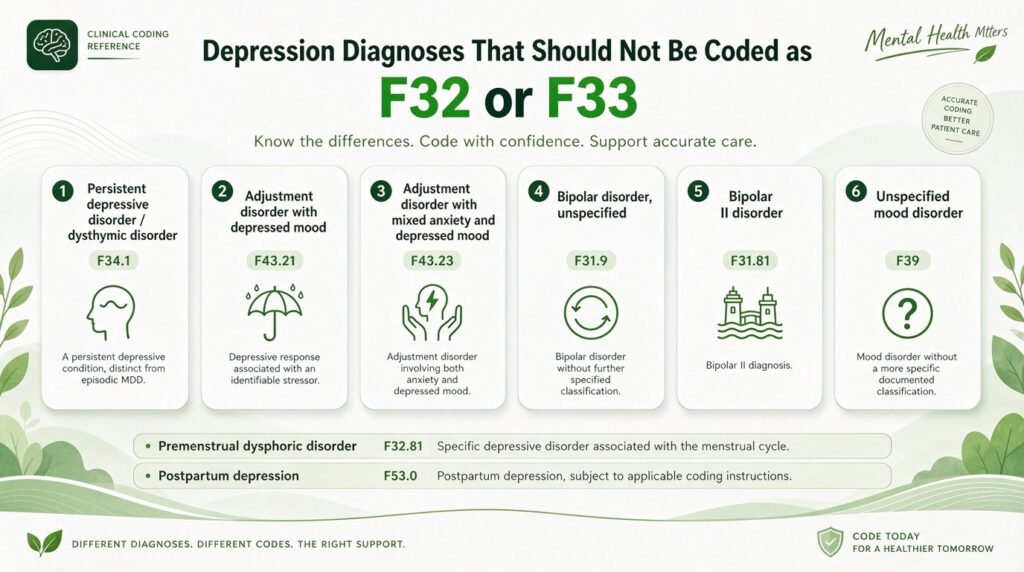
Several conditions involve low mood, loss of interest, or depressive symptoms. However, they do not automatically qualify as major depressive disorder.
The provider’s actual diagnosis determines the appropriate code family.
Persistent Depressive Disorder: F34.1
Persistent depressive disorder, historically associated with the term dysthymia, is coded as F34.1.
It should not automatically be reported as recurrent MDD. The provider must establish the diagnosis and distinguish it from other depressive conditions.
If the record uses only the phrase “chronic depression,” the coder should review the full assessment. The phrase alone may not establish whether the provider means persistent depressive disorder, recurrent MDD, or another diagnosis.
Adjustment Disorder With Depressed Mood: F43.21
F43.21 applies when the provider documents adjustment disorder with depressed mood.
The diagnosis involves a response to an identifiable stressor. It is not interchangeable with MDD simply because the patient reports sadness, reduced motivation, or emotional distress.
Adjustment Disorder With Mixed Anxiety and Depressed Mood: F43.23
F43.23 identifies adjustment disorder with mixed anxiety and depressed mood.
Do not use this code simply because a patient has both anxiety and depression. The provider must document the adjustment disorder diagnosis.
Bipolar Disorder With Depressive Symptoms
A patient with bipolar disorder may experience depressive episodes. However, the presence of depression does not make the diagnosis MDD.
When the provider documents bipolar disorder, use the appropriate F31 code based on the documented bipolar diagnosis, episode, and status.
Assigning F32 or F33 without accounting for the documented bipolar diagnosis can misrepresent the patient’s condition.
Premenstrual Dysphoric Disorder: F32.81
F32.81 identifies premenstrual dysphoric disorder (PMDD).
PMDD should not be coded as ordinary MDD merely because the patient experiences depressive symptoms. The provider must document the specific condition.
Postpartum Depression: F53.0
F53.0 identifies postpartum depression.
Postpartum depression coding requires attention to the provider’s diagnosis, the timing and context of the condition, and the applicable ICD-10-CM instructions. Do not automatically replace F53.0 with an F32 or F33 code based only on symptom severity.
When the record includes pregnancy, childbirth, or puerperium-related information, review the relevant obstetric chapter instructions and sequencing requirements before finalizing the claim.
Documentation Requirements for Depression ICD-10 Coding
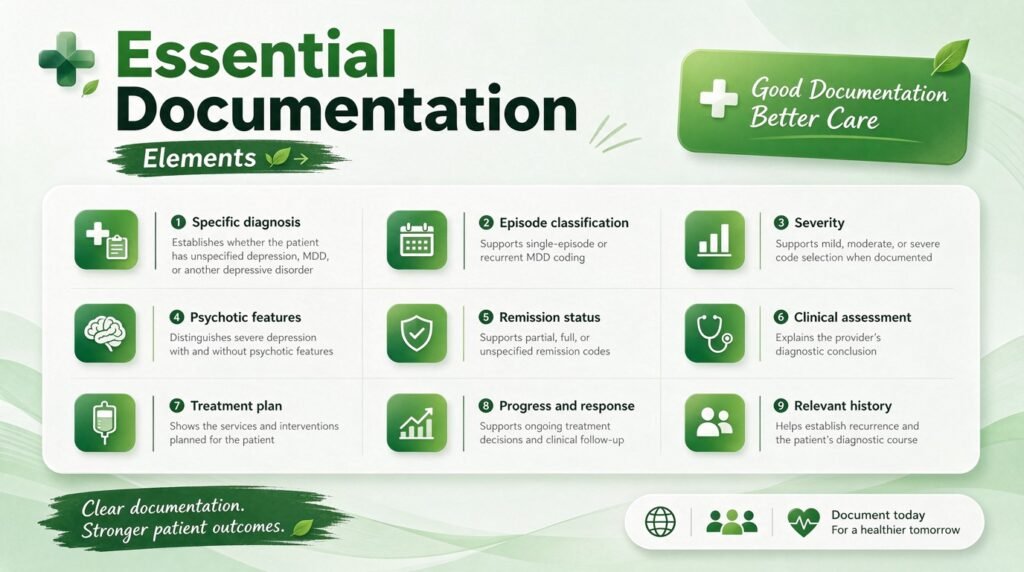
Accurate depression coding begins with a complete clinical assessment. The provider’s documentation should establish the diagnosis and support the code selected for the encounter.
A diagnosis written in the problem list may not provide enough detail to support a more specific code for every subsequent service. The treating provider should document the current clinical status and the condition addressed during the encounter.
Essential Documentation Elements
Document the Diagnosis, Not Just the Symptoms
A note that says “patient reports sadness and poor sleep” describes symptoms. It does not automatically establish MDD.
The provider should document the diagnosis when clinically established. If the assessment supports only a symptom or an unspecified depressive condition, the coder should not upgrade it to MDD.
Record Severity When Clinically Assessed
If the provider assesses the episode as mild, moderate, or severe, document that classification in the assessment.
Avoid relying on a generic template that automatically inserts a severity level without reflecting the provider’s actual evaluation.
Document Recurrence Clearly
For recurrent MDD, the record should support the provider’s conclusion that the condition involves recurrent episodes.
A patient who returns for multiple sessions during one continuous episode should not automatically receive a recurrent MDD code.
Document Remission Status
If the provider considers the condition to be in remission, document whether remission is partial or full when clinically established.
Do not assign a remission code based only on temporary symptom improvement or a patient’s statement that they feel better.
Depression Coding for Behavioral Health Providers
Psychiatrists, psychologists, licensed clinical social workers, professional counselors, and other behavioral health providers may encounter depression coding in different service settings.
The diagnosis code must reflect the condition documented by the qualified provider and comply with the applicable payer, state scope-of-practice, and billing requirements.
Psychiatrists
Psychiatrists may diagnose and treat major depressive disorder, bipolar disorders, and other mood conditions. Their records should identify the diagnosis, episode classification, severity, psychotic features, and remission status when applicable.
Medication management notes should also connect the treatment plan to the documented clinical condition.
Psychologists
Psychologists may provide diagnostic assessment and psychotherapy, subject to applicable state law and payer rules.
Their documentation should identify the condition addressed, the clinical findings, the treatment approach, and the patient’s response. The diagnosis reported on the claim must be within the provider’s authority and supported by the record.
Licensed Clinical Social Workers and Professional Counselors
Licensed clinical social workers and professional counselors may provide covered behavioral health services within their scope of practice and payer participation requirements.
They should use the diagnosis established and documented within their professional authority. Billing teams should not assume that every clinician type has identical diagnostic authority under every state law or insurance contract.
Outpatient Therapy Practices
Therapy practices should ensure that the diagnosis on the claim matches the treatment record.
For ongoing psychotherapy, progress notes should explain the condition addressed during the session, the intervention delivered, and the patient’s response. If the provider changes the diagnosis or identifies remission, the record should support that change.
Depression ICD-10 Coding and Medical Billing Considerations
Selecting a valid diagnosis code is only one part of a clean behavioral health claim. The diagnosis must also align with the service, provider, payer, and medical record.
Link the Diagnosis to the Service
The diagnosis reported on a claim should explain the clinical reason for the service.
For example, a psychotherapy claim should identify the behavioral health condition addressed during the encounter. If the patient has multiple diagnoses, the billing team should follow payer instructions for primary and additional diagnoses.
Check Medical Necessity Requirements
Payers may apply medical necessity policies to psychotherapy, psychiatric evaluations, psychological testing, and other behavioral health services.
The record should support the need for the service, the treatment approach, and the frequency or duration when relevant.
A diagnosis code alone does not establish medical necessity for every billed service.
Verify Provider Eligibility and Payer Rules
Payers may impose different rules for provider credentials, covered diagnoses, telehealth services, and documentation.
Before submitting claims, verify:
- The clinician’s enrollment and network status
- Whether the payer recognizes the provider type
- Covered diagnosis and service combinations
- Referral or authorization requirements
- Telehealth billing rules
- Documentation and medical necessity requirements
- Correct place of service and applicable modifiers
Avoid Unsupported Diagnosis Changes
Do not change a diagnosis code solely to obtain claim payment.
If a payer denies a service because the diagnosis does not meet its policy, review the medical record and coverage criteria. If the provider’s documentation is incomplete or conflicting, request clarification rather than selecting a different code without clinical support.
Use the Correct Code for the Date of Service
ICD-10-CM codes and guidelines can change each fiscal year. Billing teams must use the code set effective on the date of service.
For FY 2027, the applicable ICD-10-CM release covers encounters from October 1, 2026, through September 30, 2027. Confirm the current code files before submitting claims, particularly when working with older or recurring encounters.
Common Depression Coding Errors and How to Avoid Them
Depression coding errors often occur when billers select a familiar code without reviewing the actual diagnosis or the complete code description.
Using F32.9 for Every Depression Diagnosis
F32.9 is not a universal unspecified depression code. It represents MDD, single episode, unspecified.
When the provider documents depression without establishing MDD, review F32.A instead.
Reporting F33.9 Without Documented Recurrence
F33.9 requires a documented recurrent MDD diagnosis.
A patient with multiple visits does not automatically have recurrent MDD. Review the provider’s diagnostic history before assigning an F33 code.
Selecting Severity From a Screening Score Alone
A PHQ-9 or other screening instrument can provide useful clinical information. However, the coder should not independently translate a score into an ICD-10-CM severity code.
Use the provider’s documented diagnosis and assessment.
Confusing Partial and Full Remission
F32.4 and F32.5 describe different remission statuses for single-episode MDD. F33.41 and F33.42 distinguish partial and full remission for recurrent MDD.
Check the episode category and documented remission status before assigning the code.
Coding Bipolar Depression as MDD
A patient with bipolar disorder may present with depressive symptoms. The provider’s bipolar diagnosis must be considered when selecting the code.
Do not assign an F32 or F33 code merely because the current visit addresses depressive symptoms.
Using an Unspecified Code When the Record Supports More Detail
An unspecified code is appropriate when the record does not establish a more specific diagnosis. It should not replace a clearly documented diagnosis.
If the record contains conflicting or incomplete information, request clarification from the provider.
Missing Additional Coding Instructions
The Alphabetic Index is only the starting point. Coders must review the Tabular List for inclusion terms, Excludes notes, code-first instructions, and other applicable requirements.
Final Thoughts
Depression coding requires more than identifying a patient’s symptoms or selecting a familiar F32 or F33 code. Providers must document the actual diagnosis, episode history, severity, psychotic features, and remission status when applicable. Medical billers and coders must then verify the code against the official ICD-10-CM Index and Tabular List.
The distinction between F32.A, F32.9, and F33.9 is particularly important. F32.A represents unspecified depression, F32.9 represents single-episode MDD with unspecified severity, and F33.9 represents recurrent MDD with unspecified severity. Applying these codes correctly helps keep the claim consistent with the clinical record.
Behavioral health practices should review diagnosis documentation, monitor unspecified-code patterns, and update their coding references each fiscal year. Accurate coding supports clearer clinical records and reduces avoidable billing disputes.
Frequently Asked Questions
What is the ICD-10 code for depression?
The appropriate code depends on the provider’s diagnosis. F32.A represents depression, unspecified. F32.9 represents major depressive disorder, single episode, unspecified. F33.9 represents recurrent major depressive disorder, unspecified.
Is depression F32.A or F32.9?
F32.A applies when the provider documents unspecified depression without establishing a more specific depressive disorder. F32.9 applies when the provider documents major depressive disorder, single episode, without specifying severity.
What is the ICD-10 code for major depressive disorder?
MDD generally falls under F32 for a single episode and F33 for recurrent episodes. The final code depends on the documented severity, psychotic features, and remission status.
What is the ICD-10 code for recurrent depression?
Recurrent MDD generally falls under F33. F33.0 represents recurrent MDD, mild; F33.1 represents moderate; F33.2 represents severe without psychotic features; and F33.3 represents severe with psychotic symptoms. F33.9 applies when recurrent MDD is documented without specified severity.
What is the difference between F32 and F33?
F32 identifies the single-episode MDD category, while F33 identifies recurrent MDD. The provider’s diagnostic history determines which category applies.
What is the F33.3 diagnosis code?
F33.3 represents major depressive disorder, recurrent, severe with psychotic symptoms. The provider must document recurrent MDD, a severe current episode, and psychotic symptoms.
Can F32.9 be billed?
Yes. F32.9 is a billable ICD-10-CM code for major depressive disorder, single episode, unspecified. The medical record must support that diagnosis. It should not be used as a general code for every unspecified reference to depression.
What ICD-10 code is used for dysthymia?
F34.1 identifies dysthymic disorder, also associated with persistent depressive disorder. It is separate from the F32 and F33 MDD categories.
What is the ICD-10 code for depression with anxiety?
There is no single universal F32 or F33 code for every case of depression with anxiety. If the provider documents separate depressive and anxiety disorders, code each condition as supported by the record and applicable coding instructions. If the provider documents a different combined or mixed condition, use the appropriate diagnosis code for that condition.
Are the depression ICD-10 codes different in 2027?
The FY 2027 ICD-10-CM code set became effective October 1, 2026, and applies through September 30, 2027. Verify the current official code files and guidelines for the date of service rather than relying on an older code reference.
