

Billing Blue Cross Blue Shield for mental health services requires more than entering a CPT code and submitting a claim. Mental health providers must first identify the specific BCBS company and member plan, verify benefits, confirm network status, check authorization requirements, select the correct diagnosis and procedure codes, report the appropriate place of service, and submit the claim under the correct rendering provider information.
This matters because Blue Cross Blue Shield operates through independent local companies. A billing rule that applies to one BCBS plan may not apply to another. BCBS itself advises providers to contact their local BCBS company for billing questions.
For mental health providers, the billing process can become more complicated because behavioral health benefits may have separate utilization management rules, authorization requirements, network arrangements, reimbursement policies, and documentation requirements.
A reliable process starts before the therapy session.
What Does BCBS Mental Health Billing Involve?
BCBS mental health billing is the process of submitting claims to the applicable Blue Cross Blue Shield plan for covered behavioral health services provided by an eligible mental health professional.
Depending on the provider and service, this can include psychotherapy, psychiatric diagnostic evaluation, medication management, family psychotherapy, group psychotherapy, crisis services, psychological testing, and other behavioral health services.
The exact services covered depend on the member’s plan and the provider’s contract.
A provider should therefore avoid treating every BCBS member as having the same behavioral health coverage.
The billing team should verify the member’s plan before services are rendered and determine:
- Whether behavioral health services are covered
- Whether the provider is in network
- Whether the specific service requires authorization
- Whether a utilization management company is involved
- Whether there are visit or frequency limitations
- Whether telehealth is covered
- Which billing entity should receive the claim
- Whether the provider is correctly enrolled with the applicable plan
Anthem’s provider resources, for example, direct behavioral health providers to reimbursement policies that address behavioral health services and billable CPT and HCPCS codes. Anthem also notes that coverage under a member’s plan does not automatically guarantee reimbursement.
How to Bill Blue Cross Blue Shield
Step 1: Identify the Correct Blue Cross Blue Shield Plan
The first billing step is identifying the actual BCBS company responsible for the claim.
Do not rely only on the words “Blue Cross Blue Shield” printed on the insurance card.
Review the member ID card and identify the plan, state, member ID, group information, and applicable payer instructions.
The three character prefix on many BCBS member identification numbers can help identify the applicable BCBS plan. BCBS provides a tool that allows users to identify their local BCBS company using the member ID prefix or ZIP code.
This step matters because behavioral health policies can differ between BCBS companies.
For example, BCBSTX maintains its own clinical payment and coding policies for psychiatry and psychotherapy services. Its current policy library lists CPCP051 for psychiatry and psychotherapy professional provider services and RP033 for telemedicine and telehealth services.
A billing team should therefore identify the payer before applying a coding or authorization rule.
Step 2: Verify the Patient’s Eligibility and Mental Health Benefits
Eligibility verification should happen before the appointment whenever possible.
The verification process should establish whether the patient’s coverage is active on the date of service and whether behavioral health services are included under the plan.
The billing team should verify:
- Member eligibility
- Effective date
- Termination date when applicable
- Behavioral health benefits
- In network benefits
- Out of network benefits
- Copayment
- Coinsurance
- Deductible
- Remaining deductible
- Visit limitations
- Authorization requirements
- Referral requirements when applicable
- Telehealth coverage
- Utilization management requirements
Do not treat an active policy as proof that every mental health service will be reimbursed.
A patient can have active BCBS coverage while a particular behavioral health service remains subject to authorization, medical necessity review, plan exclusions, or provider network requirements.
BCBSTX specifically reminds behavioral health providers to check eligibility and benefits before rendering services to determine coverage and applicable authorization requirements.
Step 3: Confirm the Mental Health Provider’s Network Status
Network status directly affects reimbursement.
Before billing, confirm whether the rendering provider is participating with the specific BCBS plan.
This becomes especially important in group practices.
A group may participate with BCBS while an individual therapist or psychologist working at the group is not necessarily loaded with the payer in the same way.
The billing team should verify:
Rendering provider → group affiliation → payer network status → effective date → practice location → applicable product
Do not assume that adding a provider to the practice management system makes that provider an in network BCBS provider.
The payer must have the provider information correctly loaded according to its own credentialing and contracting process.
Step 4: Confirm the Provider’s NPI
The rendering provider’s NPI must accurately identify the professional who performed the service.
This is particularly important for mental health group practices.
BCBSTX’s current behavioral health claims guidance states that out-of-network qualified healthcare providers added to a group should bill under their own rendering NPI and that claims should not be submitted under the NPI of someone who did not render the service, except where a formal supervisor and trainee relationship applies.
This means a practice should not simply submit every therapist’s services under the owner’s or clinical director’s NPI.
The claim should accurately represent who performed the service and follow the applicable payer rules.
Step 5: Check Authorization Before the Session
Authorization is one of the most important pre billing checks for mental health services.
Some BCBS plans may require authorization or utilization management for particular behavioral health services. Requirements can vary by plan, service, provider type, and state.
The billing team should verify authorization requirements before the service is provided.
Record:
- Authorization number
- Authorized service
- Number of approved units or visits
- Approved date range
- Rendering provider
- Location
- Diagnosis when relevant
- Utilization management organization
- Any special billing instructions
Anthem provider resources, for example, direct providers to behavioral health authorization resources and describe use of Interactive Care Reviewer for certain authorization requests.
An authorization number alone does not guarantee payment. The claim still needs to satisfy the member’s benefit, provider, coding, documentation, and medical necessity requirements.
Step 6: Select the Correct CPT Code
Mental health providers should select the CPT code that accurately describes the service documented in the medical record.
Common behavioral health services can include:
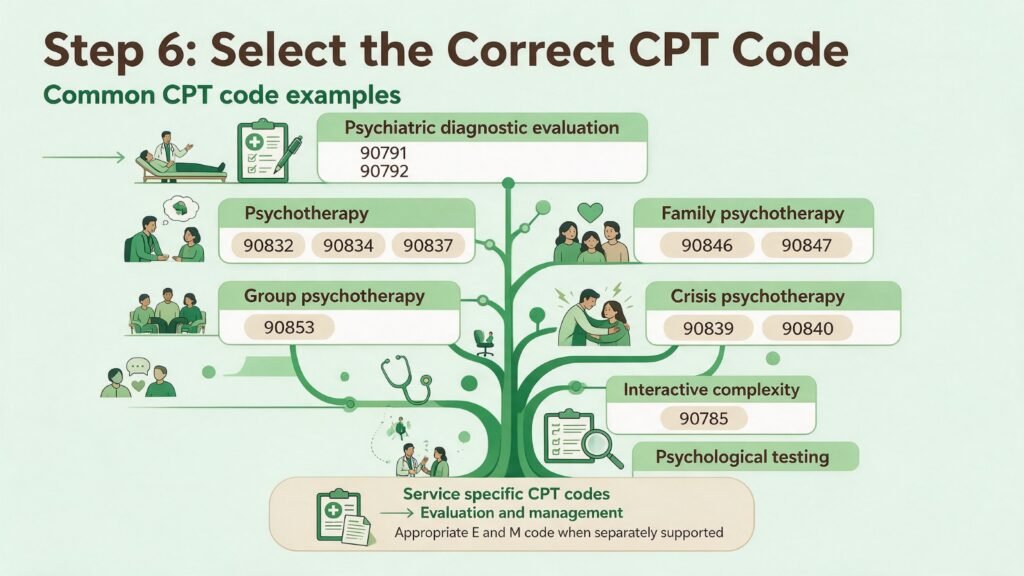
The correct code depends on the actual service, provider type, documentation, time requirements, payer policy, and applicable CPT rules.
Do not select a code because it has historically produced a higher payment.
The medical record must support the code submitted.
BCBSTX’s psychiatry and psychotherapy coding policy specifically addresses psychiatric diagnostic evaluations, psychotherapy, psychotherapy with separately identifiable evaluation and management services, crisis psychotherapy, family and group psychotherapy, interactive complexity, and pharmacologic management.
Step 7: Use the Correct Diagnosis Code
The diagnosis should reflect the condition evaluated or treated during the encounter.
For mental health claims, the ICD 10 CM diagnosis should be supported by the provider’s documentation.
Common behavioral health diagnoses can include depressive disorders, anxiety disorders, bipolar disorders, trauma related disorders, substance use disorders, and other psychiatric conditions.
Do not select a diagnosis merely because it is commonly accepted by a payer.
The diagnosis should represent the provider’s documented clinical assessment.
The medical record should support the relationship between the diagnosis and the service billed.
Step 8: Match the CPT Code to the Documentation
A CPT code is not enough by itself.
The documentation should support what occurred during the encounter.
For psychotherapy, documentation may need to establish the service performed, clinical reason for treatment, relevant symptoms or problems, interventions, response to treatment, and other information required by the payer and applicable professional standards.
The documentation should also support the reported duration when the CPT code is time based.
BCBS reimbursement policies emphasize that billed codes must be supported by the medical record or office notes.
This is one reason documentation problems can become claim problems.
Step 9: Report the Correct Place of Service
Place of service tells the payer where the service occurred.
For mental health claims, the correct POS depends on the actual location and payer requirements.
For example, an office based encounter may use POS 11. Other settings have their own POS codes.
Telehealth requires additional attention because the correct reporting can depend on the service, payer policy, and whether the patient is at home or another location.
BCBSTX specifically warns that incorrect place of service reporting can result in claim denial or delayed payment. Its behavioral health guidance provides examples including POS 11 for office services, POS 12 for the patient’s home, and POS 53 for a community mental health center.
The billing team should not automatically use the same POS for every mental health encounter.
Billing BCBS for Telehealth Mental Health Services
Telehealth billing requires a separate payer review.
The provider should verify:
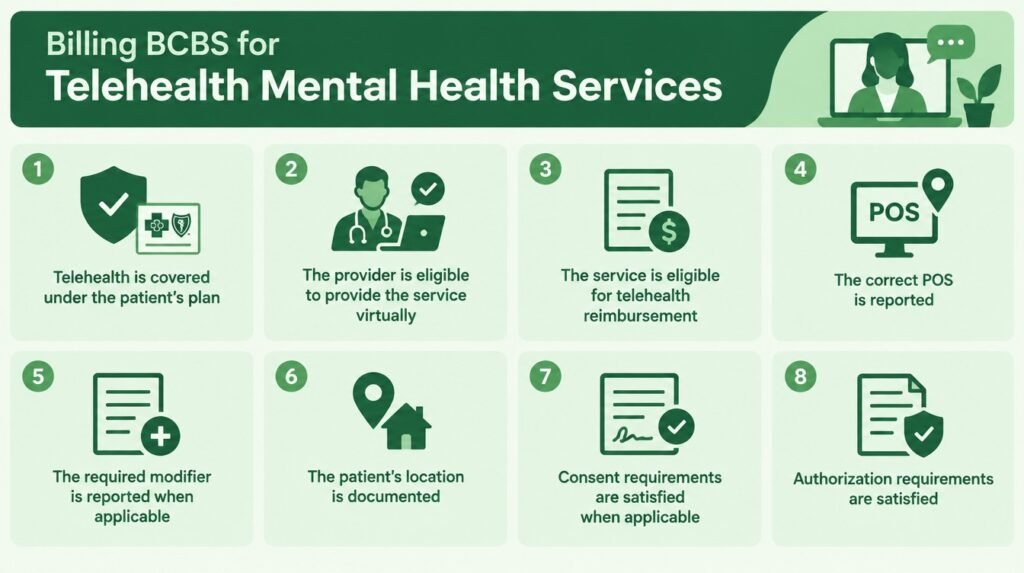
BCBSTX’s current telehealth policy states that telehealth claims must follow applicable coding requirements and that referenced codes do not by themselves guarantee reimbursement. Claims remain subject to benefit coverage, provider contract language, clinical payment policies, and coding edits.
Its 2026 telehealth policy also addresses current reporting considerations for virtual services.
Because telehealth policies change, providers should check the applicable BCBS plan’s current policy rather than relying on an old modifier or POS rule.
Step 10: Understand Rendering Provider and Supervisory Billing
Supervisory billing deserves special attention in behavioral health.
A practice should not automatically bill services under a supervisor simply because the supervisor owns the practice or employs the therapist.
BCBSTX’s current behavioral health guidance states that claims may not be submitted under the NPI of someone who did not render the service unless a formal supervisor-trainee relationship exists. It also states that qualified healthcare professionals who are not trainees should bill under their own license.
Where supervisory billing is permitted, the practice must follow the payer’s specific requirements and applicable state licensing rules.
BCBSTX’s behavioral health FAQ describes supervisory billing as permitted when a formal relationship exists and states that the supervisor must comply with applicable state requirements.
This makes provider type and licensing status important parts of the billing review.
Step 11: Submit the Claim With Accurate Provider Information
For professional mental health claims, the billing system should contain accurate:
- Billing provider information
- Rendering provider information
- NPI
- Taxonomy when required
- Tax identification information
- Place of service
- CPT code
- Modifier when applicable
- ICD-10-CM diagnosis
- Date of service
- Units
- Charges
- Authorization information when applicable
The claim should be reviewed before submission.
A small provider data mismatch can cause a rejection even when the clinical service is appropriate.
Step 12: Review the Claim Before Submission
A useful claim scrub for BCBS mental health services should check five areas.
Patient Information
Confirm the member ID, name, date of birth, group information, and payer routing information.
Provider Information
Confirm the billing and rendering NPI, taxonomy, group affiliation, and payer enrollment information.
Coding
Confirm the CPT, diagnosis, modifiers, units, and place of service.
Authorization
Confirm that the authorization applies to the provider, service, diagnosis when required, and date of service.
Documentation
Confirm that the record supports the service billed.
This final review can prevent avoidable rejections and denials.
Common BCBS Mental Health Billing Denials
Denial for No Authorization
The payer determines that the required authorization was missing or did not cover the billed service.
How to prevent it
Verify authorization requirements before the appointment and maintain an authorization tracker.
If the payer requires authorization for additional visits, do not wait until the approved visits have already been exhausted.
Denial for Incorrect Provider
The claim identifies a provider who did not render the service or whose enrollment information does not match the payer record.
How to prevent it
Verify the rendering provider NPI and payer enrollment before claim submission.
Denial for Incorrect Place of Service
The claim reports a location that does not match the service.
How to prevent it
Build POS selection into the claim review process. Do not copy the previous claim without checking the current encounter.
Denial for Medical Necessity
The payer determines that the documentation or diagnosis does not establish the medical necessity of the service under the applicable policy.
How to prevent it
Document the clinical condition, treatment rationale, interventions, patient response, and other information required by the payer.
Denial for Coding Error
The CPT, modifier, diagnosis, units, or code combination does not meet payer requirements.
How to prevent it
Review the current BCBS coding policy and CPT guidance before submitting claims.
Denial for Non-Participating Provider
The provider is not recognized as participating for the patient’s specific plan.
How to prevent it
Verify the provider’s network status for the exact BCBS product, not merely the general BCBS brand.
Final Takeaway
Billing Blue Cross Blue Shield for mental health services requires a payer-specific process.
The first step is identifying the correct BCBS company and member plan. The practice should then verify eligibility, behavioral health benefits, network participation, authorization requirements, provider enrollment, and telehealth rules before the service is rendered.
After the encounter, the claim must accurately report the rendering provider, CPT code, diagnosis, place of service, applicable modifiers, units, and other required information.
Documentation must support the service billed. BCBS reimbursement policies repeatedly emphasize that billed services and codes must be supported by the medical record.
Mental health practices should also pay close attention to rendering provider rules. Current BCBSTX guidance specifically warns against submitting claims under the NPI of someone who did not perform the service except under applicable formal supervisory arrangements.
The most important point is simple: do not treat BCBS as one payer with one set of behavioral health billing rules. Identify the local BCBS company, the member’s specific plan, the provider’s network status, and the current reimbursement policies before billing.
Frequently Asked Questions
Can all mental health providers bill Blue Cross, Blue Shield?
Eligibility to bill depends on the provider’s license, provider type, payer enrollment, network status, contract, and the member’s plan. A provider should verify participation with the specific BCBS company before treating the provider as in network.
What CPT codes are commonly used for BCBS mental health billing?
Common behavioral health CPT codes include 90791, 90792, 90832, 90834, 90837, 90846, 90847, 90853, 90839, 90840, and 90785. The appropriate code depends on the actual service, provider, documentation, and applicable BCBS policy.
Does BCBS require authorization for psychotherapy?
Authorization requirements vary by BCBS company, member plan, provider type, and service. Eligibility verification should include a specific check for behavioral health authorization requirements before services are rendered.
Can therapists bill BCBS under the practice owner’s NPI?
A practice should not automatically bill under the owner’s NPI when another provider performed the service. Current BCBSTX behavioral health guidance states that a qualified healthcare professional who is not a trainee should bill under their own license and that claims should not be submitted under the NPI of someone who did not render the service except under an applicable formal supervisory relationship.
How should telehealth mental health services be billed to BCBS?
The provider should verify the applicable BCBS plan’s current telehealth policy, confirm that the service is covered, report the appropriate place of service and modifier when required, and document the encounter according to payer requirements. Telehealth rules can differ among BCBS companies.
What causes BCBS mental health claims to be denied?
Common causes include inactive coverage, authorization problems, incorrect provider information, network issues, coding errors, incorrect place of service, unsupported medical necessity, documentation deficiencies, and claim filing errors.
Should a mental health practice appeal every BCBS denial?
No. First determine why the claim was denied. Corrected claims are appropriate for certain data or coding errors, while an appeal is more appropriate when the provider disputes the payer’s determination and has documentation or policy support for the service.
