
Medical alert devices can help older adults and people with disabilities call for assistance after a fall, during a medical emergency, or when they cannot reach a phone. For healthcare providers, care coordinators, home health professionals, and medical equipment suppliers, understanding Medicare coverage is essential when patients ask whether these devices are covered by insurance.
Does Medicare pay for medical alert devices? Generally, Original Medicare does not cover the cost of medical alert systems. However, some Medicare Advantage plans may offer coverage, discounts, or allowances for personal emergency response systems as supplemental benefits.
This distinction matters when providers counsel patients, recommend equipment, coordinate care, or help patients understand their out-of-pocket expenses.
This guide explains Medicare coverage rules, Medicare Advantage benefits, device types, eligibility considerations, patient costs, documentation, billing considerations, and practical steps providers can follow when assisting patients.
Quick Answer: Does Medicare Cover Medical Alert Systems?
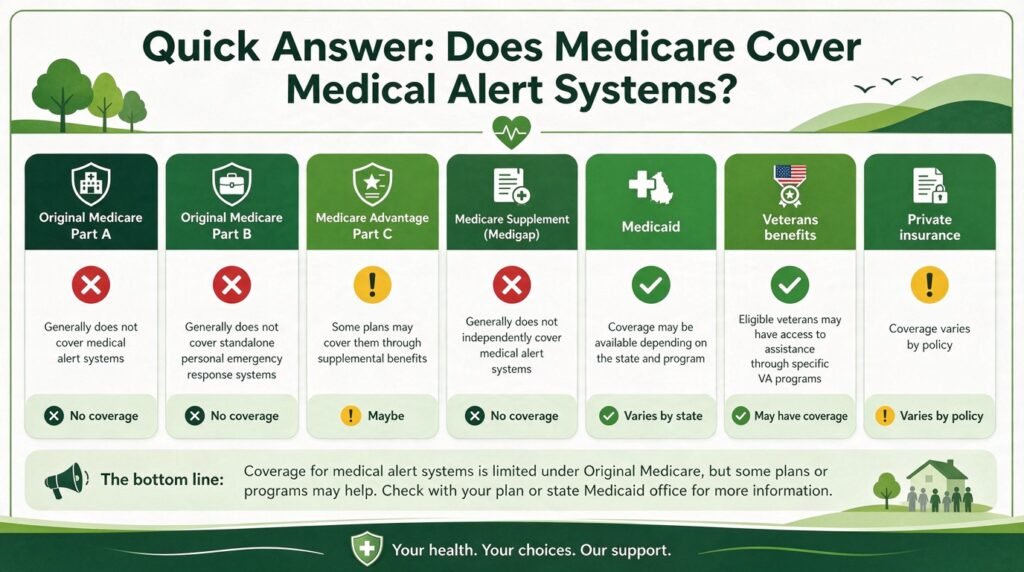
Original Medicare primarily covers medically necessary healthcare services and qualifying medical equipment. A medical alert system is generally considered a personal safety and emergency communication service rather than a covered medical treatment or standard Medicare-covered durable medical equipment benefit.
Medicare Part B does cover certain categories of durable medical equipment (DME), but an item must meet Medicare’s coverage requirements and fall within an applicable benefit category. Simply being a device used by someone with a medical condition does not automatically make it Medicare-covered equipment.
Medicare explains that coverage depends on applicable benefit categories, legal exclusions, and medical necessity requirements.
What Is a Medical Alert Device?
A medical alert device, also called a personal emergency response system (PERS), allows a person to request assistance when an emergency occurs.
These systems are commonly used by:
- Older adults who live alone
- Individuals at risk of falling
- People with mobility limitations
- Patients recovering from surgery
- Individuals with chronic medical conditions
- People with disabilities
- Individuals who may need emergency assistance when caregivers are unavailable
The primary purpose is to provide a communication link between the user and an emergency response center, caregiver, family member, or emergency services.
Common types of medical alert systems
1. Home-based medical alert systems
These systems typically include a base unit connected to a telephone line or cellular network and a wearable button.
When the user presses the button, the device connects to a monitoring center.
2. Mobile medical alert devices
Mobile systems work outside the home using cellular connectivity and, in some models, GPS location tracking.
They are useful for people who walk outdoors, visit appointments, shop, or travel independently.
3. Fall-detection medical alert devices
Some devices include sensors designed to detect sudden movement patterns associated with falls.
Automatic fall detection may trigger an alert without requiring the user to press a button. However, fall-detection technology is not perfect and may miss some falls or generate false alerts.
4. Smartwatch-based medical alert systems
Some smartwatches offer emergency calling, fall detection, location sharing, and caregiver notifications.
5. Medication and caregiver monitoring systems
Some products combine emergency alerts with medication reminders, wellness checks, activity monitoring, or caregiver communication.
Although these devices may support health and safety, their features do not automatically establish Medicare coverage.
Why Original Medicare Generally Does Not Cover Medical Alert Devices
Original Medicare consists of Medicare Part A and Part B.
Medicare Part A primarily covers inpatient hospital services, skilled nursing facility care under qualifying conditions, hospice care, and certain home health services.
Medicare Part B covers medically necessary outpatient services, physician services, preventive services, and qualifying durable medical equipment.
Part B covers certain medical equipment when it meets Medicare requirements. However, a standalone emergency alert system is generally not covered because its principal purpose is communication, personal safety, or emergency access rather than medical treatment or an eligible medical equipment function.
Medicare’s coverage framework requires an item to fit an applicable benefit category, not be excluded under the law, and meet reasonable and necessary requirements when applicable.
Why a medical alert device is different from covered DME
Providers often receive questions about whether medical alert devices qualify as durable medical equipment because patients use them at home.
However, Medicare does not cover every device used in the home.
Consider the difference:
The key difference is that Medicare covers qualifying equipment based on the applicable medical benefit and coverage criteria. A medical alert pendant generally provides a way to summon help rather than directly treating a condition or performing a Medicare-covered medical function.
Provider takeaway: Do not assume that a device is covered simply because it is wearable, medically related, used by a patient with a diagnosis, or intended to reduce fall-related risks.
Does Medicare Part B Pay for Medical Alert Devices?
Medicare Part B covers certain durable medical equipment, prosthetics, orthotics, and supplies when the patient meets the applicable coverage requirements.
For example, a physician may prescribe a walker for a patient who has difficulty walking safely. Medicare may cover the equipment if the patient meets the applicable criteria.
However, medical alert systems are generally not included in the standard Original Medicare Part B benefit for DME.
What Part B typically covers
Part B may cover qualifying equipment such as:
- Walkers
- Wheelchairs
- Canes
- Hospital beds
- Oxygen equipment
- Certain respiratory equipment
- Blood glucose monitors for eligible patients
- Other medically necessary equipment under applicable coverage rules
What Part B generally does not cover
Standalone medical alert systems and their recurring monitoring subscriptions are generally not covered by Original Medicare.
This may include:
- Emergency call pendants
- Medical alert wristbands with monitoring services
- Home-based emergency response systems
- GPS medical alert subscriptions
- Fall-detection monitoring subscriptions
- Emergency response center subscriptions
The patient should confirm the specific device or service with Medicare or their Medicare Advantage plan before purchasing it.
Medicare’s Part B coverage overview includes durable medical equipment among covered benefit categories, but coverage is limited to qualifying items and circumstances.
Medicare+1
Can Medicare Advantage Cover Medical Alert Devices?
Yes, some Medicare Advantage plans may provide medical alert systems as an additional benefit.
Medicare Advantage, also known as Medicare Part C, is offered by private insurance companies approved by Medicare.
These plans must cover Medicare-covered services but may offer additional benefits beyond Original Medicare.
Depending on the plan, supplemental benefits may include services or products intended to support preventive care, health, independence, and daily living.
Medical alert systems may be available through some plans as:
- Personal emergency response systems
- Emergency alert pendants
- Medical alert wristbands
- Fall-detection devices
- Home safety benefits
- Supplemental health and wellness allowances
- Caregiver support services
Availability varies significantly between plans.
How Medicare Advantage coverage may work
A plan may offer a medical alert device through a contracted vendor or benefit program.
The patient may receive:
- A device at no additional cost
- A discounted device
- A monthly monitoring service allowance
- A limited number of covered months
- A device through an approved supplier
- A benefit that requires enrollment or activation
Some plans may cover only specific device models or services.
For example, a Medicare Advantage plan might offer a home-based emergency response system to eligible members, while another plan may offer a mobile device with GPS capability.
A third plan may not include medical alert equipment at all.
Providers should verify the benefit before recommending a supplier
Do not rely solely on a patient’s statement that they have Medicare Advantage.
The provider or care coordinator should verify:
- The patient’s exact plan name.
- Whether the plan includes a personal emergency response system benefit.
- Whether the benefit is available to the patient.
- Whether the plan requires enrollment or prior approval.
- Which device types are covered.
- Whether the patient must use a contracted supplier.
- Whether monitoring fees are included.
- Whether the patient has any copayment, monthly charge, or additional cost.
- Whether the benefit is limited to a specific period.
- Whether fall detection or GPS functionality is included.
Medicare Advantage plans may have different provider networks, authorization requirements, and benefit rules. Patients should check their plan’s specific coverage documents rather than assuming that all Medicare Advantage plans offer the same benefits.
Does Medicare Cover Medical Alert Devices for Patients at Risk of Falling?
Fall prevention is an important part of healthcare, especially for older adults, patients with mobility limitations, and individuals recovering from illness or surgery.
Providers may recommend medical alert devices to patients who:
- Have a history of falls.
- Experience dizziness or balance problems.
- Have difficulty walking independently.
- Live alone.
- Have limited access to caregivers.
- Have a condition that could cause sudden medical emergencies.
- Need assistance when moving around the home.
- Are recovering from surgery or hospitalization.
However, a patient’s fall risk does not automatically make a medical alert system a covered Medicare benefit.
Does documenting fall risk make the device covered?
Generally, no.
A provider may document a patient’s fall risk, mobility limitations, functional status, living arrangements, and need for emergency assistance. This information can help support care planning and may be relevant when a Medicare Advantage plan evaluates eligibility for a supplemental benefit.
However, documentation alone does not change Original Medicare’s coverage rules for standalone medical alert systems.
Providers should avoid promising Medicare reimbursement based solely on a patient’s diagnosis or fall-risk assessment.
Example: Patient living alone after hospitalization
Consider a 78-year-old patient discharged home after hospitalization for a hip-related condition.
The patient:
- Uses a walker.
- Lives alone.
- Has difficulty getting up after a fall.
- Has a daughter who visits twice a week.
- Has a Medicare Advantage plan.
The discharge team recommends a medical alert pendant.
The appropriate approach is to assess the patient’s safety needs, review available coverage, and help the patient determine whether the Medicare Advantage plan offers a personal emergency response benefit.
The recommendation may be clinically reasonable even if Original Medicare does not pay for the device.
What Medical Alert Device Benefits May Medicare Advantage Plans Offer?
Coverage depends on the plan, but some Medicare Advantage plans offer supplemental benefits that may include emergency response technology.
Providers should understand that these benefits can differ in their structure.
A. Home emergency response systems
A home-based system may include a base unit and wearable emergency button.
The patient presses the button to connect with a monitoring center.
The monitoring center may contact:
- The patient
- A designated caregiver
- Emergency services
- A family member
Some plans may offer these systems through supplemental benefits.
B. Mobile GPS emergency devices
Mobile devices allow users to request help outside their homes.
They may include:
- GPS location tracking
- Cellular connectivity
- Emergency calling
- Two-way communication
- Caregiver location access
Patients who remain active outside the home may prefer mobile devices over traditional home-only systems.
C. Automatic fall detection
Fall-detection devices may use motion sensors to identify potential falls and automatically initiate an emergency call.
Providers should explain that automatic fall detection is an additional safety feature, not a guarantee that every fall will be detected.
D. Monitoring services
Some medical alert systems require a recurring subscription.
The device itself may be inexpensive, but the monitoring service can create ongoing expenses.
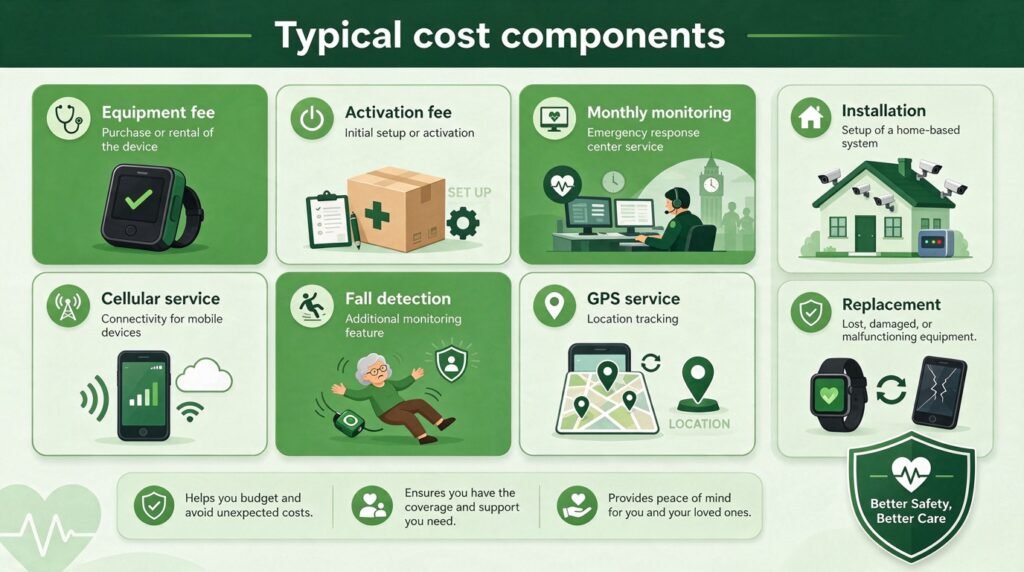
When reviewing plan benefits, providers should clarify whether the coverage includes:
- Equipment purchase or rental
- Installation
- Monthly monitoring
- Cellular service
- Fall detection
- Replacement equipment
- Battery replacement
- Caregiver notification services
A plan may cover the equipment while excluding certain premium features or additional subscription charges.
Medicare Medical Alert Device Costs: What Should Patients Expect?
When Original Medicare does not cover a medical alert system, the patient generally pays the cost directly unless another source of coverage or assistance is available.
Medical alert device costs vary by manufacturer, device type, features, and monitoring services.
Typical cost components
Providers should avoid quoting fixed prices unless they have current information from the specific supplier.
Prices may change and may differ according to promotional offers, subscription length, equipment requirements, and contract terms.
Example of patient financial responsibility
Suppose a patient purchases a medical alert device with a monthly monitoring subscription.
If the patient’s Original Medicare plan does not cover the device, the patient may be responsible for:
- The initial equipment cost
- Monthly subscription fees
- Optional fall-detection fees
- Any applicable activation or shipping charges
If a Medicare Advantage plan offers a covered device, the patient’s responsibility may be lower or potentially zero for the included benefit.
However, the patient should verify whether additional features or services create separate charges.
Important provider consideration
Do not describe a medical alert system as “free through Medicare” without confirming the patient’s actual plan and benefit eligibility.
Marketing language from vendors may refer to specific Medicare Advantage plans, limited geographic availability, or promotional arrangements.
Providers should verify the benefit through the patient’s insurance plan or official benefit documentation.
How Providers Can Verify Medical Alert Device Coverage
When a patient asks whether Medicare will pay for a medical alert system, the provider should follow a structured verification process.
Step 1: Identify the patient’s Medicare coverage
Determine whether the patient has:
- Original Medicare
- Medicare Advantage
- Medicare Advantage with prescription drug coverage
- Medicare Supplement Insurance
- Medicaid in addition to Medicare
- Employer-sponsored supplemental coverage
The coverage type determines where the provider should begin.
Step 2: Confirm the exact Medicare Advantage plan
If the patient has Medicare Advantage, obtain the complete plan name.
Do not rely on the phrase “Medicare insurance.”
Different plans from the same insurer may offer different supplemental benefits.
Step 3: Review the Evidence of Coverage
The Evidence of Coverage (EOC) document is one of the most useful resources for determining what the plan provides.
Search the document for terms such as:
- Personal emergency response system
- Emergency response system
- Medical alert system
- Personal safety device
- Fall detection
- Home safety
- Supplemental benefits
- Caregiver support
The plan’s Summary of Benefits may also identify the benefit, although the EOC generally provides more detailed conditions.
Step 4: Contact the plan directly
Ask the member services representative:
- Is a personal emergency response system covered?
- Does this patient qualify?
- Is the benefit available through the patient’s current plan?
- Does the benefit require prior authorization?
- Is a medical assessment required?
- Which supplier provides the equipment?
- Is the equipment covered at no cost?
- Are monitoring services included?
- Is there a monthly allowance?
- Are GPS and fall-detection features covered?
- Is the benefit available to the patient at home and outside the home?
- Are there restrictions on the number of devices?
- What documentation is required?
Step 5: Document the verification
Record the relevant information in the patient’s care coordination notes.
Documentation should include:
- Date of verification
- Plan name
- Representative or department contacted, when available
- Benefit description
- Eligibility requirements
- Supplier information
- Authorization requirements
- Patient cost information
- Follow-up actions
This helps prevent misunderstandings and reduces the risk of directing patients toward equipment they cannot obtain through their plan.
Medical Alert Devices and Medicare Billing: What Providers Need to Know
Medical alert systems are not generally billed as standard Medicare-covered DME under Original Medicare.
Providers and suppliers should be cautious about submitting claims for equipment that does not fall within an established covered benefit category.
Can providers bill Medicare for medical alert systems?
Generally, standalone medical alert systems are not covered under Original Medicare, so providers should not assume they can submit a Medicare Part B claim for reimbursement.
Billing eligibility depends on the specific item, benefit category, applicable coverage rules, supplier requirements, and payer policies.
Why billing errors may occur
Billing confusion can arise when:
- The device is described as medical equipment.
- A patient has a diagnosis associated with fall risk.
- A vendor advertises Medicare-related benefits.
- A medical alert device is bundled with another service.
- A provider assumes all wearable health technology qualifies as DME.
- A Medicare Advantage plan has a supplemental benefit that is mistaken for Original Medicare coverage.
Provider billing checklist
Before submitting a claim or directing a patient to a supplier, confirm:
- The specific product has an established coverage pathway.
- The applicable payer covers the product.
- The patient meets the benefit’s eligibility requirements.
- The supplier meets payer requirements.
- Required authorization has been obtained.
- Required documentation is complete.
- The billing code, if applicable, accurately describes the item or service.
- The payer’s billing instructions have been reviewed.
- Patient financial responsibility has been explained.
Do not assign a billing code based solely on a vendor’s suggestion. Confirm the appropriate coding and coverage rules with the payer and current coding resources before submitting a claim.
What Other Programs May Help Patients Obtain Medical Alert Devices?
When Medicare does not cover the device, providers can help patients explore other options.
Medicaid
Medicaid coverage varies by state. Some Medicaid programs, waiver programs, home and community-based services programs, or managed care arrangements may offer personal emergency response systems to eligible individuals.
Eligibility may depend on:
- Income
- Medical needs
- Functional limitations
- Level of care
- Program enrollment
- State-specific requirements
Providers should contact the patient’s Medicaid agency or managed care plan to determine whether emergency response technology is available.
For patients who qualify for both Medicare and Medicaid, additional assistance may be available through their Medicaid coverage.
Veterans Affairs (VA)
Eligible veterans may have access to personal emergency response equipment or related services through specific VA programs, depending on their clinical needs, eligibility, and local availability.
Providers working with veterans should consider contacting the patient’s VA care team to determine whether an emergency response device can be provided.
State and local aging programs
Local aging services may offer assistance with safety equipment, home modifications, fall prevention, and emergency response systems.
Potential resources include:
- Area Agencies on Aging
- State aging departments
- Community-based organizations
- Local senior assistance programs
- Home and community-based services
- Nonprofit organizations supporting older adults
Availability varies by community, and programs may have waiting lists or eligibility requirements.
Private insurance
Some commercial insurance policies may provide limited coverage or reimbursement for medical alert systems.
Patients should review their policy or contact their insurer directly.
Family and caregiver assistance
When insurance does not cover the device, families may help pay for equipment or monitoring subscriptions.
Providers can support informed decision-making by helping patients compare the cost of the device, monitoring service, and available alternatives.
How Providers Should Assess Whether a Patient Needs a Medical Alert Device
A medical alert device should be recommended based on the patient’s safety needs, living circumstances, functional abilities, and preferences.
Providers should consider the following factors.
1. Fall history
Ask whether the patient has experienced:
- Recent falls
- Repeated falls
- Falls without witnesses
- Falls requiring emergency care
- Difficulty getting up after a fall
A history of falls may indicate a need for additional safety planning.
2. Mobility
Evaluate whether the patient:
- Uses a walker or cane
- Has difficulty transferring
- Experiences balance problems
- Has weakness
- Needs assistance walking
- Has difficulty reaching a telephone
3. Living situation
Consider whether the patient:
- Lives alone
- Lives with a caregiver who is frequently away
- Has limited family support
- Lives in a remote location
- Has difficulty contacting emergency services
4. Cognitive and communication abilities
Determine whether the patient can:
- Recognize an emergency
- Understand how the device works
- Press the emergency button
- Communicate with a monitoring center
- Follow instructions
Patients with cognitive impairment may require additional caregiver involvement.
5. Device usability
A device may not be useful if the patient cannot reliably wear it, charge it, or activate it.
Consider:
- Wrist versus pendant design
- Comfort
- Battery life
- Waterproofing
- Ease of charging
- Voice communication
- Range
- Cellular coverage
- Caregiver notification features
6. Patient preference
The patient should be involved in the decision whenever possible.
Some patients prefer a pendant, while others may prefer a wristband or mobile device.
A device that the patient refuses to wear will not provide the intended safety benefit.
Documentation Providers Should Maintain
Documentation can help providers demonstrate the clinical reasoning behind a recommendation and support care coordination.
However, documentation should not be presented as a guarantee of Medicare reimbursement.
Recommended documentation elements
Include:
Patient assessment
- Relevant medical conditions
- Fall history
- Mobility limitations
- Functional status
- Living arrangements
- Caregiver availability
- Safety concerns
Clinical recommendation
- Why a medical alert device was recommended
- What safety need the device is intended to address
- Whether a home-based or mobile system is more appropriate
- Whether fall detection is a relevant feature
Coverage verification
- Insurance type
- Plan name
- Benefit verification details
- Authorization requirements
- Supplier information
- Patient cost estimate
Patient education
- Device operation
- Emergency response process
- Limitations of fall detection
- Battery and charging instructions
- Monitoring subscription information
- Contact information for support
Follow-up
- Whether the device was obtained
- Whether the patient can use it
- Whether caregiver training was completed
- Whether additional home safety interventions are required
Sample provider documentation
Patient reports living alone and experiencing two falls within the past three months. The patient uses a walker for ambulation and reports difficulty reaching a telephone after falling. Personal emergency response system discussed as a potential safety support. Patient education regarding device options, limitations of automatic fall detection, monitoring service costs, and insurance coverage. Original Medicare coverage for standalone medical alert systems was reviewed as generally unavailable. Patients advised to contact the Medicare Advantage plan, if applicable, to verify supplemental benefits and approved suppliers. Follow-up planned to assess access to the device and additional fall-prevention interventions.
This documentation clearly describes the patient’s needs, the recommendation, education, and coverage discussion without incorrectly stating that Medicare will pay.
13. Medical Alert Devices as Part of a Fall-Prevention Plan
Medical alert devices should not be the only intervention used to reduce fall-related risks.
Providers should consider a broader fall-prevention approach.
A practical fall-prevention checklist
| Intervention | Purpose |
| Medication review | Identify medications that may contribute to dizziness, sedation, or instability |
| Mobility assessment | Identify balance, gait, and movement limitations |
| Home safety assessment | Identify hazards such as loose rugs, poor lighting, and clutter |
| Assistive devices | Evaluate whether canes, walkers, or other equipment are appropriate |
| Exercise and rehabilitation | Improve strength, balance, and mobility when appropriate |
| Vision assessment | Identify vision problems affecting safe movement |
| Footwear review | Evaluate footwear that may increase fall risk |
| Emergency communication | Ensure the patient can contact assistance |
| Caregiver planning | Establish a response plan for emergencies |
| Follow-up | Review safety needs after changes in health or living circumstances |
A medical alert device can help a patient communicate after an emergency, but it does not prevent falls.
Providers should explain the distinction between fall prevention and fall response.
Fall prevention aims to reduce the likelihood of a fall. Medical alert systems primarily help the patient request assistance when an emergency occurs.
Provider Workflow: From Patient Assessment to Device Access
Healthcare organizations can establish a consistent process to help patients who need emergency response technology.
A simple workflow can reduce confusion between clinical recommendations, insurance coverage, and equipment access.
1. Identify the patient’s safety concern
Falls, mobility limitations, living alone, or difficulty reaching assistance
2. Assess the patient’s needs
Mobility, functional ability, caregiver support, and device usability
3. Identify the patient’s insurance
Original Medicare, Medicare Advantage, Medicaid, or other coverage
4. Verify coverage and financial responsibility
Benefits, authorization, suppliers, and patient costs
5. Arrange the appropriate device
Assist with the covered benefit or explore affordable alternatives
6. Educate and follow up
Confirm device use, patient understanding, and ongoing safety
Example workflow in a primary care setting
A patient reports that they recently fell while walking to the bathroom at night.
The provider assesses the patient’s mobility and identifies concerns related to living alone.
The care coordinator:
- Documents the fall history and safety concerns.
- Reviews the patient’s insurance coverage.
- Determines that the patient has Medicare Advantage.
- Contacts the plan to verify whether a personal emergency response system is included.
- Confirms the approved supplier and any patient charges.
- Helps the patient understand the device options.
- Documents the outcome.
- Arranges follow-up to determine whether the patient obtained and can use the device.
This process allows the healthcare team to support patient safety without making unsupported coverage promises.
Common Mistakes Providers Should Avoid
Medical alert device coverage can create confusion, particularly when suppliers advertise insurance-related benefits.
Providers should avoid the following mistakes.
Mistake 1: Telling every Medicare patient the device is covered
Original Medicare generally does not cover standalone medical alert systems.
Coverage may exist through certain Medicare Advantage plans or other assistance programs, but it must be verified.
Mistake 2: Assuming all Medicare Advantage plans provide the same benefit
Medicare Advantage plans have different supplemental benefits, suppliers, eligibility rules, and costs.
A benefit offered by one plan does not mean it is available through another.
Mistake 3: Confusing medical alert devices with covered DME
Not every medical or safety-related device meets Medicare’s DME coverage requirements.
Providers should verify the specific item and applicable coverage pathway.
Mistake 4: Promising reimbursement based on a diagnosis
A patient’s fall history, disability, or chronic illness may justify recommending a device, but these conditions do not automatically establish Original Medicare coverage.
Mistake 5: Ignoring recurring subscription fees
Patients may focus on the initial device cost and overlook monthly monitoring charges.
Providers should encourage patients to review the complete cost.
Mistake 6: Recommending a device without assessing usability
A device may offer advanced features but be unsuitable for the patient.
Consider cognitive ability, dexterity, hearing, charging requirements, mobility, and daily habits.
Mistake 7: Failing to document coverage verification
When coverage has been checked, document the plan, benefit details, and instructions provided.
This supports continuity of care and reduces misunderstandings.
Conclusion
Medical alert devices can provide important safety support for older adults, patients with mobility limitations, and individuals who live alone. However, Original Medicare generally does not cover standalone medical alert systems or their monthly monitoring services.
Some Medicare Advantage plans may provide these devices through supplemental benefits, making coverage verification an important part of patient education and care coordination.
Healthcare providers should:
- Assess the patient’s safety and mobility needs.
- Avoid promising Medicare reimbursement without verification.
- Check Medicare Advantage supplemental benefits.
- Confirm suppliers, authorization requirements, and patient costs.
- Document the recommendation and coverage discussion.
- Help patients explore Medicaid, VA, community programs, or affordable self-pay options.
- Include medical alert technology within a broader fall-prevention and home-safety plan.
The most important distinction is between recommending a device for clinical and safety reasons and determining whether an insurance plan will pay for it. Both decisions matter, but they are not the same.
Frequently Asked Questions
Does Medicare pay for medical alert devices?
Original Medicare generally does not pay for standalone medical alert systems or personal emergency response subscriptions. Some Medicare Advantage plans may offer them as supplemental benefits.
Does Medicare Part A cover medical alert systems?
No. Medicare Part A generally does not cover personal emergency response systems as a standalone benefit.
Part A primarily covers qualifying inpatient hospital care, skilled nursing facility care, hospice, and certain home health services.
Can a doctor prescribe a medical alert device?
A doctor may recommend a medical alert device based on the patient’s safety needs. However, a prescription or medical recommendation does not automatically make the device covered by Original Medicare.
Does Medicare cover medical alert systems for people who live alone?
Living alone may be an important factor in a patient’s safety assessment, but it does not automatically establish Medicare coverage. Patients should check their Medicare Advantage benefits or other assistance programs.
Does Medicare pay for monthly medical alert monitoring?
Original Medicare generally does not cover monthly monitoring subscriptions for standalone medical alert systems.
Some Medicare Advantage supplemental benefits may include monitoring services.
Are medical alert devices considered durable medical equipment?
Medical alert devices are generally not covered under Original Medicare’s standard DME benefit. Their primary function is emergency communication and personal safety rather than a Medicare-covered medical equipment function.
Does Medicaid cover medical alert systems?
Medicaid coverage varies by state and program. Some state Medicaid programs, waiver programs, or managed care arrangements may provide personal emergency response systems to eligible individuals.
What should providers do when Medicare denies coverage?
If a patient believes a Medicare denial is incorrect, they should review the denial notice and applicable appeal rights.
However, a denial of a device that is generally excluded from Original Medicare may not be overturned simply by providing additional medical documentation.
For Medicare Advantage supplemental benefits, patients should review the plan’s denial explanation and determine whether an appeal or reconsideration is available.
Medicare beneficiaries have appeal rights when Medicare or their plan makes certain coverage or payment decisions.
