

To enroll as a Texas Medicaid provider, you must submit an application through the Texas Medicaid & Healthcare Partnership (TMHP), meet the requirements for your provider type, and complete the applicable screening and verification steps. Texas Medicaid enrollment may also involve fingerprinting, site visits, professional licensing checks, ownership disclosures, and program-specific approvals. This guide explains how physicians, behavioral health providers, clinics, home health agencies, laboratories, and other healthcare organizations can apply, complete enrollment, and maintain their Medicaid participation.
Understanding Texas Medicaid Provider Enrollment
Texas Medicaid provider enrollment is administered through the Texas Health and Human Services Commission (HHSC), with application processing handled by the Texas Medicaid & Healthcare Partnership (TMHP).
TMHP uses the Provider Enrollment and Management System (PEMS) to collect applications, verify provider information, request missing documents, and communicate enrollment decisions.
A provider generally must complete two separate steps before serving Medicaid managed care members:
- Enroll with Texas Medicaid through PEMS. This establishes the provider’s enrollment in the state Medicaid program.
- Contract with the Medicaid managed care organization (MCO). This involves a separate application and credentialing process with the health plan.
State Medicaid enrollment does not automatically establish an in-network contract with every Texas Medicaid health plan. A provider who wants to serve members of multiple MCOs must contact each plan and complete its applicable contracting requirements.
Texas Health and Human Services+1
Which Texas Medicaid Programs Require Provider Enrollment?
Texas requires enrollment for providers participating in state healthcare programs, including:
- Traditional Medicaid fee-for-service.
- Medicaid managed care.
- Long-term care services.
- Medicaid pharmacy services.
- Ordering, referring, and prescribing (ORP) providers.
This requirement can apply even when a provider does not submit claims directly. For example, certain practitioners who order, refer, prescribe, certify, or supervise covered services must enroll when the applicable rules require it.
Texas Health and Human Services+1
Who Can Enroll as a Texas Medicaid Provider?
Texas Medicaid accepts enrollment applications from eligible individual practitioners, healthcare organizations, facilities, and other approved provider types. Each category has its own licensing, certification, screening, and documentation requirements.
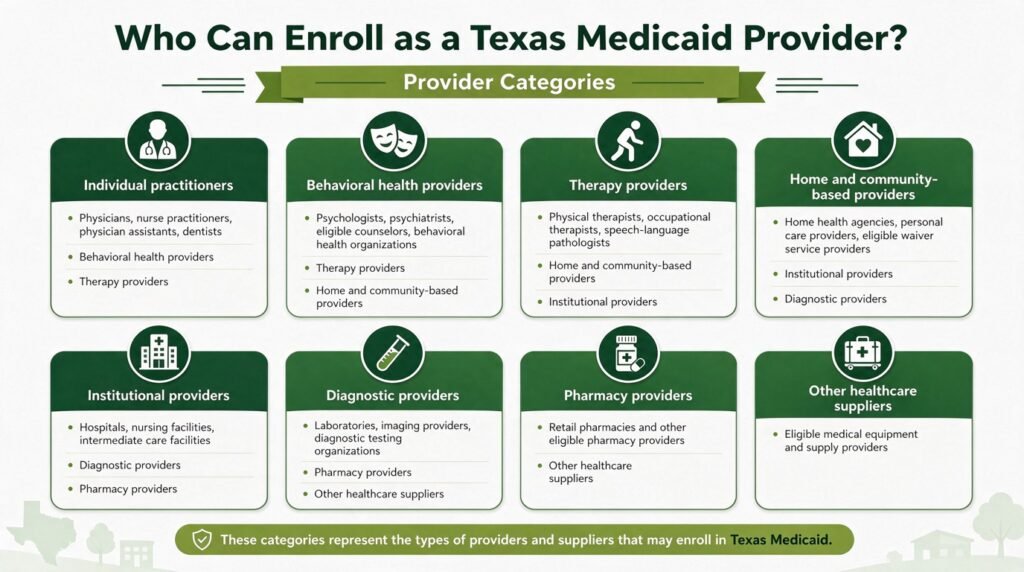
Not every professional license or business type creates automatic eligibility for Medicaid enrollment. The provider must select a recognized Texas Medicaid provider type and meet the program’s requirements.
Individual vs. Organization Enrollment
PEMS distinguishes between individual and organizational enrollment.
Individual enrollment generally applies to an individual healthcare professional enrolling under an individual NPI. This includes eligible practitioners and certain sole proprietors.
Organization enrollment generally applies to a facility, group, agency, or other healthcare entity enrolling under an organizational NPI.
A practice may need both individual and organizational enrollment records, depending on its provider type and billing structure. Do not assume that enrolling the organization automatically enrolls every practitioner who works there.
The provider should confirm the required enrollment structure before submitting an application.
Requirements to Enroll in Texas Medicaid
Before starting a PEMS application, confirm that the applicant meets the applicable state and federal enrollment requirements. Missing information, inconsistent identifiers, or incomplete ownership disclosures can delay the review.
1. National Provider Identifier (NPI)
Most healthcare providers must have an NPI issued through the National Plan and Provider Enumeration System (NPPES).
The NPI should match the provider’s legal identity, provider type, and enrollment structure. Individual practitioners generally use an individual NPI, while eligible organizations use an organizational NPI.
Providers whose services are not recognized for an NPI may qualify for an Atypical Provider Identifier (API), subject to HHSC requirements.
2. Active Professional License or Certification
Providers must maintain the license, certification, or accreditation required for their provider category.
Examples include:
- Physicians with an appropriate Texas medical license.
- Nurses with applicable Texas nursing credentials.
- Dentists with an active dental license.
- Therapists with the required professional credentials.
- Facilities with applicable state operating licenses.
- Laboratories with required certifications.
The information submitted to PEMS should match the issuing agency’s records. A license that is expired, restricted, suspended, or subject to undisclosed disciplinary action can affect enrollment eligibility.
3. Tax Identification Information
The applicant must provide the appropriate federal tax identification information.
Depending on the enrollment structure, this may include:
- Employer Identification Number (EIN).
- Individual taxpayer identification details where applicable.
- Legal business name.
- Doing-business-as (DBA) name, when applicable.
- Tax classification and business information.
The legal name and tax identification information should be consistent across relevant records, including NPPES, IRS documentation, and Medicare enrollment records when applicable.
4. Ownership and Control Disclosures
Texas requires applicable applicants to disclose ownership, control, and managing employee information.
The disclosure may include:
- Direct and indirect owners.
- Individuals or entities with ownership interests.
- Managing employees.
- Officers and directors.
- Authorized representatives.
- Relevant subcontractors and management entities.
HHSC Form 5871, Disclosure of Ownership and Control Statement, is an important ownership disclosure resource. The form requires information about ownership interests, including direct and indirect interests of 5% or more, when applicable.
Incomplete ownership information is a common reason for enrollment deficiencies. Providers should identify all reportable ownership levels before submitting the application.
Forms and Handbooks+1
5. Medicare Enrollment, When Required
Some Texas Medicaid provider types must enroll in Medicare as a prerequisite to Medicaid enrollment.
The requirement depends on the provider category and applicable HHSC rules. Certain providers whose practice does not serve Medicare-eligible individuals may qualify for an exception when HHSC approves it.
If the applicant participates in Medicare, the Medicare enrollment information should be consistent with the Texas Medicaid application. Differences in names, addresses, ownership, or identifiers may trigger additional review.
6. Background Checks and Fingerprinting
Texas Medicaid applies screening requirements based on the provider’s assigned risk category.
Depending on the provider type and risk level, screening may involve:
- Criminal background checks.
- Fingerprint-based checks.
- License verification.
- Exclusion screening.
- Ownership and control reviews.
- Site visits.
High-risk provider categories generally face more extensive screening than moderate- or limited-risk categories.
Providers should not assume that every applicant must complete the same fingerprinting process. TMHP or the relevant state agency will communicate the screening steps applicable to the enrollment.
7. Surety Bond and Site Visit Requirements
Certain provider types may have to obtain a surety bond for each enrollment location.
Texas may also conduct pre-enrollment or post-enrollment site visits, including unannounced visits, when required by the provider’s risk category or applicable regulations.
Providers should ensure that each reported location is operational and that the information in PEMS accurately reflects the services furnished there.
Documents to Prepare Before Applying
The exact document list depends on the provider type, but most applicants should organize the following information before opening PEMS.
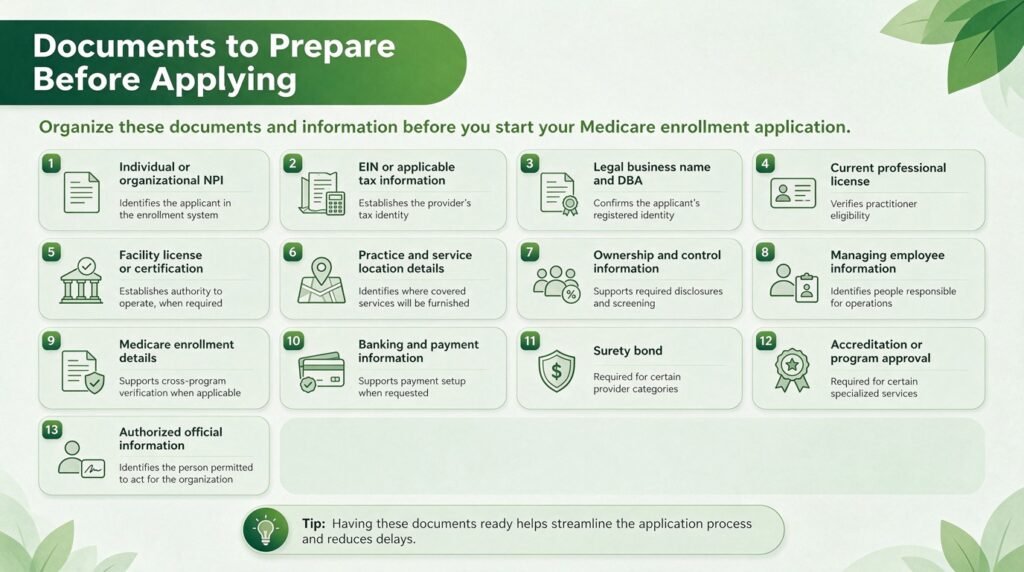
Important: This is a preparation checklist, not a universal document requirement. PEMS generates requirements based on the application type and provider category. Check the current TMHP instructions for the selected provider type before submitting.
How to Enroll as a Texas Medicaid Provider: Step-by-Step Process
Texas Medicaid applications are submitted through PEMS on the TMHP website. The application type determines how TMHP processes the request. A first-time applicant should select New Enrollment, while an already enrolled provider may need an Existing Enrollment, Maintenance, or Revalidation request instead.
Step 1: Identify the Correct Provider Type
Start by confirming the provider category under which you intend to enroll.
For an individual practitioner, identify the applicable professional provider type and specialty. For an organization, identify the facility or agency category that matches its licensed operations.
This decision affects:
- Required NPI type.
- License and certification requirements.
- Ownership disclosures.
- Risk category.
- Screening requirements.
- Required program approvals.
- Billing and rendering provider structure.
Do not choose a provider type simply because it appears similar to your business activity. For example, a home health agency, personal care provider, and home and community-based services provider may have different enrollment pathways.
Review the TMHP provider type instructions before proceeding.
Step 2: Obtain or Verify Your NPI
If your provider category requires an NPI, obtain it through NPPES before starting the Medicaid application.
Check that the NPI record contains the correct:
- Legal name.
- Provider type.
- Taxonomy code.
- Mailing address.
- Practice location.
- Authorized contact information.
The taxonomy code should accurately represent the provider’s specialty or organizational classification. Incorrect taxonomy information can create inconsistencies during enrollment and claims processing.
If the provider is eligible for an API instead of an NPI, follow the applicable HHSC instructions.
Step 3: Create or Access Your TMHP Account
Visit the TMHP Provider Enrollment page and access the Provider Enrollment and Management System.
The person responsible for enrollment should have the appropriate account access and authority to submit information on behalf of the provider.
Organizations should establish an internal process for managing:
- Provider administrator access.
- Authorized officials.
- Application contacts.
- Enrollment notifications.
- Document uploads.
- Deficiency responses.
Keep access information secure and ensure that the correct person receives application communications.
Step 4: Select New Enrollment in PEMS
For a provider that has never been enrolled in Texas Medicaid or the applicable state healthcare program, select New Enrollment.
TMHP identifies New Enrollment as the appropriate request for an NPI or API that has no existing enrollment record in PEMS. A change of ownership (CHOW) may also require a new enrollment application, depending on the circumstances.
PEMS offers other request types:
| PEMS request type | When to use it |
| New Enrollment | First-time enrollment or qualifying change of ownership |
| Existing Enrollment | Add a practice location or additional program to an existing enrollment, or request disenrollment |
| Revalidation | Renew an existing provider enrollment |
| Maintenance | Update information on an existing enrollment record |
Before selecting a request, check whether a draft or in-progress application already exists. TMHP warns that a draft request left unsubmitted for 180 calendar days expires and cannot be submitted.
explain the request types.
Step 5: Complete the Provider Information Sections
Enter the applicant’s identifying and business information carefully.
Depending on the provider type, PEMS may request:
- Legal name.
- DBA name.
- NPI or API.
- Tax identification number.
- Provider taxonomy.
- License information.
- Practice address.
- Mailing address.
- Contact information.
- Service locations.
- Provider specialty.
- Ownership and control information.
- Authorized official details.
The information should match the provider’s official records. Avoid entering an informal business name where PEMS requests the legal entity name.
For an organization, confirm that the tax ID belongs to the legal entity applying for enrollment. For an individual practitioner, verify the correct individual enrollment and tax information.
Step 6: Add Practice Locations and Service Details
Enter every location that the provider intends to include in the application.
A location record may require:
- Physical address.
- Mailing address.
- Contact details.
- Service type.
- Office hours.
- Ownership or management information.
- Facility license information, when applicable.
Do not list a mailing address as a service location unless the provider actually furnishes covered services there and the address meets the applicable requirements.
If the provider operates multiple locations, confirm whether each location needs separate enrollment information, a separate license, or additional screening.
Step 7: Complete Ownership and Control Disclosures
Provide all required information about owners, managing employees, officers, directors, and other reportable parties.
Review each disclosure carefully. The information may need to cover indirect ownership through parent entities and other business structures.
A provider should not omit an owner because the person does not work directly with patients. Ownership and control disclosure requirements are separate from clinical staffing requirements.
If HHSC requires Form 5871 or supporting ownership documentation, submit the requested information in the required format.
Step 8: Upload Licenses and Supporting Documents
Upload the documents requested for the provider category.
Check that:
- Each document is legible.
- The provider name matches the application.
- Licenses are current.
- Expiration dates are visible.
- All pages are included.
- Supporting documents correspond to the correct provider or location.
- Any requested signatures are present.
Do not upload unrelated documents in place of a required form. If PEMS requests a particular disclosure or certification, provide that specific item.
Step 9: Complete Screening Requirements
After submission and initial application review, the provider may need to complete additional screening.
Depending on the assigned risk category and provider type, the state may request fingerprinting, background checks, a site visit, or further verification.
Respond promptly to screening notices. An application may remain pending until the applicant completes the required screening activities.
Step 10: Review and Submit the Application
Before submitting, review the application from beginning to end.
Confirm:
- Correct application type.
- Correct provider and NPI structure.
- Accurate tax information.
- Current license details.
- Complete ownership disclosures.
- Correct practice locations.
- Required attachments.
- Authorized official information.
- Any applicable certifications and attestations.
Submit the application through PEMS and retain the confirmation or request information for tracking.
Step 11: Monitor the Application and Respond to Deficiencies
TMHP reviews the application and may request corrections or additional information.
A deficiency notice may identify:
- Missing ownership information.
- Inconsistent tax details.
- Expired or incomplete licensing records.
- Missing signatures.
- Incorrect NPI or taxonomy information.
- Incomplete location details.
- Missing program-specific documentation.
Respond through the designated PEMS workflow and provide exactly what the reviewer requests.
Do not assume that uploading a document automatically resolves a deficiency. Check the application status and confirm that TMHP has accepted the correction.
Step 12: Complete Any Additional HHSC or OIG Review
Some applications require additional review after TMHP determines that the application is complete.
The Texas HHSC Office of Inspector General (OIG) performs provider enrollment integrity screening based on federal and state requirements. Additional HHSC approval may also apply to certain provider categories.
The application is not complete merely because the provider submitted it or passed an initial review.
Step 13: Receive Enrollment Approval
Once all required reviews and approvals are complete, the provider receives notification confirming the enrollment decision.
Check PEMS for the final request status. A provider should confirm that the enrollment is active and that the approved provider information, locations, and programs are correct.
Keep the approval notification and enrollment records for future reference.
Step 14: Apply Separately to Medicaid Managed Care Plans
If you intend to serve Medicaid managed care members, contact the relevant MCOs after completing the state enrollment requirement.
Each plan may require:
- A separate provider application.
- Credentialing documentation.
- License and NPI verification.
- Contract review.
- Network participation approval.
- EFT and payment setup.
- Roster or group affiliation information.
Do not assume that a Texas Medicaid approval letter confirms network participation with a specific MCO. You must complete the plan’s separate process.
How Long Does Texas Medicaid Provider Enrollment Take?
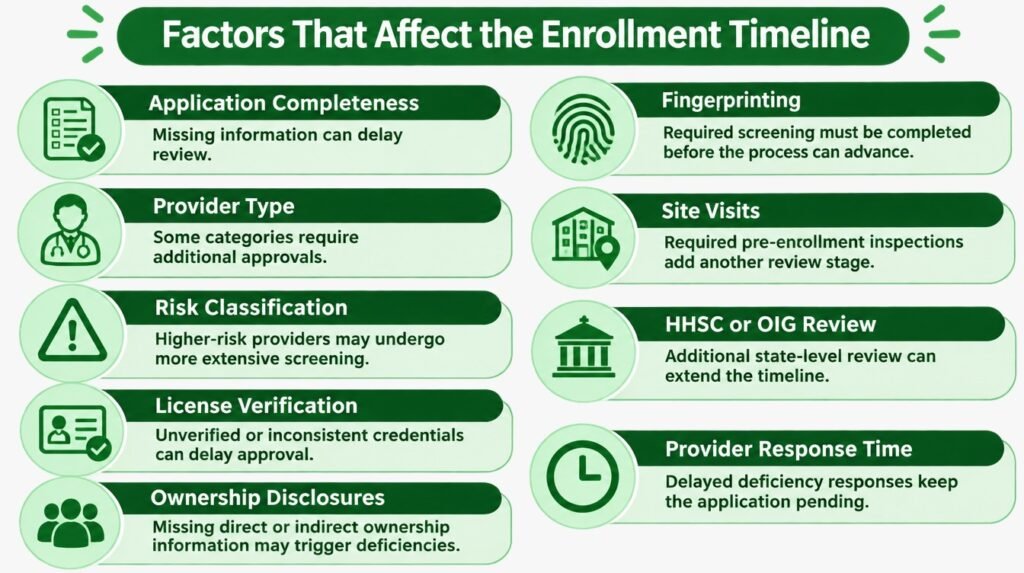
Texas Medicaid enrollment does not have one guaranteed processing time for every provider type. The timeline depends on application completeness, provider risk category, license verification, ownership disclosures, fingerprinting, site visits, and additional HHSC approvals.
TMHP’s provider enrollment manual states that the process can typically take up to 60 days after it receives all information necessary to process the application. However, the Texas HHSC Office of Inspector General currently reports that its Provider Enrollment Integrity Screenings team is processing most applications within approximately 90 to 120 days of receipt because of an unusually high application volume.
These figures describe different parts of the enrollment process and should not be treated as competing guarantees. An application requiring additional screening or corrections may take longer.
Factors That Affect the Enrollment Timeline
How to Avoid Enrollment Delays
Providers can reduce avoidable delays by preparing their records before submitting the application.
- Match the legal name and tax ID across enrollment documents.
- Verify the NPI and taxonomy information in NPPES.
- Check license status and expiration dates.
- Identify all reportable owners and managing employees.
- Complete every required disclosure.
- Upload readable documents.
- Monitor PEMS for application updates.
- Respond to deficiency notices promptly.
- Complete fingerprinting or site visits when requested.
A complete application does not guarantee immediate approval, but it reduces the risk of preventable processing delays.
What Happens After Texas Medicaid Approves Your Application?
Receiving an approval notice is an important milestone, but providers should complete several checks before treating their enrollment as operational.
Verify Your Enrollment Status
Log in to PEMS and confirm that the application has reached the appropriate enrolled status.
Review the approved information, including:
- Provider name.
- NPI or API.
- Tax identification details.
- Provider type.
- Specialty or taxonomy.
- Approved locations.
- Enrolled programs.
- Enrollment effective date.
- Revalidation due date.
Correct any errors through the appropriate PEMS maintenance request.
Confirm Your Medicaid Billing Setup
Make sure your billing team has the information needed to submit claims correctly.
This includes the provider’s Medicaid enrollment details, billing and rendering provider identifiers, service location information, and any applicable program-specific billing instructions.
Providers should also review TMHP billing guidance for their provider category before submitting claims.
Complete Managed Care Contracting
Texas Medicaid enrollment and MCO network participation are separate.
If you want to treat members enrolled in plans such as Texas Medicaid STAR, STAR+PLUS, STAR Kids, or other applicable managed care programs, identify the plans operating in your service area and contact their provider network departments.
A plan may request a separate credentialing application, contract, roster, or additional supporting documentation.
Confirm Authorization and Referral Requirements
Before providing services, review the coverage and authorization policies for the applicable Medicaid program and health plan.
Some services require prior authorization, referrals, medical necessity review, or specific provider qualifications.
State Medicaid enrollment does not remove these requirements.
Texas Medicaid Managed Care Plans: Why Separate Contracting Matters
Texas delivers a substantial portion of Medicaid benefits through managed care organizations. These plans administer benefits for enrolled members and maintain their own provider networks.
A provider who wants to participate in managed care must complete state enrollment and then follow the contracting requirements of each relevant plan.
Some major Texas Medicaid managed care organizations include:
| Health plan | Examples of relevant programs |
| Aetna Better Health of Texas | Medicaid managed care and related programs |
| Amerigroup Texas | Medicaid managed care programs |
| Blue Cross and Blue Shield of Texas | Medicaid managed care programs |
| Community Health Choice | Medicaid managed care programs |
| Molina Healthcare of Texas | Medicaid managed care programs |
| Superior HealthPlan | Medicaid managed care programs |
| UnitedHealthcare Community Plan of Texas | Medicaid managed care programs |
Plan participation varies by service area and program. Not every plan operates in every Texas county or offers every Medicaid program.
Providers should use the current HHSC managed care plan directory to identify the health plans serving their area.
How to Contract With a Texas Medicaid MCO
The general contracting process involves the following steps:
- Identify the Medicaid plans operating in the provider’s service area.
- Confirm that the plan accepts the provider’s specialty and provider type.
- Contact the plan’s provider network or contracting department.
- Request its Medicaid provider application.
- Submit the required credentialing and contracting documents.
- Complete any additional verification or review.
- Review and sign the provider agreement.
- Confirm the effective date and network participation status.
- Verify claims submission, authorization, and payment instructions.
Do not schedule Medicaid managed care services on the assumption that a state enrollment approval automatically makes the provider in-network. Confirm the plan’s contract status first.
Texas Medicaid Enrollment for Behavioral Health Providers
Behavioral health practitioners and organizations must identify the correct enrollment category before applying. Texas Medicaid recognizes different provider types and service arrangements, and the requirements vary according to the services furnished.
Potential applicants include:
- Psychiatrists.
- Psychologists.
- Licensed clinical social workers.
- Licensed professional counselors.
- Licensed marriage and family therapists.
- Behavioral health clinics.
- Substance use disorder treatment providers.
- Eligible community mental health service organizations.
The specific provider category, license, service program, and billing arrangement determine the enrollment requirements. Not every behavioral health license qualifies an individual or organization to bill every Medicaid behavioral health service.
Behavioral Health Provider Enrollment Considerations
Behavioral health providers should review the following before applying:
Professional credentials: Confirm that the practitioner holds the license or credential required for the services being furnished.
Organizational structure: Determine whether the practitioner enrolls individually, through an organization, or under another recognized arrangement.
Rendering and billing providers: Confirm which practitioners must enroll individually and how the organization reports them on claims.
Program requirements: Some behavioral health services require additional program approval, certification, or participation in a designated service delivery arrangement.
Managed care contracting: Contact the applicable Medicaid MCO and follow its separate credentialing and contracting process.
Service-specific billing: Review the applicable Texas Medicaid provider manual for the covered service, authorization requirements, documentation, and claim submission rules.
Behavioral health providers should not assume that a general Medicaid provider enrollment automatically authorizes billing for every community-based, rehabilitative, or specialized behavioral health service.
Texas Medicaid Enrollment for Home Health Agencies
Home health agencies must meet the applicable Texas licensing, enrollment, and program requirements before billing Medicaid for covered home health services.
An agency should confirm:
- Appropriate state licensure.
- Organizational NPI.
- Tax identification information.
- Ownership and managing employee disclosures.
- Service location details.
- Required certifications or approvals.
- Applicable Medicare enrollment requirements.
- Medicaid provider category.
- Managed care contracting requirements.
Home health services may involve separate authorization and documentation requirements depending on the service, patient, and payer.
An agency that provides services through a Medicaid managed care plan must also complete the applicable MCO contracting process.
Texas Medicaid Enrollment for Physicians and Individual Practitioners
Individual practitioners should verify their professional credentials and enrollment structure before beginning the application.
The general preparation process includes:
- Confirm an active Texas license or other applicable credential.
- Obtain or verify the individual NPI.
- Confirm the taxonomy code.
- Review whether Medicare enrollment is required.
- Prepare tax and practice information.
- Complete the individual provider application in PEMS.
- Submit required supporting documents.
- Complete screening and any requested verification.
- Confirm final enrollment status.
- Apply separately to the Medicaid MCOs where network participation is desired.
A practitioner who works for a group may still need individual enrollment, depending on the provider category and billing arrangement. The group should verify the required individual and organizational records before submitting claims.
Texas Medicaid Enrollment for Out-of-State Providers
An out-of-state provider may qualify for Texas Medicaid enrollment when the applicable program rules allow it and the provider meets the required eligibility conditions.
Out-of-state enrollment is not automatic. The provider must satisfy Texas requirements for the applicable provider category and service.
Depending on the circumstances, HHSC may require information about:
- The provider’s active license or certification.
- The provider’s home-state enrollment.
- Medicare participation, when applicable.
- The reason for furnishing services to a Texas Medicaid member.
- The service location and delivery arrangement.
- Applicable out-of-state provider eligibility criteria.
Providers should review the out-of-state enrollment section of the Texas Medicaid Provider Procedures Manual and confirm eligibility with TMHP before applying.
An out-of-state provider should also check whether the relevant MCO requires a separate contract or has additional network restrictions.
Common Reasons Texas Medicaid Provider Applications Are Delayed or Denied
Enrollment problems often arise from incomplete disclosures, inconsistent provider information, and failure to meet provider-specific requirements.
1. Incorrect NPI or Taxonomy Information
An incorrect NPI, taxonomy code, or provider classification can create inconsistencies between PEMS and NPPES.
How to prevent it: Verify the NPI record before starting the application and confirm that the taxonomy accurately represents the provider’s practice.
2. Inconsistent Legal Name and Tax ID
The applicant may use a DBA name in one section and a different legal entity name in another. This can create problems during tax and identity verification.
How to prevent it: Use the legal name associated with the tax ID and provide the DBA only where requested.
3. Missing Ownership Disclosures
Failure to report all required direct and indirect owners, managing employees, or other reportable parties can delay screening.
How to prevent it: Map the organization’s ownership structure before completing the application. Review every disclosure requirement and submit supporting documentation.
4. Expired or Incomplete Licenses
A license that has expired or does not match the provider’s identity can prevent the application from progressing.
How to prevent it: Verify each license through the appropriate state licensing authority and upload current records.
5. Missing Fingerprinting or Screening Information
Some providers must complete fingerprint-based screening or other background checks.
How to prevent it: Follow the screening instructions issued by TMHP or HHSC and complete the required steps within the specified timeframe.
6. Incorrect Provider Type
Choosing the wrong provider category can result in requests for corrections or an application that does not match the services being furnished.
How to prevent it: Confirm the appropriate provider type before creating the PEMS request.
7. Missing Program-Specific Approval
Certain facilities and specialized providers need additional approvals beyond general Medicaid enrollment.
How to prevent it: Identify all applicable licensing, certification, and program requirements before applying.
8. Failure to Respond to Deficiency Notices
An application may remain pending when the provider does not supply the requested documents or corrections.
How to prevent it: Assign an enrollment contact to monitor PEMS and respond to every deficiency notice.
9. Assuming State Enrollment Includes MCO Credentialing
A provider may complete PEMS enrollment but fail to contract with the health plans it wants to serve.
How to prevent it: Start the MCO contracting process separately and confirm network participation before treating managed care members as an in-network provider.
10. Failure to Complete Revalidation
An existing provider can lose enrollment when the revalidation deadline passes without an approved application.
How to prevent it: Monitor the revalidation date in PEMS and begin the renewal process early.
Texas Medicaid Provider Revalidation: How to Keep Your Enrollment Active
Provider enrollment does not end when HHSC approves the initial application. Texas requires providers to revalidate their enrollment periodically.
Most providers have a five-year enrollment period, although some provider categories may have shorter periods depending on their risk level or other requirements.
The revalidation process confirms that the provider’s information remains accurate and that the provider continues to meet enrollment requirements.
When Should You Start Revalidation?
Providers should check their revalidation due date in PEMS and begin the process well before the deadline.
TMHP encourages providers to start revalidation up to 180 days before the end of their enrollment period. HHSC also advises providers to submit revalidation at least 120 days before the deadline to allow time for processing.
Starting early is particularly important when the provider needs to update ownership, licensing, locations, or other information.
What Happens If You Miss the Revalidation Deadline?
Failure to complete revalidation by the applicable deadline can result in disenrollment from Texas Medicaid and other state healthcare programs.
The provider may lose the ability to submit payable claims or prior authorization requests during the disenrollment period. The provider may need to submit a new re-enrollment application to regain participation.
TMHP also describes a 45-day grace period for certain revalidation requests submitted before the due date that reach Closed-Enrolled status within the grace period. Providers should not treat this as an extension that removes the need to submit on time.
The safest approach is to complete revalidation before the listed due date.
and the
explain the current process.
How to Update Your Texas Medicaid Provider Information
Providers must keep their enrollment records accurate after approval. Changes to business or professional information may require a Maintenance request in PEMS.
Common updates include:
- Practice address.
- Mailing address.
- Contact information.
- Ownership or control.
- Authorized officials.
- Tax information.
- License information.
- Provider specialty.
- Service locations.
- Organizational details.
A provider should not wait until revalidation to report a change that must be updated sooner. Review the applicable PEMS maintenance instructions to determine the correct request type and supporting documents.
Changes in ownership may require a new enrollment application rather than a routine maintenance update. Confirm the correct process with TMHP before submitting the change.
How to Check Your Texas Medicaid Provider Enrollment Status
Providers can monitor their application through PEMS.
The system provides information about enrollment requests and their current processing status. Review the Requests page for pending applications, deficiency notices, and completed enrollment decisions.
When checking an application:
- Sign in to PEMS.
- Open the relevant enrollment request.
- Review the current status.
- Check for outstanding deficiencies.
- Review any messages or requested documents.
- Submit corrections through the required workflow.
- Confirm that the request reaches its final enrolled status.
Keep copies of application confirmations, deficiency responses, and approval notices. These records can help resolve questions about enrollment dates and provider participation.
Where Can Texas Medicaid Providers Get Enrollment Help?
TMHP provides enrollment instructions, training materials, and support resources for providers.
Useful resources include:
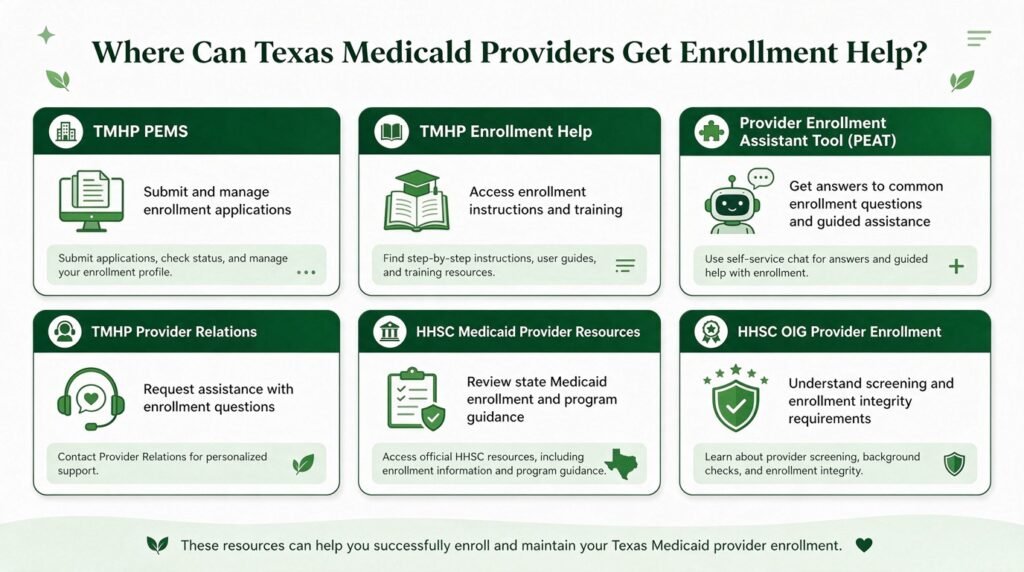
Contact TMHP for Enrollment Assistance
Providers can contact TMHP for assistance with the enrollment process.
- TMHP Provider Enrollment phone: 800-925-9126, Option 3
- Provider Relations email: Provider.relations@tmhp.com
- Website: www.tmhp.com
TMHP introduced the Provider Enrollment Assistant Tool (PEAT) to help providers find answers, access step-by-step PEMS instructions, and request an enrollment walkthrough with a Provider Relations representative. The tool can help applicants understand which steps apply to their provider type.
Texas Medicaid Provider Enrollment Checklist
Use this checklist before submitting a new enrollment application.
| Enrollment task | Status |
| Confirm the correct provider category | ☐ |
| Determine individual or organizational enrollment | ☐ |
| Obtain or verify NPI or API | ☐ |
| Verify taxonomy information | ☐ |
| Confirm active professional or facility license | ☐ |
| Verify legal name and tax ID | ☐ |
| Prepare ownership and control disclosures | ☐ |
| Identify managing employees | ☐ |
| Check Medicare enrollment requirements | ☐ |
| Prepare required program approvals | ☐ |
| Confirm practice and service locations | ☐ |
| Review fingerprinting and screening requirements | ☐ |
| Prepare surety bond if applicable | ☐ |
| Create or access the TMHP account | ☐ |
| Select the correct PEMS application type | ☐ |
| Complete all application sections | ☐ |
| Upload required supporting documents | ☐ |
| Review and submit the application | ☐ |
| Monitor PEMS for deficiencies | ☐ |
| Complete additional HHSC or OIG screening | ☐ |
| Confirm final enrollment approval | ☐ |
| Apply separately to relevant MCOs | ☐ |
| Record the revalidation due date | ☐ |
Frequently Asked Questions
How do I enroll as a provider in Texas Medicaid?
You must submit an enrollment application through the Texas Medicaid & Healthcare Partnership’s Provider Enrollment and Management System (PEMS). Select the correct provider type and application category, provide the required NPI or API, licensing, tax, ownership, and location information, and complete any screening or additional review requested by TMHP or HHSC.
Where do I apply for Texas Medicaid provider enrollment?
Apply through the TMHP Provider Enrollment and Management System. Start at the TMHP Provider Enrollment page and follow the instructions for your provider category.
Is TMHP the same as Texas Medicaid?
No. Texas Medicaid is administered by the Texas Health and Human Services Commission (HHSC). TMHP is the contractor that handles provider enrollment and other Medicaid administrative functions.
Do I need an NPI to enroll in Texas Medicaid?
Most healthcare providers need an NPI. Providers whose services are not recognized for an NPI may qualify for an Atypical Provider Identifier, subject to HHSC requirements.
Can an organization enroll without enrolling its individual practitioners?
The answer depends on the provider type and billing arrangement. Some organizations must also have individual practitioners enrolled as rendering, ordering, referring, or prescribing providers. Confirm the applicable requirements before submitting claims.
How long does it take to get approved for Texas Medicaid?
There is no guaranteed processing time. TMHP’s provider manual describes a typical process of up to 60 days after receiving all necessary information. However, the HHSC OIG currently reports processing times of approximately 90 to 120 days for most applications handled by its screening team. Additional reviews or deficiencies may extend the timeline.
Can I enroll in Texas Medicaid and Medicaid managed care at the same time?
You must complete Texas Medicaid enrollment through TMHP before managed care participation can be approved. You must then complete the separate contracting and credentialing requirements of the MCO you want to join.
Does Texas Medicaid enrollment automatically include all managed care plans?
No. State enrollment does not automatically establish network participation with every Medicaid managed care organization. Each plan may require a separate contract and credentialing process.
What documents are required for Texas Medicaid enrollment?
Requirements depend on the provider type. Common information includes an NPI, tax ID, legal business name, license or certification, practice location, ownership disclosures, managing employee information, and any required program approvals or supporting forms.
Do behavioral health providers need to enroll in Texas Medicaid?
Behavioral health practitioners and organizations must enroll when they furnish services or perform functions for which Texas Medicaid enrollment is required. The specific enrollment category depends on the provider’s license, service type, and billing arrangement.
Can an out-of-state provider enroll in Texas Medicaid?
Some out-of-state providers may qualify under Texas Medicaid rules. They must meet the applicable provider eligibility and program requirements. Enrollment is not automatic simply because the provider has a license or Medicaid participation in another state.
What happens if Texas Medicaid requests additional information?
TMHP may issue a deficiency notice requesting corrections or missing documents. The provider should respond through the designated PEMS workflow and monitor the application until the deficiency is resolved.
