
Prior authorization is eating up more staff time than almost any other administrative task in healthcare today.
The American Medical Association's own physician survey found that practices complete an average of 43 prior authorizations per physician every single week, and more than half of surveyed providers say they simply don't have enough time in the day to get through them all. If you run a practice or manage its billing team, you already know this number isn't an exaggeration.
Remember that prior authorization delays aren't random. They follow patterns, and once you understand where the friction actually comes from, you can build a process that gets medications approved in days instead of weeks.
Let’s understand how to speed up medication prior authorization by addressing documentation habits that prevent denials.
Why Prior Authorization Takes So Long?
Before fixing the problem, it helps to understand what's actually causing the delay. Prior authorization requests slow down for a handful of very specific, very fixable reasons, and almost none of them come down to the medication itself.
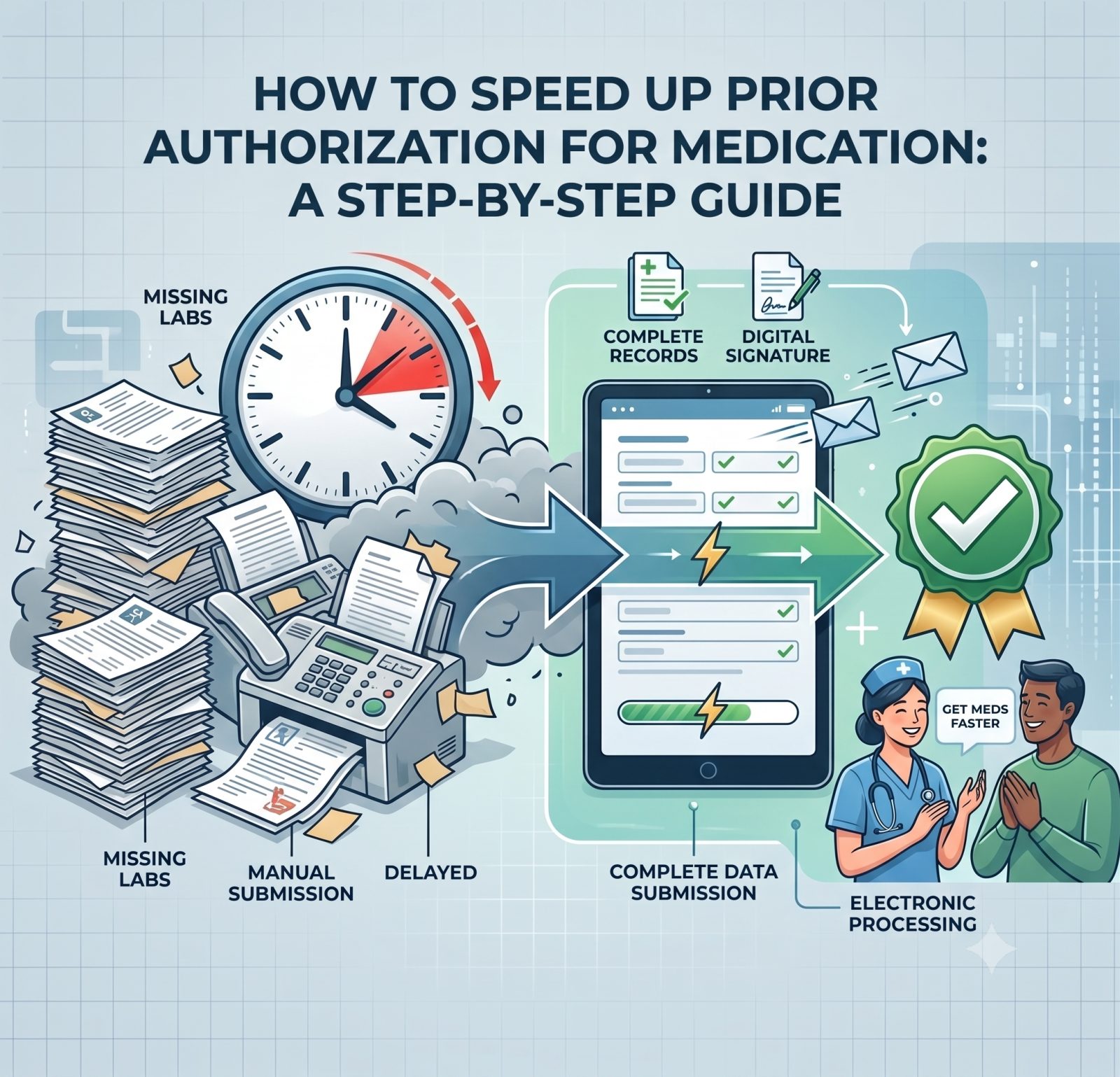
Incomplete documentation is a major cause of prior authorization delay. When a request goes out missing a lab result, a prior treatment history, or a clear statement of medical necessity, the payer doesn't deny it outright most of the time.
Instead, they pause it and request more information, which restarts the clock and can add days or weeks to a process that should have taken 24 to 72 hours. A clean, complete first submission is genuinely the single biggest lever your practice has for speeding this up.
Manual, non-electronic submission is another major driver. Fax- and phone-based prior authorization requests move through payer systems far more slowly than electronic ones, and they're also more prone to being lost, misrouted, or stuck in a queue behind hundreds of other paper requests.
Practices that still rely on fax submissions are working with one hand tied behind their backs; request volume plays a role, too, particularly for specialty medications and GLP-1 drugs, where payer utilization management teams are currently swamped. And finally, unclear or outdated payer-specific requirements catch many practices off guard, since every payer, and often every individual plan within that payer, has its own forms, its required fields, and its criteria for medical necessity.
Most Common Reasons Prior Authorization Requests Get Delayed
- Missing or incomplete clinical documentation supporting medical necessity
- Requests submitted by fax or phone instead of through an electronic prior authorization system
- Blank fields, misspellings, or incorrect NDC or diagnosis codes on the submission form
- Requests classified as standard when they actually qualify for expedited review
- Using an outdated version of a payer's prior authorization form after the criteria changed
- High-volume backlogs at the payer for certain drug classes, particularly specialty and GLP-1 medications
- No clear internal process for following up within 48 hours of submission
How to Speed Up Prior Authorization?
Step 1: Submit Electronically Every Single Time
If your practice is still submitting prior authorizations by fax as a default, this is the fastest fix available to you today. Electronic prior authorization, often called ePA, routes the request directly into the payer's system in real time, eliminating issues caused by manual data entry, lost faxes, and requests left in a physical inbox.
Payers process electronic requests measurably faster than manual ones, and ePA platforms also reduce the error rate that causes so many requests to stall in the first place.
Most major ePA platforms integrate directly with your EHR, so patient demographics, diagnosis codes, and medication history populate the request automatically, rather than staff having to retype everything by hand.
This eliminates a huge share of the blank-field and typo-driven delays that plague manually submitted requests. If your practice hasn't adopted an ePA workflow yet, this is genuinely the highest-leverage change you can make this quarter.
Step 2: Get the Documentation Right the First Time
A clean first submission is the fastest path through prior authorization, full stop. Payers don't reward speed on incomplete requests; they simply pause them and ask for more information, which is often slower than if the request had never been submitted at all.
Prior Authorization requirement include:
- A clear, specific statement of medical necessity tied directly to the patient's diagnosis.
- Documentation of prior treatments tried and their outcomes, especially for step-therapy requirements.
- Current, accurate lab results or diagnostic findings that support the prescribed medication
- The correct payer-specific form, confirmed current for this plan year, rather than assumed from memory
- Accurate NDC codes, dosage, and quantity match exactly what the physician prescribed.
- The prescribing diagnosis code is clearly linked to the specific medication requested.
- Contact information for rapid follow-up if the payer needs clarification
Before submitting, confirm the medication is actually on the payer's formulary and check which tier it falls under, since non-formulary drugs almost always require prior authorization and often need additional step-therapy documentation showing that lower-tier alternatives were tried first and either failed or weren't appropriate. Skipping this formulary check is one of the more avoidable reasons a request gets delayed after the fact.
Step 3: Request Expedited Review When It's Genuinely Warranted
Not every prior authorization needs to move at the same speed; payers must distinguish between standard and expedited requests.
Under CMS's Interoperability and Prior Authorization Final Rule, which took effect for impacted payers on January 1, 2026, standard requests must be decided within seven calendar days, while requests, meaning situations where a delay could seriously jeopardize the patient's life, health, or ability to regain function, must be decided within 72 hours.
This is a meaningful shift. Before this rule, standard turnaround times at many payers stretched up to 14 days, so the new seven-day ceiling effectively cut the maximum wait in half for a large share of requests.
The 72-hour expedited timeline applies specifically to situations that genuinely meet clinical urgency criteria, so it's worth training your clinical staff to correctly identify when a request qualifies as urgent rather than defaulting everything to standard processing out of habit, or conversely, flagging everything as urgent, which payers will push back on if the clinical picture doesn't support it.
Step 4: Build a Repeatable Internal Process
Speed comes from consistency, not heroics. Practices that handle prior authorization well almost always have a defined, repeatable internal process rather than relying on whichever staff member happens to have time that day.
Here’s how you can speed up approval times:
- Maintain a master list of which procedures and medications require prior authorization for each of your major payers. Designate the same staff member or small team to handle prior authorizations consistently, so payer familiarity builds over time.
- Alert scheduling and front-desk staff early about medications that will need authorization, so the process starts before the patient shows up, expecting a prescription.
- Check the status of every submitted request within 48 hours, rather than waiting for the payer to reach out.
- Keep a documented log of every denial reason by payer and medication, so patterns become visible and preventable
- Sign up for payer newsletters or provider bulletins that announce changes to formulary and prior authorization criteria.
- Centralize payer contact information, portal logins, and fax numbers in one place that your whole team can access.
A practice that documents denial reasons over time starts to see clear patterns. Maybe one particular payer consistently wants a request for a specific lab value that isn't part of the standard note template.
Maybe another always denies step-therapy exceptions unless the prior medication's failure is documented in a very specific way.
Once you know the pattern, you can build it directly into your submission checklist and stop hitting the same wall over and over.
Step 5: Follow Up Proactively, Don't Wait
A request sitting silently in a payer's queue isn't necessarily moving toward a decision on its own.
Checking the status within 48 hours of submission, rather than waiting the full seven days to see what happens, gives your staff a chance to catch and fix problems while there's still time to influence the outcome.
If the payer flags a missing piece of information, a same-day response from your team can be the difference between a three-day delay and a two-week one.
Keep a clear record every time you follow up: who you spoke with, the date and time, and any reference number provided.
This record matters twice over. It protects your practice if a dispute arises over timeline compliance, and it serves as a foundation for your appeal if the request is ultimately denied.
Step 6: Know How to Appeal Quickly When a Request Is Denied
Even a clean, well-documented request can be denied, and knowing how to move quickly matters just as much as getting the initial submission right.
Appeals succeed most often when the prescriber can clearly demonstrate medical necessity, or when the original denial resulted from a straightforward clerical error rather than a genuine coverage question.
What strengthens a prior authorization appeal
- A direct statement from the prescribing physician, reinforcing why this specific medication is medically necessary for this specific patient
- Additional clinical documentation that wasn't included in the original submission, such as more recent lab work or specialist notes
- A clear explanation of why alternative, lower-cost medications were tried, failed, or were contraindicated
- Correction of any clerical errors identified in the original denial, such as a wrong NDC code or a missing diagnosis pairing
- A peer-to-peer review request, where the prescribing physician speaks directly with the payer's medical reviewer
- Reference to the payer's own published clinical criteria, showing the patient meets the stated coverage standard
Under the CMS rule taking effect in 2026, payers are now required to provide a specific reason for every prior authorization denial rather than a vague coverage statement.
This is a real advantage for practices, since it gives you the exact criteria that weren't met, rather than forcing your staff to guess what the payer actually wants before resubmitting or appealing.
Final Thoughts
Speeding up prior authorization for medication comes down to a small number of disciplined habits rather than any single trick.
Submit electronically. Get the documentation complete on the first try. Know when a request genuinely qualifies as urgent. Follow up within 48 hours instead of waiting.
Track your denial patterns so you stop repeating the same avoidable mistakes.
And keep an eye on the regulatory changes rolling out through 2026 and 2027, since federal policy is actively pushing payers toward faster, more transparent decisions, which works in your favor as long as your practice's own process is ready to move at that same pace.
Prior authorization delays cost your practice time, revenue, and, most importantly, the care your patients are waiting for.
Our Medivantek Billing, Michigan-based medical billing expert handles prior authorization from submission through appeal for practices across specialties, keeping approval times fast and denial rates low.
Reach out today for a free review of your current prior authorization process and see where the delays are coming from.
Frequently Asked Questions
How long does prior authorization for medication typically take in 2026?
Most standard requests are now decided within seven calendar days under the CMS final rule that took effect January 1, 2026, down from timelines that previously stretched up to 14 days at many payers. Expedited requests, for situations where delay could seriously harm the patient, must be decided within 72 hours. Actual turnaround still varies by payer and by how complete the original submission was, so a clean, well-documented first request remains the fastest path through the process regardless of these new ceilings.
Can a practice request an expedited prior authorization for any medication?
No, expedited review is reserved for situations where the standard timeframe could seriously jeopardize the patient's life, physical or mental health, or ability to regain function. Payers do push back on expedited requests that don't clearly meet this clinical-urgency standard, so it's worth training prescribing staff to document the specific urgency factor and to request expedited review, rather than defaulting every request to urgent status out of habit.
What's the biggest single change a practice can make to speed up prior authorizations?
Switching from fax or phone-based submission to a true electronic prior authorization workflow tends to produce the fastest, most measurable improvement, since it removes manual data entry and routes requests directly into the payer's review system rather than into a physical queue. Pairing that switch with a consistent, documented internal process, rather than handling each request ad hoc, compounds the improvement significantly over just a few months.
Do all insurance plans require prior authorization for the same medications?
No, and this is one of the most common sources of confusion for both practices and patients. Formulary requirements and prior authorization criteria vary significantly by payer and even by individual plan within the same payer, and they can change during the plan year as formularies get updated. Building a habit of confirming current formulary status and prior authorization requirements before prescribing, rather than relying on what was true last time, prevents delays.
What should a practice do if a prior authorization request is denied?
Start by reading the specific denial reason carefully; carriers are now required to provide one rather than a vague coverage statement. From there, determine whether the denial stemmed from a correctable clerical error, missing documentation, or a genuine medical dispute over the necessity of each, which would require a different response. A prompt, well-documented appeal, sometimes paired with a peer-to-peer review between the prescribing physician and the payer's medical reviewer, resolves the majority of denials that were based on documentation gaps rather than an outright coverage exclusion.
How much staff time does prior authorization actually consume, and is outsourcing worth it?
Industry surveys consistently show providers and their teams spending some 15 to 20 hours a week on prior authorization tasks, which amounts to nearly a full-time position dedicated to this administrative function. For practices where that burden pulls clinical staff away from patient care, or where denial rates suggest the internal process needs specialized attention, outsourcing to a team that handles prior authorization full-time and stays current on payer-specific requirements often pays for itself through faster approvals and fewer treatment delays.
