

A healthcare provider usually needs prior authorization from an insurance company before delivering a service that requires it. But what happens when the service has already been provided and the provider discovers that authorization was missing? This is where retro authorization in medical billing can become important. Retro authorization, also called retrospective authorization or retroactive authorization, allows a provider to ask the payer to review and approve a service after it has already occurred. However, not every insurer permits retro authorization, and obtaining it does not automatically guarantee claim payment. The provider must still meet the payer’s medical necessity, documentation, coding, eligibility, and coverage requirements.
Retro Authorization in Medical Billing?
Retro authorization, also called retrospective authorization or retroactive authorization, is an approval that a health insurance payer gives after a medical service has already been provided.
Normally, a provider obtains prior authorization before performing a service. With retro authorization, the provider or facility asks the payer to review the service afterward and approve it retroactively.
For example, a patient receives an MRI without prior authorization. The claim later denies because the payer required authorization. The provider contacts the payer and requests a retroactive authorization, submitting the clinical records and other documentation needed to show that the MRI met the payer’s coverage and medical necessity requirements.
| Example: Imagine a physician orders an advanced imaging service.The patient’s plan requires prior authorization.The staff mistakenly schedules the procedure without obtaining it.The patient receives the service.The claim then comes back with an authorization related denial.The billing team reviews the denial and confirms that the payer accepts retro authorization for this type of service.The team submits:The physician’s order Clinical notes Diagnosis Medical necessity documentation Procedure information Patient and provider details The payer reviews the request.If the payer grants retro authorization, the provider may then request claim reconsideration or reprocessing.If the payer refuses retro authorization, the provider may need to pursue an appeal if the plan permits one. |
If the payer approves the retro authorization, it may reconsider or reprocess the claim. Retro authorization does not guarantee payment.
Retro Authorization vs. Prior Authorization
| Feature | Prior Authorization | Retro Authorization |
|---|---|---|
| When requested | Before treatment | After treatment |
| Main purpose | Obtain approval before service | Seek approval for a service already provided |
| Timing | Prospective | Retrospective |
| Approval guaranteed? | No | No |
| Common trigger | Planned service requires authorization | Authorization was missed or couldn’t be obtained |
| Claim impact | Helps prevent authorization related denials | May help resolve an authorization related denial |
The biggest difference is timing.
Prior authorization happens before the service.
Retro authorization happens after the service.
When Is Retro Authorization Used?
A payer may allow retro authorization in certain situations, including:
Emergency Services
Emergency situations can prevent providers from obtaining authorization before treatment. Some plans allow providers to request authorization after emergency care.
Urgent Admissions
A patient may require immediate inpatient or behavioral health treatment, leaving little time for the normal authorization process.
Eligibility or Insurance Changes
A patient’s insurance information may change or become available after treatment. The provider may then need to determine whether the payer requires retrospective review.
Authorization System Problems
A provider may have attempted to obtain authorization but encountered a payer portal, system, or communication problem.
Provider or Staff Error
Sometimes staff simply miss an authorization requirement.
Some payers may allow retroactive requests for certain services, while others may deny them outright.
How Does Retro Authorization Work?
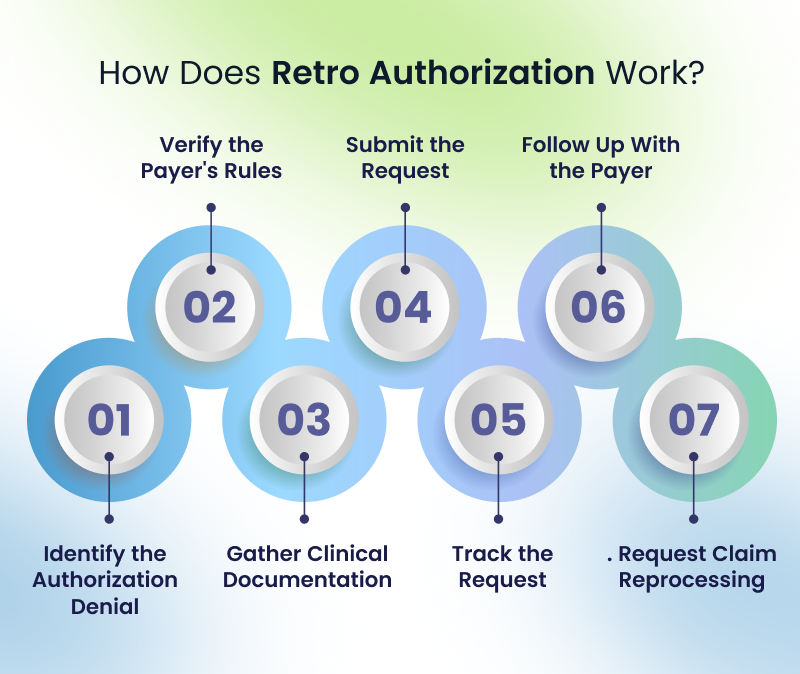
The exact process varies by payer, but most retro authorization workflows follow several stages.
1. Identify the Authorization Denial
The billing team reviews the EOB, ERA, denial code, or claim status.
The first question should be:
Did the payer deny the claim because the required authorization was missing?
Not every denial requires retro authorization.
2. Verify the Payer’s Rules
Before submitting anything, confirm whether the payer allows retrospective authorization for the specific service.
Some payers may permit retro requests under certain circumstances. Others may require a formal appeal instead.
3. Gather Clinical Documentation
The provider may need to submit information such as:
- Physician notes
- Treatment records
- Diagnosis information
- Procedure reports
- Orders
- Referral documentation
- Medical necessity records
- Treatment plans
- Discharge summaries
- Relevant diagnostic results
The documentation should support why the service was appropriate.
4. Submit the Request
The authorization team submits the retro request using the payer’s approved process.
Depending on the insurer, this may involve a payer portal, telephone request, fax, or another designated submission method.
5. Track the Request
Document:
- Submission date
- Authorization number
- Payer representative
- Reference number
- Requested service
- Dates of service
- Expected response
- Follow up date
6. Follow Up With the Payer
A pending authorization should not disappear into a queue.
The billing or authorization team should monitor the request and follow up according to the payer’s stated timeframe.
7. Request Claim Reprocessing
If the payer approves the retro authorization, the claim may still require additional action.
The provider may need to request:
- Claim reconsideration
- Claim reprocessing
- Corrected claim submission
- Denial reversal
- Appeal review
The exact next step depends on the payer.
Can a Claim Get Paid Without Retro Authorization?
Possibly, but it depends on the payer’s rules and the reason for the denial.
A payer may:
- Approve the retro authorization and reprocess the claim
- Approve the authorization but require a separate reconsideration
- Deny the retro authorization
- Allow an appeal instead
- Require additional documentation
- Maintain the original denial
That’s why billing staff shouldn’t assume that obtaining retro authorization automatically changes the claim’s payment status.
Does Retro Authorization Guarantee Payment?
No.
This is one of the most important points.
Retro authorization generally addresses the authorization requirement. It doesn’t necessarily resolve every other claim issue.
A claim could still deny because of:
- Incorrect coding
- Eligibility problems
- Noncovered services
- Medical necessity
- Timely filing
- Incorrect provider information
- Bundling
- Benefit limitations
- Missing documentation
For example, suppose a payer approves retro authorization for a physical therapy treatment. The claim could still deny because the patient’s benefit limit had already been reached.
Authorization and payment represent separate parts of the claims process.
Retro Authorization in Behavioral and Mental Health Billing
Retro authorization can become particularly important in behavioral health because treatment sometimes begins under urgent circumstances.
For example, a patient may require inpatient psychiatric treatment or another higher level of behavioral health care.
The facility may need to provide clinical information supporting:
- Diagnosis
- Symptoms
- Risk level
- Functional impairment
- Previous treatment
- Current treatment needs
- Level of care
- Treatment plan
The payer then determines whether the requested treatment meets its applicable authorization criteria.
Behavioral health providers should also pay close attention to authorization periods. An initial authorization may cover only a specific number of days or visits.
If treatment continues beyond the approved period, the provider may need concurrent review or continued stay authorization.
That is different from retro authorization.
Retro Authorization in Physical Therapy
Physical therapy practices can also encounter authorization problems.
For example, a payer may require authorization after a certain number of visits.
If the patient receives additional visits before the practice obtains the required authorization, the provider may face an authorization related denial.
If the payer permits retrospective review, the practice can investigate whether it can submit a retro authorization request.
The billing team should review:
- Number of visits
- Authorized units
- Dates of service
- Treatment notes
- Plan of care
- Medical necessity
- Payer specific requirements
The practice should not assume that the payer will approve additional visits simply because the treatment was clinically appropriate.
Retro Authorization in Medical Imaging
Imaging services frequently involve authorization requirements.
MRI, CT, PET, and certain other diagnostic services may require authorization depending on the payer and patient’s plan.
A missed authorization can result in a claim denial.
When this happens, the provider should determine:
- Whether authorization was actually required.
- Whether the service met the payer’s coverage criteria.
- Whether the payer allows retro authorization.
- Whether the request falls within the payer’s submission timeframe.
- What clinical documentation the payer requires.
If the payer doesn’t allow retro authorization, the provider may need to pursue another form of claim reconsideration or appeal.
Retro Authorization in Hospital Billing
Hospitals and facilities can encounter retro authorization issues during:
- Emergency admissions
- Inpatient stays
- Observation services
- Behavioral health admissions
- Surgical procedures
- Transfers between facilities
Hospital billing teams need to distinguish between notification requirements, authorization requirements, and continued stay reviews.
These processes aren’t interchangeable.
A hospital may notify a payer about an emergency admission but still need additional review for continued inpatient days.
Retro Authorization vs. Concurrent Authorization
These terms can cause confusion.
Retro authorization deals with services that have already occurred.
Concurrent authorization generally involves review while treatment continues.
For example:
- Retro authorization: The patient received treatment Monday, but authorization wasn’t obtained. The provider requests approval afterward.
- Concurrent review: The insurer approved five inpatient days, but the patient still needs treatment. The payer reviews the clinical information before approving additional days.
Understanding this difference helps billing and authorization teams route cases correctly.
What Happens If the Payer Denies Retro Authorization?
A denied retro authorization request doesn’t necessarily mean the provider has no options.
The next step depends on the payer’s rules.
Possible options include:
Claim Reconsideration
The provider can ask the payer to review the claim again.
Formal Appeal
The provider may submit an appeal with supporting clinical documentation.
Peer to Peer Review
For certain medical necessity disputes, a clinician may participate in a peer review with the payer.
Corrected Claim
If the payer identifies a claim submission problem rather than a coverage issue, a corrected claim may be appropriate.
Patient Responsibility Review
The provider should not automatically transfer a denied amount to the patient. The practice needs to review the payer contract, benefit terms, applicable regulations, and reason for denial before determining patient responsibility.
How Does Retro Authorization Affect the Revenue Cycle?
Retro authorization can influence several stages of the revenue cycle.
| RCM Stage | Impact |
| Scheduling | Identifies authorization requirements |
| Eligibility | Confirms active coverage |
| Authorization | Determines whether payer approval exists |
| Coding | Supports correct service reporting |
| Claim submission | Includes applicable authorization information |
| Payment posting | Identifies authorization related denials |
| Denial management | Initiates retro authorization or appeal |
| AR management | Tracks unresolved balances |
| Reporting | Identifies recurring authorization failures |
A practice that repeatedly requests retro authorization should investigate the root cause.
If the same payer generates frequent authorization denials, the problem may involve the scheduling workflow, payer policy knowledge, staff training, or communication between departments.
How Much Does Retro Authorization Cost?
There isn’t one universal cost.
The financial impact depends on:
- Staff time
- Clinical documentation requirements
- Payer processes
- Service value
- Number of claims affected
- Appeal requirements
- External billing support
The larger concern often involves lost or delayed reimbursement.
A $20,000 procedure that receives an authorization denial can create a much larger financial problem than the administrative cost of submitting the retro request.
That’s why practices should track authorization related denials as a revenue cycle KPI.
How to Improve Retro Authorization Success
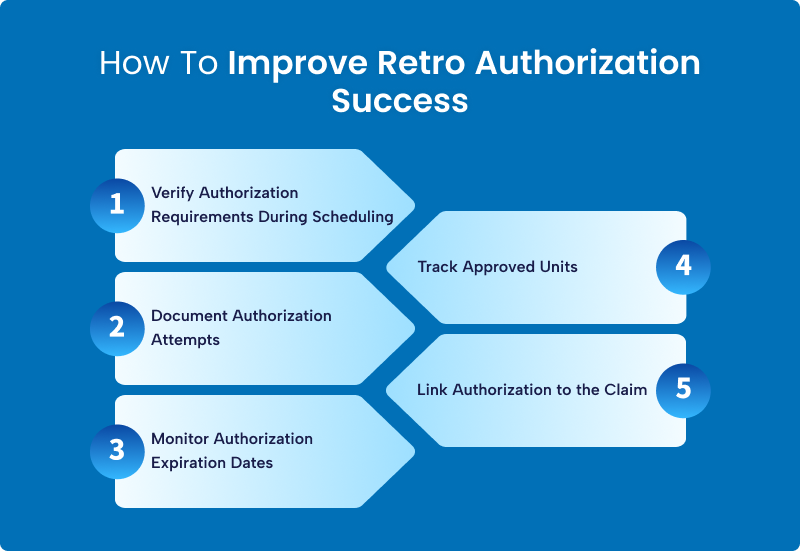
Providers can reduce authorization related revenue loss by building a strong front end authorization workflow.
Verify Authorization Requirements During Scheduling
Don’t wait until claim submission to discover that authorization was required.
Document Authorization Attempts
If staff attempted to obtain authorization but experienced a payer issue, document:
- Date and time
- Payer representative
- Reference number
- Portal issue
- Phone interaction
- Instructions received
This documentation can become useful during a retro authorization request or appeal.
Monitor Authorization Expiration Dates
An authorization may cover a specific date range, number of visits, or number of services.
Track Approved Units
A payer may authorize 12 therapy visits, but the patient may receive 15. The additional visits can create authorization related problems.
Link Authorization to the Claim
Make sure the authorization number and approved service information reach the billing team.
Bottom Line
Retro authorization is a payer’s retrospective approval of a healthcare service that occurred before the authorization was obtained.
It can provide a path to resolving certain authorization related denials, particularly when the payer allows retrospective review because of emergencies, urgent treatment, system problems, or other qualifying circumstances.
However, retro authorization isn’t the same as guaranteed reimbursement.
The safest approach remains obtaining prior authorization whenever the payer requires it. When that doesn’t happen, act quickly, check the payer’s specific retro authorization rules, gather strong clinical documentation, and track the request through claim reprocessing or appeal.
Turn Retro Authorization Denials into Recovered Revenue
A missed authorization doesn’t have to become a permanent revenue loss. Medivantek Billing helps healthcare practices manage authorization related denials, retro authorization requests, claim reconsiderations, and payer follow up with a structured revenue cycle process.
Our team can help you:
- Identify claims denied for missing authorization
- Verify payer specific retro authorization requirements
- Organize clinical documentation for submission
- Track authorization requests and payer responses
- Manage claim reconsiderations and reprocessing
- Follow up on unresolved accounts and aging AR
- Identify recurring authorization problems in your workflow
Don’t let preventable authorization denials keep your practice’s money tied up.
Contact Medivantek Billing today
FAQs
What does retro authorization mean?
Retro authorization means requesting insurance approval after a healthcare service has already been provided. It differs from prior authorization, which occurs before treatment. Payers may allow retro authorization in certain circumstances, but their rules vary.
Can you get prior authorization after a procedure?
You may be able to obtain retroactive authorization, but you cannot assume the payer will approve it. The insurer must permit retrospective requests for the service, and the provider may need to demonstrate medical necessity and meet specific documentation and timing requirements.
Is retro authorization the same as an appeal?
No.
A retro authorization request asks the payer to approve a service after it occurred.
An appeal asks the payer to reconsider a decision it has already made.
Sometimes a provider may need both. For example, the payer may approve retro authorization but still require the provider to appeal or request reprocessing of the original denied claim.
Can a provider bill a patient when insurance denies for no authorization?
Not automatically.
The provider should review the patient’s plan, payer contract, applicable laws, denial reason, and financial responsibility rules before billing the patient. A provider’s failure to obtain required authorization doesn’t automatically mean the patient becomes responsible for the full charge.
How long does retro authorization take?
There isn’t one universal timeframe. The turnaround time depends on the payer, service, urgency, submission method, clinical review requirements, and whether additional information is requested.
Always ask the payer for the expected decision timeframe and document the reference number.
What information is needed for retro authorization?
Requirements vary, but a payer may request the patient’s diagnosis, clinical notes, treatment records, physician order, procedure information, medical necessity documentation, dates of service, and provider details.
Can Medicare allow retroactive authorization?
Medicare rules differ from commercial payer authorization processes. Providers should identify the specific Medicare program, service, contractor requirements, and applicable coverage rules rather than assuming that a commercial payer’s retro authorization policy applies to Medicare.
What is a retro authorization number?
A retro authorization number is the reference or authorization identifier issued by the payer after it approves a retrospective request. The provider should record it and follow the payer’s instructions for attaching or communicating it to the related claim.
