

Medical debt remains a major concern for healthcare providers, hospitals, and medical practices across the United States. As policymakers, regulators, and consumer advocates continue to examine medical debt, providers face an important question: How could medical debt legislation and related policy changes affect billing, collections, financial assistance, and revenue cycle management?
The term Medical Debt Forgiveness Act often creates confusion because no single federal law currently provides universal medical debt forgiveness for patients or automatically eliminates outstanding healthcare balances. Instead, the discussion includes proposed federal legislation, credit reporting policies, state laws, financial assistance requirements, and changing rules around medical debt collection.
For healthcare organizations, this issue goes beyond whether a patient pays a bill.
It affects how your practice verifies insurance, processes claim, handles denials, communicates patient responsibility, offers financial assistance, manages accounts receivable, and works with collection agencies.
Providers that understand these changes can build better billing workflows, reduce avoidable patient balances, and manage collections with greater attention to applicable federal and state requirements.
This guide explains medical debt legislation, financial assistance, credit reporting, and the practical steps that can help protect both patient relationships and revenue.
What Is the Medical Debt Forgiveness Act?
The phrase Medical Debt Forgiveness Act does not currently refer to one universal federal law that automatically cancels medical debt for patients.
The term often appears in discussions about proposed legislation and broader efforts to address medical debt.
For providers, the distinction matters.
Medical debt policy can address several separate issues, including:
- Whether providers or debt collectors can report medical debt to consumer reporting agencies.
- How creditors and collection agencies handle medical accounts.
- How nonprofit hospitals administer financial assistance.
- How states regulate medical debt collection.
- How healthcare organizations communicate patient financial responsibility.
- How providers handle unpaid balances before sending accounts to collections.
A proposal that restricts medical debt reporting does not necessarily forgive the underlying debt.
Likewise, a financial assistance policy that reduces a patient’s balance does not mean that every patient qualifies for free care.
Healthcare organizations should therefore avoid treating “medical debt forgiveness” as a single policy with one set of rules.
Instead, providers should monitor the specific laws and regulations that apply to their organization, location, payer mix, and collection practices.
What Is the Medical Debt Relief Act of 2025?
One federal proposal that healthcare providers should understand is the Medical Debt Relief Act of 2025.
The legislation was introduced as S. 2519 during the 119th Congress. The proposal seeks to amend the Fair Credit Reporting Act to prohibit medical debt from appearing on consumer reports.
The proposal focuses primarily on credit reporting rather than automatic cancellation of medical debt.
That distinction matters for medical practices.
If legislation restricts medical debt reporting, the underlying patient balance may still exist. A provider may still need to manage the account, communicate with the patient, offer applicable financial assistance, and follow relevant collection rules.
Healthcare organizations should therefore avoid assuming that credit reporting restrictions eliminate their obligation to maintain accurate billing records or manage accounts receivable.
Because proposed legislation can change during the legislative process, providers should verify the current status of any bill through official government sources before changing their billing or collection policies.
Did the CFPB Medical Debt Rule Take Effect?
Healthcare providers should also understand the history of the Consumer Financial Protection Bureau’s medical debt rule.
In January 2025, the CFPB finalized a rule that would have restricted creditors from considering certain medical information related to consumer credit decisions and would have restricted consumer reporting agencies from including medical debt information in credit reports.
However, the U.S. District Court for the Eastern District of Texas vacated the rule on July 11, 2025.
The CFPB now identifies the rule as vacated and states that the court concluded the rule exceeded the agency’s statutory authority under the Fair Credit Reporting Act.
For providers, this creates an important compliance lesson:
Do not build a billing or collection policy around an outdated federal rule.
Medical practices should review current federal requirements, state laws, payer requirements, and applicable contractual obligations before changing how they manage medical debt.
Providers should also monitor developments because medical debt remains an active policy issue.
Why Medical Debt Matters to Healthcare Providers
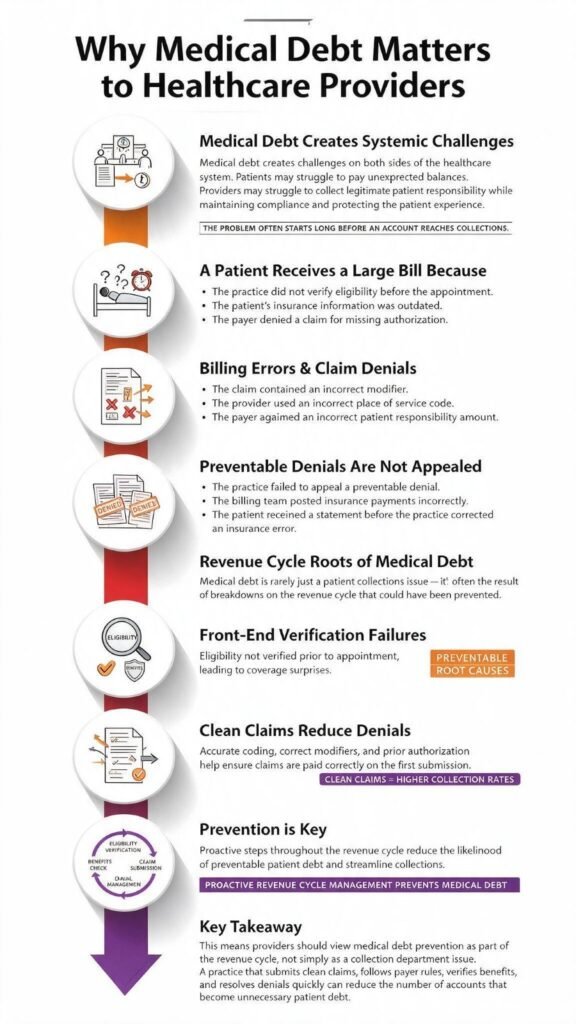
Medical debt creates challenges on both sides of the healthcare system.
Patients may struggle to pay unexpected balances.
Providers may struggle to collect legitimate patient responsibility while maintaining compliance and protecting the patient experience.
The problem often starts long before an account reaches collections.
A patient may receive a large bill because:
- The practice did not verify eligibility before the appointment.
- The patient’s insurance information was outdated.
- The payer denied a claim for missing authorization.
- The claim contained an incorrect modifier.
- The provider used an incorrect place of service code.
- The payer assigned an incorrect patient responsibility amount.
- The practice failed to appeal a preventable denial.
- The billing team posted insurance payments incorrectly.
- The patient received a statement before the practice corrected an insurance error.
This means providers should view medical debt prevention as part of the revenue cycle, not simply as a collection department issue.
A practice that submits clean claims, follows payer rules, verifies benefits, and resolves denials quickly can reduce the number of accounts that become unnecessary patient debt.
Medical Debt Often Starts With a Billing Problem
Consider a simple example.
A physician performs a procedure that generates a $5,000 claim.
The patient’s insurance should cover most of the allowed amount.
The patient’s expected responsibility equals $500.
However, the billing team submits the claim with an incorrect member ID.
The payer rejects the claim.
The practice’s billing system later sends the patient a statement showing $5,000.
The patient cannot afford the balance and ignores the bill.
The account eventually moves into collections.
The practice now faces a medical debt problem that began with an eligibility or claim submission error.
The patient may never have owed $5,000.
This example demonstrates why healthcare providers should focus on accurate patient responsibility before pursuing collections.
Before sending an account to collections, practices should confirm that:
- The claim processed correctly.
- The payer applied the correct benefits.
- The provider received the expected insurance payment.
- The patient’s deductible and coinsurance amounts match the EOB.
- The practice posted payments correctly.
- The account contains no duplicate charges.
- Any applicable claim appeal or correction process has ended.
- The patient received an accurate statement.
A strong revenue cycle process can prevent billing errors from becoming patient debt.
How Medical Practices Can Reduce Unnecessary Patient Debt
Medical practices cannot eliminate every unpaid balance.
However, they can reduce avoidable medical debt by strengthening front-end and back-end billing processes.
Verify Insurance Eligibility Before Services
Eligibility verification allows your team to identify coverage problems before the patient receives care.
Your process should confirm, when applicable:
- Active coverage.
- Member status.
- Deductible.
- Coinsurance.
- Copayment.
- Out of pocket maximum.
- Network status.
- Benefit limitations.
- Referral requirements.
- Prior authorization requirements.
Practices should document verification results and communicate expected patient responsibility clearly.
Eligibility verification does not guarantee payment, but it helps reduce surprises.
Perform Accurate Benefits Verification
Eligibility alone does not tell you everything about a patient’s financial responsibility.
Benefits verification can provide additional information about coverage for specific services.
For example, a behavioral health practice may need to verify outpatient mental health benefits before providing treatment.
A physical therapy practice may need to confirm visit limits.
A surgical practice may need to review authorization and network requirements.
The more complex the service, the more important detailed benefits verification becomes.
Obtain Prior Authorization When Required
A denied claim can quickly become a patient balance.
Before providing services that require authorization, verify the payer’s requirements and obtain the necessary approval.
Your team should document:
- Authorization number.
- Approved service.
- Approved number of units or visits.
- Effective dates.
- Rendering provider.
- Facility or location.
- Payer reference information.
If the provider changes the service or treatment plan, check whether the authorization needs an update.
Submit Clean Claims
Clean claims reduce delays and prevent avoidable patient balances.
Your billing team should review:
- Patient demographics.
- Insurance information.
- Member ID.
- Group number.
- Provider NPI.
- Tax ID.
- Billing NPI.
- Rendering provider.
- CPT codes.
- HCPCS codes.
- ICD 10 CM diagnosis codes.
- Modifiers.
- Place of service.
- Authorization information.
Even a small data error can delay payment.
Manage Denials Before Billing the Patient
A denied claim does not automatically mean the patient owes the balance.
Providers should determine why the payer denied the claim.
The denial may involve:
- Incorrect coding.
- Missing documentation.
- Authorization.
- Eligibility.
- Timely filing.
- Medical necessity.
- Duplicate billing.
- Coordination of benefits.
- Noncovered services.
- Incorrect provider information.
Your billing team should determine whether the practice can correct or appeal the claim before transferring responsibility to the patient.
This step can prevent many avoidable patient balances.
Financial Assistance Policies and Medical Debt
Financial assistance represents one of the most important areas for healthcare organizations to understand.
For tax exempt hospitals covered by Section 501(r), federal requirements apply to financial assistance policies, limitations on charges, and billing and collection practices.
The IRS states that qualifying hospital organizations must establish a written Financial Assistance Policy, or FAP, and a written emergency medical care policy. The FAP must cover emergency and medically necessary care and include eligibility criteria, the basis for calculating charges, and the application process.
These requirements apply specifically to qualifying tax exempt hospital organizations.
That distinction matters.
A physician owned medical practice does not automatically face the same Section 501(r) requirements simply because it provides medical services.
However, other federal and state laws, contracts, payer rules, and organizational policies may still affect how the practice handles financial assistance and collections.
Healthcare organizations should therefore determine which rules actually apply to their structure.
What Section 501(r) Means for Tax Exempt Hospitals
Tax exempt hospitals face specific requirements under Section 501(r).
These include:
- Conducting a community health needs assessment.
- Maintaining a written financial assistance policy.
- Maintaining an emergency medical care policy.
- Limiting charges for FAP eligible patients.
- Following specific billing and collection requirements.
The IRS explains that hospitals must limit amounts charged to FAP eligible individuals for emergency or medically necessary care to no more than the amounts generally billed to individuals with insurance covering that care. Hospitals also cannot use gross charges as the basis for charging FAP eligible patients for covered care.
For hospital revenue cycle teams, this means financial assistance cannot operate as an informal discount program without documented policies and procedures.
Your organization should clearly define:
- Who qualifies.
- Which services qualify.
- How the organization calculates patient charges.
- How patients apply.
- What documentation patients must provide.
- How staff review applications.
- How the organization handles presumptive eligibility.
- How billing and collections staff receive updates.
- How the organization handles accounts already placed with third parties.
The IRS also requires qualifying hospital facilities to widely publicize their Financial Assistance Policies and make the policy, application, and plain language summary available through specified channels.
Medical Debt Collections: What Providers Need to Review
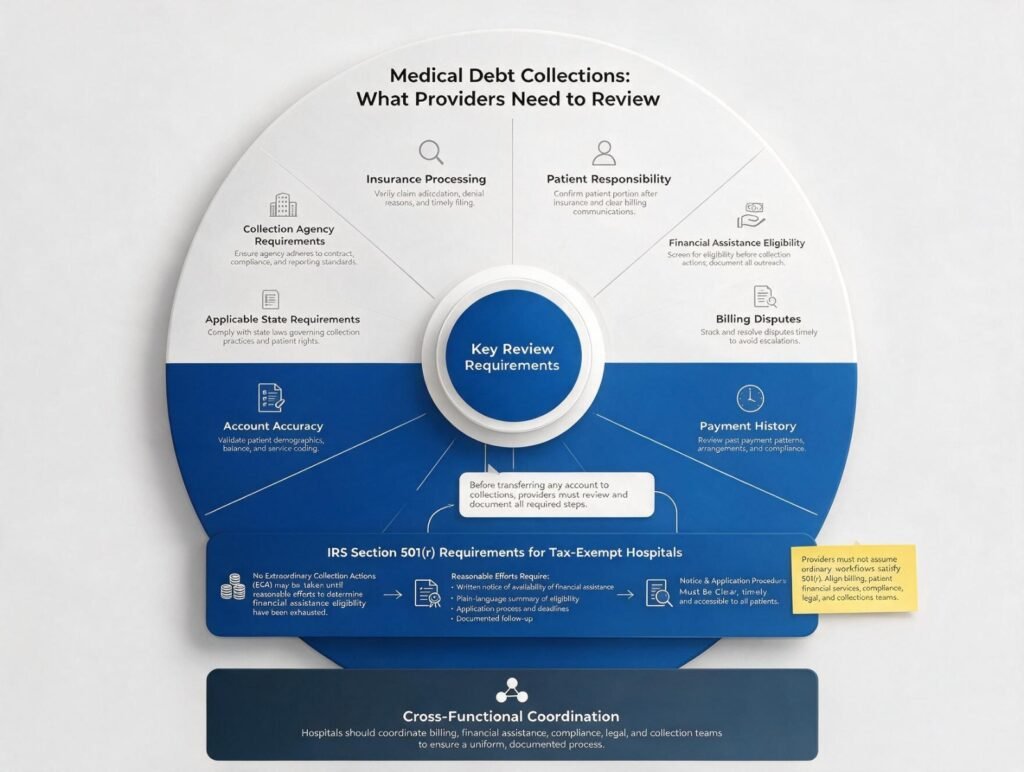
Medical practices should review their collection processes regularly.
This becomes especially important when an organization uses an outside collection agency.
Before transferring an account, providers should have a documented process for reviewing:
- Insurance processing.
- Patient responsibility.
- Financial assistance eligibility.
- Billing disputes.
- Payment history.
- Account accuracy.
- Applicable state requirements.
- Collection agency requirements.
For tax-exempt hospitals subject to Section 501(r), the IRS classifies certain actions as extraordinary collection actions, including selling an individual’s debt, reporting adverse information to consumer reporting agencies, initiating certain legal processes, and other specified actions.
The IRS requires qualifying hospitals to make reasonable efforts to determine whether a person qualifies for financial assistance before taking extraordinary collection actions. The rules also establish specific notice and application procedures.
This area requires careful attention.
A provider should not assume that its ordinary collection workflow automatically satisfies Section 501(r) requirements.
Hospitals should coordinate billing, financial assistance, compliance, legal, and collection teams so everyone follows the same documented process.
What Happens When a Patient Applies for Financial Assistance?
For organizations subject to Section 501(r), the process requires careful account management.
If a patient submits a complete financial assistance application during the applicable period, the hospital must follow specific requirements.
According to IRS guidance, the hospital must suspend applicable extraordinary collection actions, determine eligibility, and notify the patient in writing of the determination and its basis. If the patient qualifies for free care, the hospital must notify the patient that nothing more is owed. If the patient qualifies for discounted care, the hospital must provide information about the amount owed and how the organization determined that amount.
This creates a practical revenue cycle requirement:
Your billing system and collection workflow should identify financial assistance applications quickly.
If a patient submits an application, the account should not continue through an automated collection workflow without appropriate review.
Credit Reporting
Medical debt credit reporting remains a changing area.
The CFPB’s 2025 medical debt rule was vacated in July 2025, so providers should not rely on that rule as an active nationwide prohibition.
The CFPB currently states that the rule was vacated and that the FCRA permits certain medical debt information to be furnished and considered under applicable requirements.
At the same time, credit reporting companies have adopted voluntary policies concerning certain medical collections.
Providers should therefore avoid making assumptions about what they can report or when they can report it.
Instead, review:
- Current federal requirements.
- Applicable state laws.
- Credit reporting policies.
- Collection agency contracts.
- Patient financial assistance requirements.
- Internal compliance policies.
If your practice reports medical debt directly or works with a third party that does, involve qualified compliance or legal counsel when necessary.
How the Medical Debt Debate Could Affect Revenue Cycle Management
The medical debt debate may influence how providers approach patient collections.
Revenue cycle teams should prepare for continued scrutiny of:
- Patient financial responsibility.
- Collection practices.
- Medical debt reporting.
- Financial assistance.
- Billing transparency.
- Debt sales.
- Third party collection agencies.
The best response does not involve simply collecting faster.
It involves improving the entire revenue cycle.
A strong process should move through:
Eligibility verification → Benefits verification → Authorization → Accurate coding → Clean claim submission → Denial management → Payment posting → Patient statement → Financial assistance review → Appropriate collections
Each stage affects the next.
If the front end performs poorly, the back end often inherits the problem.
Medical Debt and the Importance of Accurate Patient Responsibility
One of the most important lessons for providers involves the difference between a patient balance and a valid patient responsibility amount.
A patient balance becomes problematic when the practice bills the patient before confirming that the amount reflects the payer’s final adjudication.
For example, if the payer has not processed the claim, the practice should not automatically treat the full billed charge as the patient’s responsibility.
The billing team should review the claim status.
If the payer denied the claim, the team should determine whether the practice should correct or appeal the denial.
If the payer processed the claim, the team should compare the EOB with the patient account.
This process can reduce unnecessary billing disputes and help patients understand what they actually owe.
What Medical Practices Should Do Now
Healthcare providers should take several practical steps to prepare for changes in medical debt policy.
Audit Your Patient Billing Workflow
Review how your practice moves an account from insurance billing to patient billing and eventually to collections.
Identify where errors can occur.
Look specifically at:
- Eligibility.
- Benefits.
- Authorization.
- Claim submission.
- Denials.
- Payment posting.
- Patient statements.
- Financial assistance.
- Collection placement.
Review Your Collection Agency Agreements
If you use an outside collection agency, review the agreement and workflow.
Confirm who handles:
- Patient disputes.
- Financial assistance applications.
- Credit reporting.
- Account recalls.
- Insurance corrections.
- Payment arrangements.
Make sure your practice knows what happens when a patient disputes an account after the agency receives it.
Review State Requirements
Medical debt laws can vary by state.
A provider operating in multiple states should not assume that one collection policy works everywhere.
Review applicable requirements concerning:
- Medical debt collection.
- Credit reporting.
- Interest.
- Patient statements.
- Financial assistance.
- Debt lawsuits.
- Wage garnishment.
- Collection notices.
When necessary, seek advice from qualified healthcare counsel.
Strengthen Denial Management
Denial management can directly affect medical debt.
The faster your team resolves preventable denials, the less likely your practice will transfer incorrect balances to patients.
Track denial trends by:
- Payer.
- CPT code.
- Provider.
- Location.
- Denial reason.
- Service line.
Then address the root cause.
Improve Patient Financial Communication
Patients often struggle to understand medical bills.
Your statements should clearly identify:
- Date of service.
- Service description.
- Insurance payment.
- Adjustments.
- Patient responsibility.
- Payment options.
- Contact information.
Clear communication can reduce disputes and help patients resolve balances before accounts become seriously delinquent.
A Medical Debt Compliance Checklist for Healthcare Providers
Use this checklist as a starting point for reviewing your current process.
Billing Accuracy
- Verify insurance eligibility.
- Confirm benefits.
- Obtain required authorizations.
- Submit accurate claims.
- Correct rejected claims quickly.
- Review payer denials.
- Appeal appropriate claims.
- Post payments accurately.
Patient Responsibility
- Wait for appropriate insurance adjudication.
- Compare patient balances with EOB information.
- Investigate disputed balances.
- Correct billing errors.
- Provide clear statements.
Financial Assistance
- Determine whether your organization must maintain a Financial Assistance Policy.
- Keep applicable policies current.
- Train staff on eligibility requirements.
- Make required financial assistance information available.
- Establish a process for reviewing applications.
- Coordinate financial assistance with billing and collections.
Collections
- Review accounts before collection placement.
- Confirm that the balance is accurate.
- Follow applicable federal and state laws.
- Monitor collection agency activity.
- Establish a process for account recalls.
- Document patient disputes.
Compliance
- Monitor federal medical debt developments.
- Monitor state laws.
- Review credit reporting requirements.
- Review collection contracts.
- Involve compliance and legal professionals when necessary.
FAQs
Is there a federal Medical Debt Forgiveness Act that requires providers to erase patient balances?
No single federal law currently requires all healthcare providers to forgive medical debt.
The phrase often refers to proposed legislation or broader policy discussions surrounding medical debt.
Providers should verify the current status of specific legislation before changing billing or collection policies.
Does the Medical Debt Relief Act of 2025 cancel patient medical debt?
The proposed Medical Debt Relief Act of 2025 focuses on medical debt reporting rather than universal cancellation of the underlying debt.
Healthcare providers should distinguish between credit reporting restrictions and actual debt forgiveness.
Did the CFPB ban medical debt from credit reports?
The CFPB issued a medical debt rule in January 2025, but a federal court vacated the rule on July 11, 2025. The CFPB now identifies the rule as vacated.
Providers should review current federal and state requirements before making decisions about medical debt reporting.
Does Section 501(r) apply to every medical practice?
No.
Section 501(r) imposes specific requirements on organizations described under Section 501(c)(3) that operate hospital facilities.
A private physician practice does not automatically become subject to Section 501(r) simply because it provides healthcare services.
However, other federal laws, state requirements, payer contracts, and organizational policies may apply.
What must a tax-exempt hospital include in its Financial Assistance Policy?
A qualifying hospital’s Financial Assistance Policy must address eligibility criteria, whether the organization provides free or discounted care, how it calculates amounts charged to eligible patients, and how patients can apply.
The policy must also meet specific requirements for public availability and communication.
Can a hospital send medical debt to collections?
Potentially, yes, but tax-exempt hospitals subject to Section 501(r) must follow specific requirements before taking extraordinary collection actions.
The IRS requires qualifying hospitals to make reasonable efforts to determine whether an individual qualifies for financial assistance before taking certain extraordinary collection actions.
State law and other applicable requirements may also affect collection practices.
Can healthcare providers sell medical debt?
Debt sales can create additional compliance considerations.
For hospitals subject to Section 501(r), the IRS generally treats selling an individual’s debt as an extraordinary collection action. Specific requirements apply, and a hospital may need to take reasonable steps to determine financial assistance eligibility before proceeding. Certain written agreements with debt purchasers can affect how the rules apply.
Providers should obtain qualified legal or compliance guidance before changing debt sale practices.
How can medical billing companies help providers manage medical debt risk?
A qualified medical billing company can help providers strengthen the revenue cycle before an account becomes a patient debt problem.
Depending on the service arrangement, support may include eligibility verification, benefits verification, medical coding, claim submission, denial management, payment posting, accounts receivable follow up, patient billing support, and reporting.
The right billing partner should help identify problems at their source rather than simply focus on collecting unpaid balances.
Final Thoughts
The discussion around the Medical Debt Forgiveness Act reflects a much larger issue facing healthcare providers.
Patients want affordable and transparent healthcare.
Providers need reliable reimbursement to keep their practices running.
Medical practices therefore need a billing process that protects both sides.
For providers, the best response to changing medical debt policies involves more than watching Congress or waiting for new regulations.
Don’t wait for medical debt policy to force your practice to rethink its billing process.
Let Medivantek Medical Billing help you identify revenue leaks, reduce avoidable denials, and build a cleaner path from patient visit to final payment.
Contact Medivantek Medical Billing today
