
ICD-10-CM Z01.818 represents Encounter for other preprocedural examination. Providers use this code when a patient receives an evaluation before a planned surgery or procedure and the examination does not fall into a more specific preprocedural category, such as cardiovascular, respiratory, or laboratory examination.
For medical practices, hospitals, ambulatory surgery centers, and billing teams, the key point is simple: Z01.818 describes the purpose of the encounter, not the condition that led to the upcoming procedure. Coders often need to report an additional diagnosis that explains why the patient will undergo the procedure.
The current ICD-10-CM code set remains date-specific. CMS lists the FY 2027 ICD-10-CM files for encounters from October 1, 2026 through September 30, 2027.
What Is ICD 10 CM Z01.818?
Z01.818, Encounter for other preprocedural examination, belongs to category Z01, Encounter for other special examination without complaint, suspected or reported diagnosis.
The code applies when the provider evaluates a patient before a planned procedure or surgery and the encounter does not qualify for one of the more specific preprocedural examination codes.
The preprocedural examination may involve reviewing the patient’s medical history, performing a physical examination, reviewing medications, assessing surgical risk, or evaluating available diagnostic information.
The purpose of the visit matters more than the patient’s general health status.
For example, a patient with hypertension who visits a primary care provider specifically for clearance before cataract surgery may receive Z01.818 as the first listed diagnosis when the encounter represents a general preprocedural evaluation.
The hypertension can appear as an additional diagnosis when the provider documents it as relevant to the evaluation.
Z01.818 Code Details
| Coding element | Details |
| ICD 10 CM code | Z01.818 |
| Official description | Encounter for other preprocedural examination |
| Category | Z01 |
| Code type | Z code |
| Encounter purpose | Preprocedural or preoperative evaluation |
| Typical setting | Physician office, hospital outpatient department, specialty practice, surgical facility |
| Primary use | General preprocedural examination that does not fit a more specific Z01.81 code |
CMS’s ICD 10 CM materials list Z01.810 for cardiovascular examination, Z01.811 for respiratory examination, Z01.812 for laboratory examination, and Z01.818 for other preprocedural examination.
That distinction matters during coding because medical coders should not automatically select Z01.818 whenever a patient receives testing before surgery.
When Should You Use Z01.818?
Use Z01.818 when the medical record supports a preprocedural examination and the service does not belong to a more specific preprocedural examination category.
Common examples include:
- General medical clearance before surgery
- Preoperative physical examination
- Evaluation before an invasive procedure
- Medical assessment before an orthopedic procedure
- Examination before cataract surgery
- Preprocedural assessment before certain gastrointestinal procedures
- General clearance before an elective surgical procedure
- Evaluation requested by a surgeon before an upcoming procedure
The provider should clearly document why the patient came for the visit.
A note that simply says “follow up” or “physical examination” may not adequately support Z01.818.
The documentation should connect the examination to the planned procedure.
Example
A patient has symptomatic gallstones and plans to undergo cholecystectomy.
The surgeon asks the patient’s primary care provider to perform a preoperative medical evaluation.
The primary care provider reviews the medical history, medications, cardiovascular risk, physical findings, and available laboratory results.
The provider documents that the patient presents for preoperative evaluation before cholecystectomy.
In this situation, Z01.818 can describe the preprocedural examination.
The diagnosis for the condition prompting the surgery, such as documented gallbladder disease, can also be reported when appropriate.
The ICD-10-CM guidelines instruct coders to sequence a code from Z01.81, which includes Z01.818, first when the encounter provides a preoperative evaluation only. The condition responsible for the planned surgery should appear as an additional diagnosis.
When Should You Not Use Z01.818?
Z01.818 does not fit every visit that happens before a procedure.
The most common mistake involves confusing a preprocedural examination with treatment of an active condition.
Suppose a patient scheduled for surgery visits the physician because their blood pressure remains uncontrolled. The provider spends the visit evaluating and treating the hypertension rather than performing a preoperative examination.
The coder should not automatically assign Z01.818 simply because surgery appears in the patient’s future.
The actual reason for the encounter should drive diagnosis selection.
The official guidelines state that preoperative and preprocedural examination Z codes apply when the patient receives clearance for a procedure or surgery and no treatment occurs for a condition during that examination.
This distinction can affect both coding accuracy and claim payment.
Z01.818 vs Other Preprocedural Codes
Z01.818 sits within a group of related codes. Choosing the right one requires looking at what type of examination the provider actually performed.
Z01.810
Z01.810, Encounter for preprocedural cardiovascular examination
Use this code when the encounter specifically involves a cardiovascular preprocedural evaluation.
For example, a cardiologist evaluates a patient before major surgery because the surgical team needs a cardiovascular assessment.
Z01.811
Z01.811, Encounter for preprocedural respiratory examination
This code applies to a respiratory focused preprocedural examination.
A pulmonologist may use it when evaluating pulmonary status before a planned procedure.
Z01.812
Z01.812, Encounter for preprocedural laboratory examination
This code applies to encounters involving preprocedural laboratory examination.
It should not replace a general medical preoperative examination merely because laboratory testing occurs during the visit.
Z01.818
Z01.818, Encounter for other preprocedural examination
Use Z01.818 when the examination serves a preprocedural purpose but does not fall into the cardiovascular, respiratory, or laboratory categories.
The distinction becomes especially important when multiple services occur as part of surgical preparation.
Z01.818 and the Reason for Surgery
One of the most important coding rules involves the diagnosis that explains the planned procedure.
Z01.818 tells the payer:
- The patient came for a preprocedural examination.
- It does not tell the payer why the patient needs the procedure.
- The medical record may therefore support another diagnosis that identifies the condition responsible for the upcoming surgery.
Example
A patient needs knee replacement because of documented primary osteoarthritis of the knee.
The patient’s primary care provider performs a general preoperative evaluation before the scheduled replacement.
The claim may include:
- First listed: Z01.818, preprocedural examination
- Additional diagnosis: The documented osteoarthritis code that explains the planned surgery
The exact secondary code depends on the provider’s documentation, anatomical site, laterality, and diagnosis.
Do not select a disease code simply because it appears somewhere in the patient’s history. The medical record must support its relevance to the encounter.
Can Z01.818 Be the Primary Diagnosis?
Yes.
For an encounter performed specifically for a preoperative evaluation, Z01.818 can serve as the first listed diagnosis when it accurately represents the service.
The official outpatient coding guidelines specifically instruct coders to sequence a code from Z01.81 first for patients receiving preoperative evaluations only. The condition responsible for the surgery follows as an additional diagnosis.
This rule becomes important when practices submit claims for preoperative consultations.
Example
A patient presents to an internist for medical clearance before an elective hernia repair.
The provider performs:
- Medical history review
- Physical examination
- Medication review
- Surgical risk assessment
- Review of relevant test results
- Preoperative recommendations
If the provider documents the encounter as a preoperative evaluation and does not treat another condition as the main purpose of the visit, Z01.818 can serve as the first listed diagnosis.
Z01.818 With an Underlying Condition
Coders often need to report both the preprocedural examination and the condition associated with the upcoming procedure.
For example:
- Patient: Scheduled for cataract surgery
- Visit: Medical preoperative examination
- Possible coding approach: Z01.818 plus the documented cataract diagnosis
The second diagnosis provides clinical context for the planned procedure.
However, the coder should use the diagnosis documented by the provider. Do not infer the surgical indication from the procedure name alone.
Z01.818 and Abnormal Findings
A preprocedural examination may uncover an abnormal finding.
The coder should not simply ignore that finding.
The official guidelines allow additional codes for findings related to the preoperative evaluation.
For example, a patient presents for preoperative clearance and the provider discovers an abnormal cardiac finding.
If the provider evaluates or documents the finding, the appropriate diagnosis may need to appear in addition to Z01.818.
The exact code depends on what the provider documents.
Suppose the provider identifies an abnormal ECG and postpones surgery pending cardiology evaluation.
The claim should accurately reflect the documented clinical situation.
Do not report an unspecified abnormality when the provider establishes a more specific diagnosis.
Z01.818 and Preprocedural Testing
Preoperative encounters frequently involve laboratory work, imaging, ECGs, or other diagnostic testing.
This creates a common coding problem.
A practice may assume that every test performed before surgery should carry Z01.818.
That approach can produce inaccurate claims.
The diagnosis should support the specific service being billed.
For example, CMS coverage guidance for certain vascular studies specifically identifies Z01.818 as a primary diagnosis in defined preprocedural situations and requires additional diagnoses to identify the reason for the study or relevant findings.
Therefore, coders should check the applicable payer policy, National Coverage Determination, Local Coverage Determination, and billing instructions when a diagnostic test accompanies a preprocedural encounter.
Z01.818 for Medical Clearance
“Medical clearance” appears frequently in clinical documentation.
However, coders should not rely on the phrase alone.
A strong note should explain:
- Why the patient needs the examination
- What procedure the patient plans to undergo
- When the procedure will occur, when known
- What medical history the provider reviewed
- What examination the provider performed
- What risks the provider assessed
- What relevant test results the provider reviewed
- Whether the provider identified conditions that require additional evaluation
- Whether the provider provided recommendations regarding the planned procedure
This documentation gives the coder a clear connection between the visit and Z01.818.
Documentation Requirements for Z01.818
Good documentation helps the billing team defend the diagnosis during payer review.
A preprocedural note should ideally contain a clear statement such as:
“Patient presents today for preoperative medical evaluation before scheduled surgical procedure.”
The provider should then document the actual work performed.
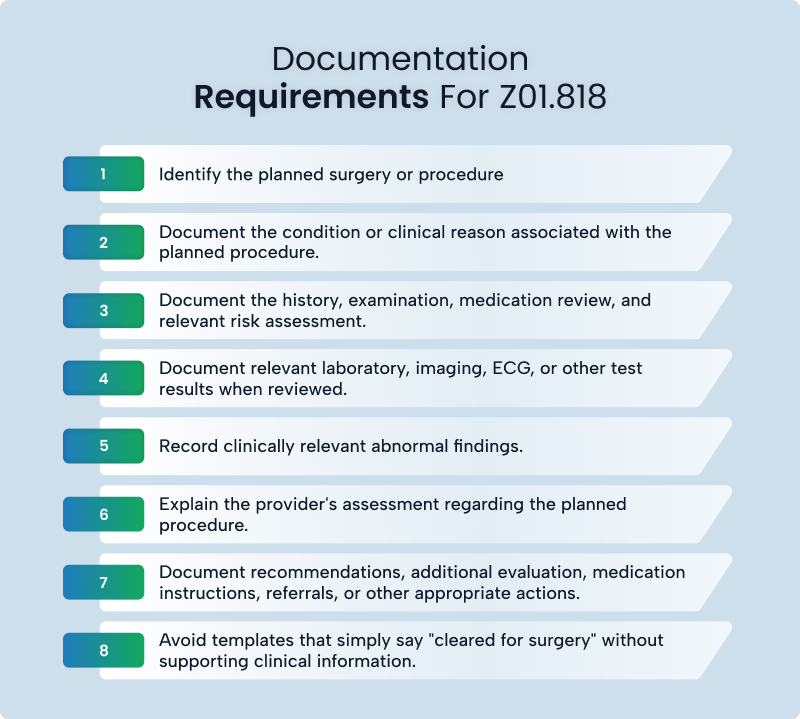
A useful documentation is to:
- Identify the planned surgery or procedure.
- Document the condition or clinical reason associated with the planned procedure.
- Document the history, examination, medication review, and relevant risk assessment.
- Document relevant laboratory, imaging, ECG, or other test results when reviewed.
- Record clinically relevant abnormal findings.
- Explain the provider’s assessment regarding the planned procedure.
- Document recommendations, additional evaluation, medication instructions, referrals, or other appropriate actions.
- Avoid templates that simply say “cleared for surgery” without supporting clinical information.
Common Z01.818 Coding Mistakes
Reporting Z01.818 for every visit before surgery
The timing of the visit does not determine the diagnosis.
The purpose of the encounter does.
If the patient receives treatment for an active condition, the coder must evaluate whether that condition actually drives the encounter.
Using Z01.818 instead of a more specific Z01.81 code
A cardiovascular preprocedural examination should not automatically receive Z01.818.
Review the more specific codes first.
The ICD 10 CM classification separately identifies cardiovascular, respiratory, laboratory, and other preprocedural examinations.
Reporting only Z01.818
Z01.818 explains the examination but may not explain why the patient needs surgery.
When appropriate, add the diagnosis responsible for the planned procedure.
Guessing the surgical indication
Coders should not infer a diagnosis from the scheduled procedure.
The provider must document the condition.
Ignoring abnormal findings
A preoperative evaluation can uncover clinically important findings.
When the provider documents a relevant abnormality or diagnosis, report the appropriate additional code when coding rules support it.
Using Z01.818 when treatment occurred
The official guidelines restrict preoperative and preprocedural examination Z codes to situations where the patient receives clearance and no treatment occurs for a condition during the examination.
This makes the distinction between evaluation and treatment particularly important.
Treating “clearance” as a guarantee of payment
A correct diagnosis code does not automatically guarantee reimbursement.
Payers may apply their own coverage rules, medical necessity requirements, frequency limitations, or benefit restrictions.
The billing team should review the payer’s policy before submitting unusual preprocedural services.
Z01.818 Billing and Claim Submission
Correct diagnosis coding represents only one part of the billing process.
The claim also needs the appropriate procedure code, provider information, place of service, payer information, and supporting documentation.
For a preprocedural evaluation, the billing team should verify that the CPT or HCPCS code accurately describes the service performed.
The diagnosis should then support the medical necessity and purpose of that service.
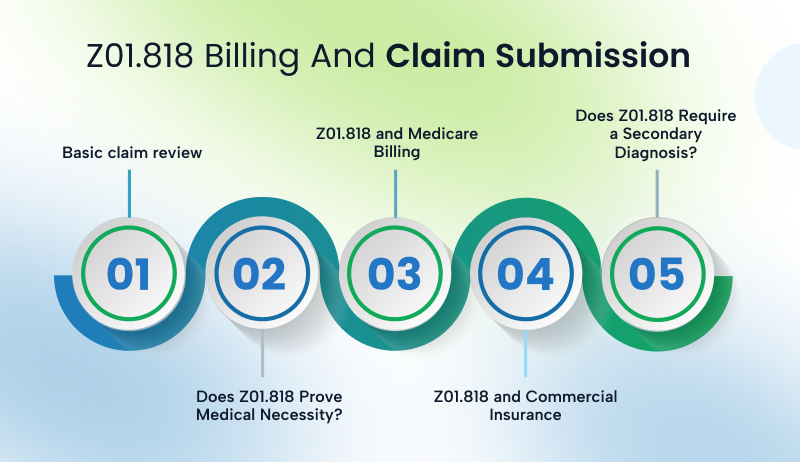
Basic claim review
Before submitting the claim, verify:
- Patient demographics
- Insurance eligibility
- Date of service
- Rendering provider
- Billing provider
- Place of service
- CPT or HCPCS code
- Modifier requirements
- Z01.818 when supported
- Additional diagnosis codes
- Procedure indication
- Documentation
- Payer specific requirements
A claim can contain a technically valid ICD 10 CM code and still deny if the payer does not cover the service under the reported circumstances.
Does Z01.818 Prove Medical Necessity?
No.
Z01.818 identifies a preprocedural examination. It does not independently prove that every service associated with the encounter qualifies for payment.
Medical necessity depends on the service, documentation, payer policy, patient benefits, and other claim details.
For example, a payer may have specific requirements for preoperative laboratory testing, ECGs, imaging, or specialist consultations.
The billing team should check the applicable payer policy rather than assuming that Z01.818 supports every related service.
Z01.818 and Medicare Billing
Medicare claims require the same basic coding principle: report diagnoses that accurately describe the patient’s encounter and support the services billed.
CMS coverage documents demonstrate that Z01.818 can support specific preprocedural services when the applicable Medicare policy identifies it as an acceptable diagnosis. For some vascular studies, CMS instructs providers to use Z01.818 as the primary diagnosis and add diagnoses describing the reason for the study or findings.
However, Medicare coverage varies by service.
A practice should review the applicable Medicare policy before using Z01.818 to support a diagnostic service.
Z01.818 and Commercial Insurance
Commercial insurers may use their own medical policies and claim editing rules.
Some payers may accept Z01.818 for a particular service, while others may require a more specific diagnosis.
Before billing, the practice should check:
- Payer medical policy
- Provider contract
- Prior authorization requirements
- Preprocedural testing requirements
- Diagnosis restrictions
- CPT and ICD 10 CM combinations
- Frequency limitations
- Documentation requirements
Do not assume that Medicare and commercial payer rules always match.
Does Z01.818 Require a Secondary Diagnosis?
Not in every situation, but many preprocedural encounters benefit from an additional diagnosis that explains the reason for the planned procedure.
The official coding guidance specifically states that the condition responsible for the surgery should be assigned as an additional diagnosis for preoperative evaluations.
For example:
- Z01.818: Preprocedural examination
- Additional diagnosis: Documented condition for which the planned procedure will occur
The exact secondary diagnosis depends on the patient’s medical record.
Final Thoughts
Z01.818, Encounter for other preprocedural examination, plays an important role in coding preoperative and preprocedural visits. The code tells the payer that the patient received an examination related to an upcoming procedure.
The biggest coding mistake involves treating Z01.818 as a universal code for anything that happens before surgery.
It isn’t.
Coders need to identify the actual purpose of the encounter, check whether a more specific preprocedural code applies, report the documented condition responsible for the planned procedure when required, and capture relevant findings.
The FY 2026 ICD 10 CM guidelines state that preoperative and preprocedural examination Z codes apply when the patient receives clearance for surgery or a procedure and no treatment occur for a condition during that examination.
Because ICD 10 CM updates take effect on specific dates, billing teams should always verify the code against the applicable year and date of service. CMS currently provides the FY 2027 ICD-10-CM files for encounters beginning October 1, 2026.
Need Help With Medical Billing and Coding?
Accurate diagnosis selection affects more than the claim form. It can affect medical necessity edits, payer denials, documentation requests, and reimbursement.
Medivantek helps healthcare providers, medical practices, and healthcare facilities manage coding, claim submission, denial follow-up, payment posting, and broader revenue cycle work. A billing team that reviews diagnosis selection before submission can catch many avoidable errors before they reach the payer.
Frequently Asked Questions
What does Z01.818 mean in ICD 10 CM?
Z01.818 means Encounter for other preprocedural examination. It describes an encounter in which a provider evaluates a patient before a planned surgery or procedure, when the examination does not fit a more specific preprocedural category.
Can Z01.818 be the primary diagnosis?
Yes. For an encounter performed specifically for a preoperative evaluation, Z01.818 can serve as the first listed diagnosis when the documentation supports it. The diagnosis responsible for the planned surgery generally appears as an additional diagnosis.
What is the difference between Z01.818 and Z01.812?
Z01.818 describes other preprocedural examinations, while Z01.812 describes a preprocedural laboratory examination. The coder should select the code that matches the actual purpose and service documented in the medical record.
Can you use Z01.818 with a surgical diagnosis?
Yes. The surgical diagnosis can appear as an additional diagnosis when the provider documents the condition responsible for the planned procedure. Z01.818 describes the preprocedural evaluation, while the additional diagnosis supplies the clinical reason for the upcoming procedure.
Does Z01.818 guarantee insurance payment?
No. A correct ICD-10-CM code does not guarantee reimbursement. The payer may apply medical necessity rules, benefit restrictions, authorization requirements, or specific diagnosis and procedure combinations.
Can Z01.818 be used when the provider treats another condition during the visit?
Coders should review the encounter carefully. Official guidelines limit preprocedural examination Z codes to situations where the patient receives clearance for the procedure, and no treatment occurs for a condition during that examination. If treatment drives the encounter, the coding approach may change.
Is Z01.818 still valid for 2026?
Yes. CMS’s FY 2026 ICD-10-CM materials list Z01.818 as Encounter for other preprocedural examination. CMS also provides the FY 2027 code files effective October 1, 2026, so billing teams should verify the applicable code set based on the date of service.
