
UHC timely filing limits determine how long a provider has to submit a claim to UnitedHealthcare after delivering a covered service. Missing the applicable deadline can lead to a claim denial, even when the service itself meets coverage and medical necessity requirements.
UnitedHealthcare does not use one universal timely filing limit for every claim. The applicable deadline can vary based on the member’s plan, provider agreement, claim type, applicable government program, and other circumstances.
That makes UHC timely filing different from simply remembering one number.
Let’s discuss how UnitedHealthcare timely filing works, where providers should verify the deadline, what happens when a claim arrives late, and how billing teams can prevent avoidable timely filing denials.
What Is the UHC Timely Filing Limit?
A timely filing limit is the period a provider has to submit a claim to a health plan after providing a service.
For a UnitedHealthcare claim, the applicable deadline depends on the specific UnitedHealthcare plan and the provider’s contractual or program requirements.
You should not assume that every UHC claim has the same filing window.
For example, a commercial UnitedHealthcare plan may follow different requirements from a UnitedHealthcare Medicare Advantage plan or a Medicaid plan.
Your billing team should verify the applicable requirement before relying on a specific number.
When a provider submits a claim after the applicable filing period, UnitedHealthcare may deny it for timely filing.
A timely filing denial can create a particularly frustrating situation because:
- The patient received the service.
- The provider performed the service correctly.
- The claim may contain accurate coding.
- The payer may cover the service.
- Yet the payer can still deny payment because the provider submitted the claim too late.
That makes timely filing management a basic revenue cycle responsibility.
Does UHC Have a 90 Day Timely Filing Limit?
You may see 90 days mentioned frequently in discussions about UHC timely filing.
However, providers should not treat 90 days as a universal UnitedHealthcare rule.
UnitedHealthcare administers multiple products and networks, and filing requirements can differ by plan and contractual arrangement.
The most reliable source for a particular claim is the applicable:
- Provider agreement
- Member benefit plan
- UnitedHealthcare administrative guide
- Claims submission guidance
- Government program requirements
- Payer instructions associated with the patient’s coverage
If your practice uses a billing system with a generic “UHC = 90 days” rule, review that setup before relying on it.
A generic payer rule can create unnecessary write-offs when the actual contract requires a different filing period.
UHC Timely Filing Limits by Plan Type
The first question your billing team should ask is:
Which UnitedHealthcare product covers this patient?
UnitedHealthcare offers different types of coverage, and the applicable claims rules can vary.
| UHC Coverage | What Providers Should Verify |
| Commercial plans | Member plan and provider agreement |
| UnitedHealthcare Medicare Advantage | Applicable Medicare Advantage claims guidance and contract |
| UnitedHealthcare Community Plan | State-specific Medicaid or applicable government program rules |
| Dual eligible plans | Applicable plan and government program requirements |
| Employer sponsored plans | Member plan and applicable provider contract |
| Self-funded plans | Plan-specific administrative requirements |
| Out of network claims | Applicable plan and contract requirements |
This distinction matters because the payer name alone does not always tell you the correct timely filing rule.
How to Find the Correct UHC Timely Filing Limit
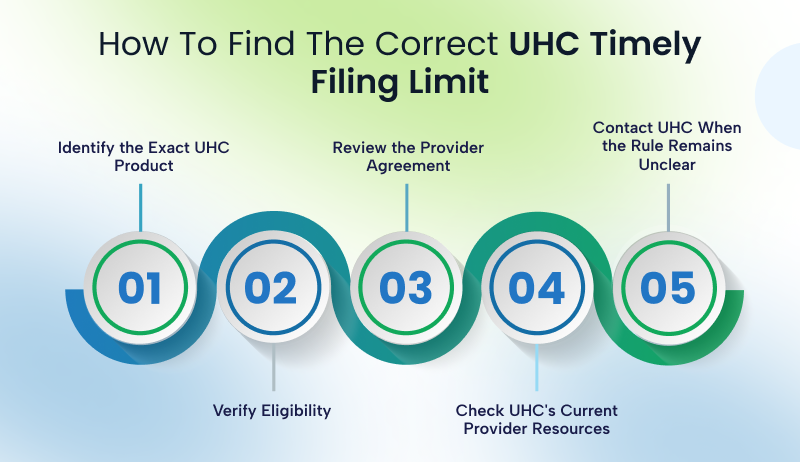
Instead of searching Google every time a claim gets close to the deadline, build a verification process.
Identify the Exact UHC Product
Look at the patient’s insurance card.
Check:
- UnitedHealthcare product name
- Member ID
- Group number
- Network information
- Claims address
- Plan identifiers
- Applicable payer information
Do not assume that a card displaying the UnitedHealthcare name automatically means the same claims rules apply.
Verify Eligibility
Confirm the patient’s coverage for the date of service.
Check:
- Active coverage
- Effective date
- Termination date
- Product type
- Network status
- Primary payer
- Secondary payer
Eligibility verification can help your staff identify the correct payer before claim submission.
Review the Provider Agreement
Your UnitedHealthcare provider agreement may contain specific claims submission requirements.
If your practice participates with UHC, your contract should take priority over generic information found online.
Check UHC’s Current Provider Resources
UnitedHealthcare updates its administrative and claims guidance periodically.
Use the current UnitedHealthcare provider resources rather than relying on an old blog post, saved PDF, or outdated billing cheat sheet.
Contact UHC When the Rule Remains Unclear
If the applicable deadline remains unclear, contact UnitedHealthcare through the appropriate provider channel.
Document:
- Date of contact
- Representative name or identifier
- Reference number
- Question asked
- Answer received
This documentation can help if the practice later needs to explain why it submitted a claim after the expected deadline.
When Does the UHC Timely Filing Clock Start?
The filing period generally relates to the date the provider rendered the service, but the applicable rule can depend on the claim type and payer requirements.
For professional claims, the date of service usually provides the starting point for calculating the filing period.
For institutional claims, billing periods and claim circumstances can affect how the deadline applies.
Do not calculate every UHC deadline from the date your staff entered the claim into the billing system.
Example
A patient receives an office visit on January 10.
Your staff enters the claim into the practice management system on January 20.
The filing clock does not normally start on January 20 simply because that is when staff entered the claim.
Your billing team should follow the applicable UnitedHealthcare claim submission rule.
What Happens When UHC Denies a Claim for Timely Filing?
A timely filing denial means UnitedHealthcare determined that the claim reached the payer after the applicable filing deadline.
The explanation of benefits, electronic remittance advice, or claim response should provide information about the denial.
Your billing team should review:
- Date of service
- Claim submission date
- Claim acceptance date
- Payer receipt information
- Claim status history
- Clearinghouse reports
- Rejection reports
- Previous payer activity
- Corrected claim history
- Applicable UHC filing requirement
Do not immediately bill the patient.
First determine why the claim arrived late.
UHC Timely Filing Denial vs Claim Rejection
This distinction can save a practice from unnecessary confusion.
Claim Rejection
A clearinghouse or payer may reject a claim because it contains an error that prevents processing.
Examples include:
- Invalid member ID
- Missing required data
- Invalid provider information
- Incorrect claim format
- Invalid payer routing
A rejected claim may not count as a successfully received claim for timely filing purposes.
That makes rapid correction important.
Claim Denial
A payer accepts the claim into its adjudication process but then denies payment.
A timely filing denial falls into this category when the payer determines that the provider missed the applicable deadline.
Suppose your practice submits a claim on March 1.
The clearinghouse rejects it because of an invalid payer ID.
Your staff discovers the problem on March 20 and resubmits the claim.
If the practice waits too long to correct the rejection, the corrected submission may arrive after the applicable filing deadline.
That creates a preventable revenue problem.
Does a Clearinghouse Rejection Protect the Provider from Timely Filing?
Not automatically.
Your billing team needs evidence showing when the claim reached the appropriate destination and whether the payer accepted or rejected it.
Save:
- Original submission report
- Clearinghouse acceptance report
- Rejection report
- Payer acknowledgement
- Claim control number
- Corrected submission record
- Correspondence with UHC
A simple “we submitted it on time” statement may not provide enough evidence.
The stronger argument includes documentation showing the claim’s transmission history.
How to Prove Timely Filing to UHC
When appealing a timely filing denial, collect evidence that demonstrates when the practice submitted the claim.
Useful documentation can include:
- Clearinghouse Acceptance Report
- Payer Acceptance
- Electronic Claim Transaction Records
- Claim Control Number
- Rejection Reports
- Payer Correspondence
If another insurer processed the claim first, retain the primary payer’s EOB or ERA.
This evidence can become important when the provider needs to demonstrate that circumstances outside its control caused the delay.
UHC Timely Filing Appeals
When UHC denies a claim because of timely filing, review the denial before submitting an appeal.
Your appeal should answer a simple question:
Why should UnitedHealthcare consider this claim despite the late filing?
Possible circumstances may include:
- Payer processing issues
- Incorrect payer information
- Coordination of benefits delays
- Retroactive eligibility
- Incorrect member information supplied at the time of service
- Another insurer processed the claim first
- System problems
- Clearinghouse transmission problems
- Provider enrollment or credentialing circumstances
- Other documented circumstances recognized by the applicable plan or contract
Do not invent a reason.
Document what actually happened.
What Should a UHC Timely Filing Appeal Include?
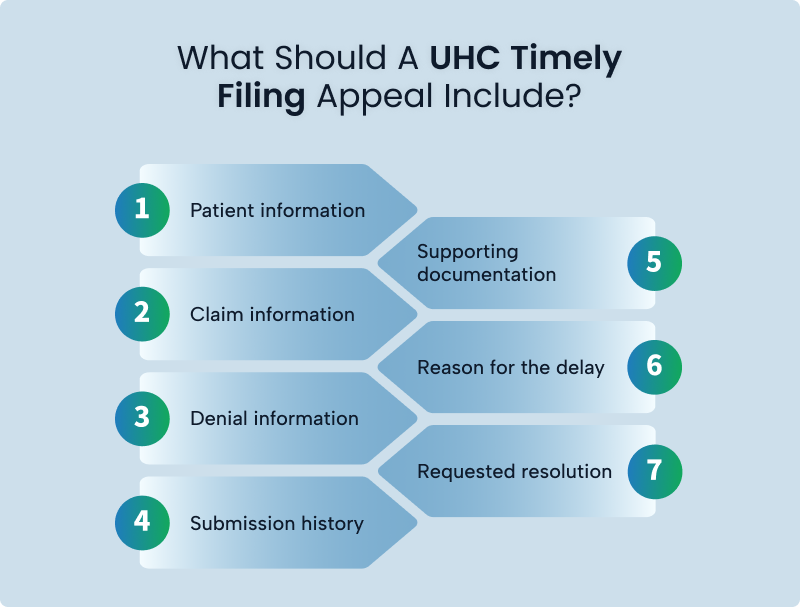
A strong appeal should stay focused.
Include:
Patient information
Name, member ID, date of birth, and other identifiers required by UHC.
Claim information
Claim number, date of service, billed amount, and provider information.
Denial information
Copy or details of the timely filing denial.
Submission history
Explain when you originally submitted the claim and what happened afterward.
Supporting documentation
Attach relevant clearinghouse reports, claim acknowledgments, EOBs, eligibility records, or correspondence.
Reason for the delay
Explain the specific circumstance that caused the late submission.
Requested resolution
Ask UHC to reconsider the timely filing denial based on the documented circumstances.
Keep the explanation factual.
Common Reasons UHC Claims Miss the Filing Deadline
Timely filing problems usually begin somewhere in the revenue cycle.
Delayed Charge Entry
The provider performs the service, but the billing team does not enter the charge promptly.
Eligibility Problems
Staff discover coverage problems after the visit.
Incorrect Insurance Information
A wrong member ID or payer causes the claim to go to the wrong destination.
Clearinghouse Rejections
The practice receives a rejection but does not correct it quickly.
Coordination of Benefits
The practice waits for another payer and then submits to UHC too late.
Credentialing Issues
The practice delays claim submission while resolving enrollment problems.
Staff Turnover
A claim remains in someone’s work queue after the employee leaves.
Poor Claim Tracking
The practice cannot identify which claims remain unsubmitted.
Manual Billing Processes
Staff rely on spreadsheets, paper reports, or manual claim follow up.
Outdated Payer Rules
The billing team follows an old filing deadline.
How to Prevent UHC Timely Filing Denials
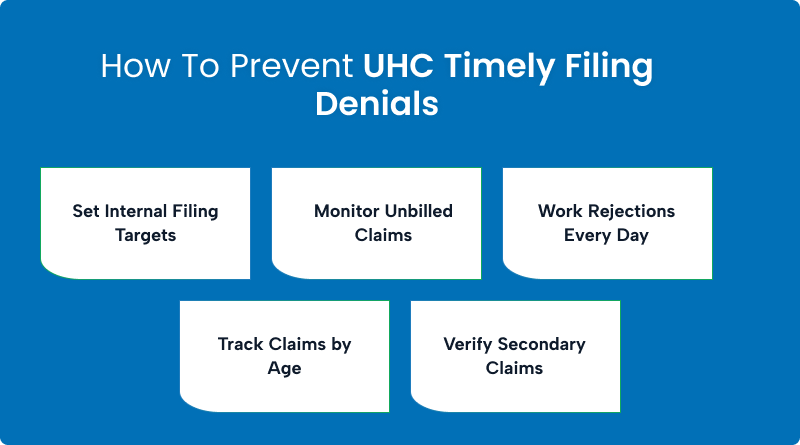
Prevention costs less than repeated appeals.
Set Internal Filing Targets
Do not make the payer’s final deadline your internal deadline.
If the applicable payer rule allows a certain period, give your team an earlier internal target.
That creates room for:
- Corrections
- Rejections
- Eligibility problems
- System outages
- Staff review
- Resubmission
Monitor Unbilled Claims
Create a daily work queue for services that have not produced claims.
Your team should know:
- Date of service
- Provider
- Patient
- Payer
- Charge status
- Claim status
- Days outstanding
Work Rejections Every Day
A rejected claim can become a timely filing problem if nobody fixes it.
Set a daily rejection work queue.
Track Claims by Age
Useful aging categories include:
- 0 to 15 days
- 16 to 30 days
- 31 to 45 days
- 46 to 60 days
- 61 to 90 days
- Over 90 days
Adjust these categories according to your actual payer requirements.
Verify Secondary Claims
Do not allow coordination of benefits to push claims beyond the secondary payer’s filing deadline.
Document the primary payer’s adjudication and submit to the secondary payer promptly.
UHC Timely Filing and Corrected Claims
A corrected claim does not automatically reset the original filing deadline.
That point matters.
Suppose your practice submits an original claim and UHC denies it because of a coding error.
The practice cannot assume that submitting a corrected claim months later gives it a new full timely filing period.
Follow the applicable UnitedHealthcare corrected claim instructions and deadlines.
Keep the original claim information and proof of submission.
UHC Timely Filing for Secondary Claims
Secondary billing creates another common problem.
A provider may wait for the primary insurer to process a claim before submitting the balance to UHC as secondary.
That delay can create a filing issue.
Your workflow should identify:
- Primary payer
- Primary claim submission
- Primary adjudication
- Patient responsibility
- Secondary claim submission
- Secondary payer deadline
Do not simply wait for the primary EOB to arrive without monitoring the calendar.
UHC Timely Filing for Out of Network Providers
Out of network providers should pay particular attention to the patient’s specific plan.
The filing requirement may differ based on:
- Plan type
- Provider agreement
- State requirements
- Network status
- Benefit structure
- Applicable federal rules
An out of network provider should verify the patient’s coverage and applicable claim submission requirements before assuming that an online UHC filing rule applies.
UHC Timely Filing for Medicare Advantage Claims
UnitedHealthcare Medicare Advantage claims operate within a different regulatory and contractual framework from ordinary commercial claims.
Do not apply a commercial UHC filing rule to a Medicare Advantage claim without verification.
Medicare Advantage providers should consult the applicable UnitedHealthcare Medicare Advantage provider materials and contract.
This distinction matters because Medicare Advantage plans must follow CMS requirements that do not necessarily apply to every commercial UnitedHealthcare product.
UHC Community Plan and Medicaid Claims
UnitedHealthcare Community Plan administers Medicaid and other government sponsored coverage in different markets.
The applicable rules can vary by state and program.
For these claims, verify:
- State
- Medicaid program
- UnitedHealthcare Community Plan product
- Provider agreement
- Claim type
- Filing requirement
Do not copy a commercial UHC timely filing limit into your Medicaid billing policy.
UHC Timely Filing for Institutional Claims
Hospitals and other institutional providers should distinguish institutional claim requirements from professional claim requirements.
The billing workflow may involve:
- Admission date
- Discharge date
- Statement period
- Interim billing
- Final claim
- Corrected claim
- Claim frequency
- Facility specific requirements
Use the applicable UnitedHealthcare institutional claims guidance and contract rather than applying a professional claim rule to every facility claim.
What If the Patient Gave You the Wrong Insurance Information?
This situation requires documentation.
Suppose a patient provides an insurance card that does not identify UHC as the responsible payer.
Your practice submits the claim to the insurer listed on the card.
The insurer later determines that another plan should pay.
Your team then submits the claim to UHC.
The key question becomes whether the applicable UnitedHealthcare plan permits an exception based on the circumstances.
Document:
- Insurance information supplied by the patient
- Eligibility verification
- Original payer submission
- Original payer response
- Date the practice discovered UHC coverage
- Date the UHC claim was submitted
Do not assume that UHC will automatically waive the filing requirement.
Ask the plan to review the specific circumstances.
How Medical Billing Teams Can Monitor UHC Timely Filing
A useful dashboard should include:
| Metric | Why It Matters |
| Unbilled claims | Finds services that have not entered billing |
| Claims approaching deadline | Identifies immediate risk |
| Rejected claims | Prevents submission failures from aging |
| Timely filing denials | Measures revenue loss |
| Timely filing appeals | Tracks recovery activity |
| Appeal success rate | Shows whether documentation works |
| Days to initial submission | Measures billing speed |
| Days from rejection to correction | Measures staff response |
| Claims over internal threshold | Flags management issues |
This turns timely filing from a reactive problem into a measurable process.
Final Takeaway
The biggest mistake providers make with UHC timely filing is treating one number as a universal rule.
UnitedHealthcare administers different products, and the applicable claim submission requirement can vary. Your billing team should verify the patient’s exact plan, review the applicable provider agreement and payer guidance, and maintain evidence of every claim submission.
The best defense against a timely filing denial starts long before the denial arrives.
Submit claims quickly. Monitor rejections every day. Track claims by age. Document payer interactions. Follow up on unresolved claims. And when a timely filing denial does occur, build the appeal around facts and submission evidence.
For a medical practice, timely filing should not depend on someone remembering a deadline from a spreadsheet created years ago. Build the deadline into your billing workflow and monitor it before the claim becomes a problem.
Don’t Let UHC Timely Filing Denials Drain Your Revenue
A claim can contain the right codes, correct documentation, and a covered service, yet still go unpaid when it misses the applicable filing deadline.
Medivantek helps healthcare providers manage UHC claims, monitor filing timelines, address rejections, and handle denials before they turn into avoidable write offs.
Protect Your Claims and Get Paid on Time
Frequently Asked Questions
What is the UHC timely filing limit?
UnitedHealthcare does not use one universal filing deadline for every product and claim. The applicable limit can depend on the member’s plan, provider contract, claim type, and government program requirements. Providers should verify the current rule for the specific claim.
Is the UHC timely filing limit 90 days?
Do not assume that every UnitedHealthcare claim has a 90-day filing limit. The applicable deadline can vary. Check the patient’s plan and the provider’s applicable UnitedHealthcare agreement or claims guidance.
What happens if I submit a UHC claim late?
UnitedHealthcare may deny the claim for timely filing. Review the denial, determine why the claim arrived late, and check whether the applicable plan allows reconsideration or an exception.
Can I appeal a UHC timely filing denial?
Yes, when the applicable plan provides an appeal or reconsideration process. Submit documentation that explains the delay and supports the claim’s submission history.
Does a clearinghouse rejection count as timely filing?
A clearinghouse rejection does not automatically establish that the payer received a valid claim within the applicable filing period. Keep the original submission and rejection records and correct rejected claims promptly.
Does submitting a corrected claim restart timely filing?
Not necessarily. A corrected claim generally does not automatically create a new full filing period. Follow the applicable UHC corrected claim requirements.
How can providers prevent UHC timely filing denials?
Submit claims promptly, monitor clearinghouse rejections daily, track claims by age, verify payer information, document coordination of benefits, and maintain proof of claim submission.
Does UHC timely filing differ for Medicare Advantage?
It can. Medicare Advantage claims operate under applicable Medicare Advantage requirements and the specific UnitedHealthcare plan and contract. Do not automatically apply a commercial UHC filing rule.
