
If you have been doing physical therapy billing for any length of time, you know that picking the right CPT code is the difference between getting paid and getting a denial.
The codes themselves might look simple, just a few numbers, but using them correctly takes some practice. And in 2026, there are some changes you need to know about.
This guide covers the most common CPT codes used in physical therapy, explains what each one is for, and highlights the mistakes that lead to denials.
What Is a CPT Code in Physical Therapy?
CPT stands for Current Procedural Terminology. These codes are developed and maintained by the American Medical Association. They are the standard way that healthcare providers describe the services they deliver to patients.
In physical therapy, CPT codes serve a few purposes:
- They tell the insurance company what treatment the patient received
- They determine how much the practice gets paid
- They create a common language across the healthcare system
Physical therapists use CPT codes for everything from the initial evaluation to therapeutic exercises to manual therapy. Knowing how to select the right code is essential for getting the practice paid and staying compliant.
The Evaluation and Re-Evaluation Codes
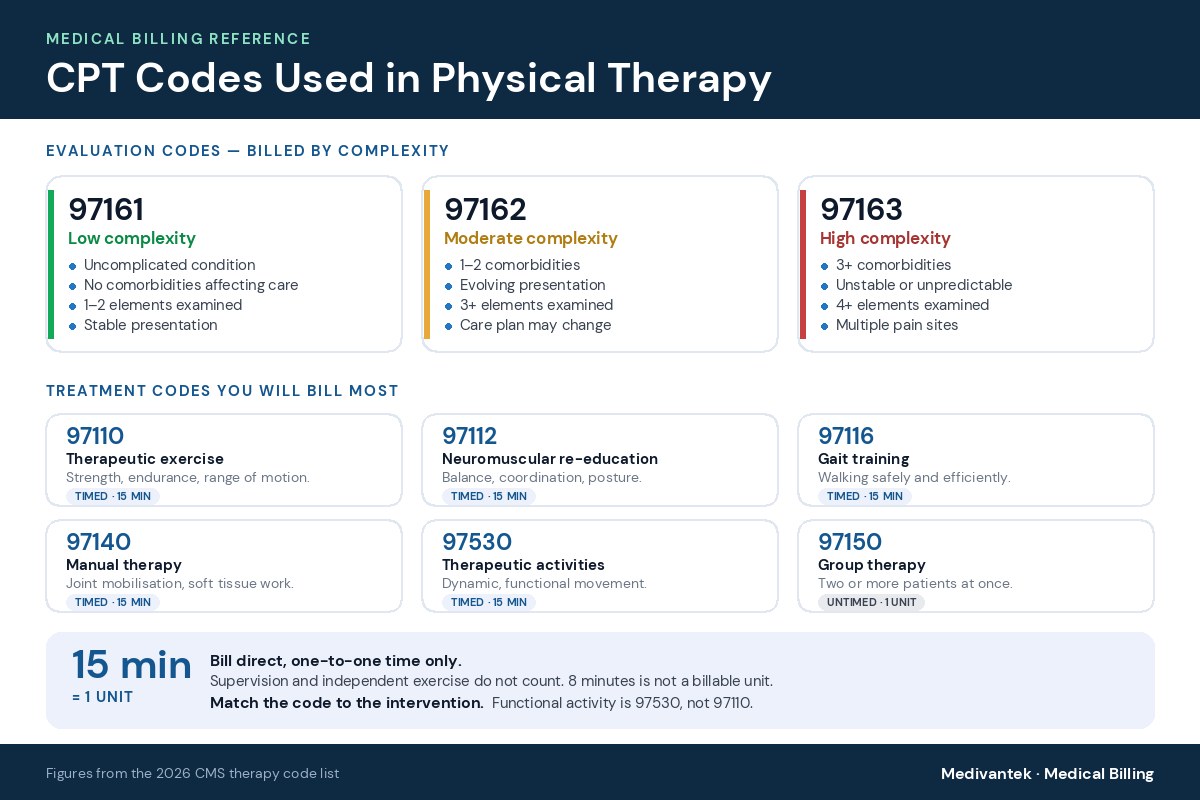
Every patient journey starts with an evaluation. The evaluation codes are tiered by complexity, not just by time. You have to pick the one that matches the patient's clinical presentation.
97161 – Low Complexity Evaluation
Use this when the patient has an uncomplicated condition with no significant personal factors or comorbidities that affect the plan of care. The clinical presentation should be stable, and the clinical decision-making should be straightforward.
Usage: A patient with a minor ankle sprain. No other health issues that affect treatment.
The exam covers one or two elements from body structures and functions or activity limitations. Usually about 20 minutes face-to-face.
97162 – Moderate Complexity Evaluation
This code is for patients with one or two comorbidities or personal factors that affect the treatment plan. The clinical presentation might be evolving, and the exam covers at least three elements of body functions or activity limitations.
Usage: A patient with knee pain who also has diabetes that affects wound healing. Or a patient with neck pain and a history of cervical fusion. Usually about 30 minutes face-to-face.
97163 – High Complexity Evaluation
This is for complex patients with three or more comorbidities that affect the plan of care.
The clinical presentation is often unstable or unpredictable. The exam covers four or more elements.
Usage: A patient with multiple chronic conditions, multiple pain sites, and unpredictable responses to treatment. Usually about 45 minutes face-to-face.
97164 – Re-Evaluation
Use this when you need to re-assess the patient's progress and make changes to the plan of care. This is not a routine follow-up, there must be a documented reason for the re-evaluation.
Usage: A patient who was making progress but suddenly worsened, requiring a new approach. Or a patient who has reached a plateau.
Important: You cannot bill a re-evaluation on the same day as a treatment session.
These are separate visits.
The Therapeutic Procedure Codes
These are the treatment codes you will use most often. They are all time-based, which means they are billed in 15-minute increments and require direct, one-on-one contact with the patient.
97110 – Therapeutic Exercise
This is the most commonly used CPT code in physical therapy. It covers exercises designed to develop strength, endurance, range of motion, and flexibility. Activities like resistance band exercises, stretching, and strengthening programs all fall under this code.
How time works: This is a timed code. Each unit covers 15 minutes of direct, one-on-one contact. If you spend 25 minutes on therapeutic exercise, you bill two units.
If you spend 8 minutes, you do not bill for it.
97112 – Neuromuscular Reeducation
This code is for activities that improve balance, coordination, posture, and movement patterns. It is often used for patients with neurological conditions or for retraining movement after an injury.
Usage: Balance training on a wobble board. Proprioceptive exercises after an ankle sprain. Postural retraining for patients with chronic neck pain. It can also include retraining coordination of scapular stabilizers using PNF patterns.
97116 – Gait Training
This covers teaching patients how to walk safely and efficiently. It includes training with assistive devices like canes, walkers, and crutches, as well as improving stride patterns and weight distribution.
Usage: Patients recovering from a stroke, total joint replacement, or lower extremity injury.
97140 – Manual Therapy
Manual therapy includes hands-on techniques like joint mobilization, soft tissue manipulation, myofascial release, and manual lymphatic drainage. These techniques are often used early in treatment when patients are more symptomatic.
Documentation tip: You need to document the specific techniques used, not just "manual therapy." Be specific about which joints or tissues were treated and the patient's response.
97530 – Therapeutic Activities
This code covers dynamic, functional activities that improve a patient's ability to perform real-world tasks. Activities like sit-to-stand training, lifting, reaching, and transfers fall under this code.
When to use: Therapeutic activities are used when treatment moves beyond simple exercises to more functional movements that mimic daily tasks. The reimbursement rate for 97530 is often higher than 97110, so be sure you are using the right code for the right activity.
97535 – Self-Care and Home Management Training
This code is used when the therapist teaches patients how to perform activities of daily living more safely and independently. This includes instruction for dressing, grooming, bathing, and using adaptive equipment at home.
Other Common Procedure Codes
97150 – Group Therapy
Group therapy is for two or more patients receiving therapy services at the same time.
This code is untimed, you bill one unit for the session regardless of length. You cannot bill individual therapy codes for the same patients during the same session if they are receiving group treatment.
97545 / 97546 – Work Conditioning
These codes are used for structured programs designed to help injured workers return to their job duties. Work conditioning typically happens after formal physical therapy has ended and focuses on job-specific tasks like lifting, pushing, pulling, and cardiovascular endurance.
- 97545: Work conditioning, first hour
- 97546: Work conditioning, each additional hour
97761 – Prosthetic Training
This code is used for training patients on how to use a prosthetic limb. It includes the fitting of the prosthetic and teaching the patient how to use it. Documentation should specify the type of prosthetic being used and the patient's progress in adapting to it.
2026 Updates for Physical Therapy CPT Codes
The CMS therapy code list changes every year. For 2026, there are some important updates you need to know about.
New Remote Therapeutic Monitoring Codes
Effective January 1, 2026, CMS added new codes for Remote Therapeutic Monitoring (RTM):
- 98984: Remote therapeutic monitoring; device(s) supply for data access or data transmissions to support monitoring of respiratory system, 2-15 days in a 30-day period
- 98985: Remote therapeutic monitoring; device(s) supply for data access or data transmissions to support monitoring of musculoskeletal system, 2-15 days in a 30-day period
- 98979: Remote therapeutic monitoring treatment management services, first 10 minutes
Important: Existing RTM codes 98976 and 98977 were revised to account for 16-30 days in a 30-day period. These are designated as "sometimes therapy" codes, which means therapists must use them under a therapy plan of care with the appropriate GP, GO, or GN modifiers.
RVU Updates
The Relative Value Units for some codes were updated based on the 2023 Medicare utilization data:
- 97110: Work RVU of 0.45
- 97112: Work RVU of 0.50
These values affect reimbursement rates, so staying current matters.
The Documentation Rules
Most insurance claim denials in physical therapy billing happen because the documentation is missing something. Here are the rules that will keep your claims out of the denial pile.
Rule 1: Document Time Accurately
For timed codes like 97110, 97112, and 97530, you need to document the exact amount of one-on-one time spent with the patient. That means direct contact with the therapist or assistant, not time spent supervising independent exercise.
Common mistake: Billing for time spent supervising a patient who is doing exercises on their own. This is not billable time.
Rule 2: Match the Code to the Intervention
Do not use 97110 for everything. If the activity is functional and dynamic, use 97530. If it is balance and coordination work, use 97112. Using the wrong code is one of the most common audit triggers.
Rule 3: Document the Medical Necessity
Every note needs to justify why the service was necessary. This means documenting the patient's limitations, what you did to address them, and the patient's response. The documentation should always support the code you bill.
Rule 4: Know the Difference Between Group and Individual Therapy
Group therapy (97150) is for two or more patients receiving therapy at the same time.
You cannot bill individual codes if you are treating patients in a group. And you cannot bill group therapy if you gave significant one-on-one time to each patient.
Common Billing Mistakes
Overusing Therapeutic Exercise (97110)
Therapeutic exercise is the most common code, which makes it the most common source of errors. Therapists often bill 97110 for activities that should be coded under 97112, 97530, or other codes.
How to avoid it: Make sure you understand the definition of each code. Match the code to the specific intervention you are providing, not just the one you are most comfortable with.
Misunderstanding Time-Based Billing
Time-based codes require accurate time tracking. Bill only for direct, one-on-one time.
Supervision and independent exercise time do not count. Billing for more time than was actually spent is overbilling and can lead to audits.
Billing 97110 for Functional Activities
Functional activities that improve a patient's ability to perform daily tasks should be billed under 97530, not 97110. 97530 typically reimburses at a higher rate, so using 97110 for these activities underbills and undercounts the service delivered.
Not Differentiating Evaluation Complexity
Using 97161 for a complex evaluation with multiple comorbidities is underbilling and leaves money on the table. Using 97163 for a simple ankle sprain is upcoding and can trigger an audit. Document the complexity accurately and pick the code that matches.
Not Staying Current with CPT Updates
CPT codes change every year. In 2026, new RTM codes were added, and existing codes were revised. If you are still using last year's codes, your claims will deny.
Your 2026 Coding Checklist
1. Review the new RTM codes. If you do remote therapeutic monitoring, make sure you are using the correct codes for 2026.
2. Verify your documentation. Make sure every note supports the code you are billing and documents the time spent.
3. Match the code to the intervention. Do not use 97110 for everything.
4. Know the difference between low, moderate, and high complexity evaluations. Bill the one that matches the patient's presentation.
5. Track time accurately. Only bill for direct, one-on-one time.
The Bottom Line
Physical therapy coding does not have to be hard.
The key is knowing the codes, matching them to the right interventions, documenting accurately, and staying current with updates. Use 97110 for therapeutic exercise, 97112 for neuromuscular reeducation, 97116 for gait training, 97140 for manual therapy, and 97530 for therapeutic activities.
Use 97161, 97162, and 97163 for evaluations based on complexity. Track time accurately and document thoroughly.
Get these basics right, and your claims will pay.
Medivantek Medical Billing handles the entire physical therapy billing process from start to finish. Our team knows the 2026 CPT codes inside and out. We verify patient eligibility, submit clean claims, track denials, and appeal them when they happen. We make sure your documentation meets payer standards so you get paid for every minute of care you provide.
Contact Our Billing Experts
Frequently Asked Questions
What is the most commonly used CPT code in physical therapy?
The most commonly used code is 97110 for therapeutic exercise. This code covers activities like stretching, strengthening, and range of motion exercises. You will see it on most physical therapy claims because it is the foundation of most treatment plans. It is a timed code, so you bill it in 15-minute units.
How many units can I bill for a 60-minute session?
For timed codes like 97110 and 97112, you bill in 15-minute increments. A 60-minute session with one code gives you four units. If you split time between two codes, say 30 minutes of 97110 and 30 minutes of 97530, you bill two units of each. Just make sure your documentation supports the time split.
Can I bill 97110 and 97530 on the same day?
Yes, you can bill both codes on the same day if you provided both types of services.
The key is documenting the time separately for each code. For example, if you spent 30 minutes on therapeutic exercise and 20 minutes on therapeutic activities, you would bill two units of 97110 and one unit of 97530. The total time must match the session length.
What is the difference between 97110 and 97530?
97110 covers exercises that focus on strength, endurance, and range of motion. Think of it as the building blocks of therapy. 97530 covers functional, dynamic activities that mimic real-world tasks like sit-to-stand, lifting, or reaching. The activities under 97530 are usually more complex and functional than those under 97110.
How do I bill for a re-evaluation?
Use 97164 for re-evaluation. This is a separate code from the initial evaluation codes (97161, 97162, 97163). You cannot bill it on the same day as a treatment session. The re-evaluation must be medically necessary, meaning you are reassessing the patient's progress and making changes to the plan of care. Document the reason for the re-evaluation clearly.
What are the 2026 RTM code changes?
New codes 98984, 98985, and 98979 were added for remote therapeutic monitoring.
These cover device supply and data transmission for monitoring the respiratory and musculoskeletal systems. Existing codes 98976 and 98977 were revised. These are "sometimes therapy" codes, which means they require therapy modifiers like GP, GO, or GN when used under a therapy plan of care.
