
Chest pain can range from a minor chest wall complaint to a sign of a serious underlying condition.
For ICD-10-CM coding, R07.9 is the general code for chest pain when the provider does not document enough detail for a more specific R07 code.
Other codes apply when the record identifies precordial pain, intercostal pain, pain with breathing, pleurodynia, or other specified chest pain.
The key is to code from the provider’s final documentation rather than choosing R07.9 automatically.
What Is the ICD 10 Code for Chest Pain?
The most commonly referenced code is:
R07.9, Chest pain, unspecified
Use R07.9 when the provider documents chest pain but does not provide enough detail to assign a more specific R07 code.
Other chest pain codes include:
| ICD 10 CM code | Description | When it may apply |
| R07.1 | Chest pain on breathing | Pain associated with respiration |
| R07.2 | Precordial pain | Pain documented as precordial |
| R07.81 | Pleurodynia | Documented pleurodynia |
| R07.82 | Intercostal pain | Pain involving the intercostal area |
| R07.89 | Other chest pain | Specified chest pain that does not fit another listed R07 category |
| R07.9 | Chest pain, unspecified | Chest pain without further documented specificity |
CMS’s current FY 2026 material continues to identify R07.2, R07.82, R07.89, and R07.9 among the diagnoses associated with the chest pain DRG.
The correct code depends on the provider’s documentation, not simply on the patient’s description of the symptom.
R07.9, Chest Pain, Unspecified
R07.9 represents chest pain, unspecified.
This code works when the medical record establishes chest pain but does not identify a more specific type or confirmed underlying cause.
For example, a provider may document:
“Patient presents with chest pain.”
The provider evaluates the patient but does not establish a more specific diagnosis.
In that situation, R07.9 may be appropriate.
Another record might state:
“Intermittent chest discomfort, etiology unclear.”
The final code depends on the provider’s complete assessment and the applicable coding rules. If the provider ultimately documents only unspecified chest pain, R07.9 can fit.
The important point involves the word unspecified.
A coder should not choose R07.9 simply because it appears first in a code search.
- If the record clearly states “intercostal pain,” R07.82 provides more detail.
- If the provider documents “precordial pain,” R07.2 may apply.
- If the provider documents chest pain while breathing, R07.1 should receive consideration.
CMS specifically identifies R07.9 as chest pain, unspecified and advises consideration of more specific codes when the documentation supports them.
R07.89, Other Chest Pain
R07.89 represents other chest pain.
This code often creates confusion because coders sometimes treat “other” and “unspecified” as interchangeable.
- Unspecified means the documentation does not give enough information to identify the specific type.
- Other specified means the provider gives enough information to establish a particular form of chest pain, but that description does not have its own dedicated code within the category.
For example, CMS’s Tabular List includes anterior chest wall pain NOS under R07.89.
Consider two documentation examples.
Example:
“Localized anterior chest wall pain.”
The provider has described the pain more specifically.
R07.89 may be appropriate when the documentation supports that classification.
This distinction can look small on a claim. It reflects an important coding principle, though. Coders should use the detail that the provider documented instead of defaulting to an unspecified code.
R07.2, Precordial Pain
R07.2 represents precordial pain.
The term “precordial” refers to the area over or near the heart and the front portion of the chest.
A provider who specifically documents precordial pain gives the coder a more precise diagnostic term than simply “chest pain.”
For example:
“Patient reports recurrent precordial pain.”
The coder should review R07.2 rather than automatically assigning R07.9.
CMS includes R07.2 among the ICD 10 CM diagnoses associated with its chest pain DRG.
The coder should still review the full assessment. If the provider establishes a cardiac condition responsible for the pain, the underlying condition may change the coding approach.
R07.1, Chest Pain on Breathing
R07.1 represents chest pain on breathing.
The code includes painful respiration.
This code differs from ordinary chest pain because the provider connects the pain with breathing.
For example:
“Sharp chest pain increases with deep inspiration.”
If the provider’s final assessment identifies chest pain on breathing, R07.1 may be appropriate.
The documentation should support the relationship between respiration and the pain.
Do not assign R07.1 simply because the patient happens to have chest pain and shortness of breath.
Shortness of breath and pain during breathing are not the same thing.
R07.82, Intercostal Pain
R07.82 represents intercostal pain.
Intercostal pain involves the area between the ribs.
A provider may document:
“Localized intercostal pain on the left side.”
That description differs from a generic complaint of chest pain.
If the provider establishes intercostal pain as the diagnosis, R07.82 should receive consideration.
CMS currently includes R07.82 among the chest pain diagnoses recognized in the FY 2026 MS DRG material.
R07.81, Pleurodynia
R07.81 represents pleurodynia.
Pleurodynia can produce intense chest or thoracic pain that often worsens with movement or breathing.
The coding distinction matters because R07.81 specifically identifies the documented condition.
There is also an important coding note.
The ICD 10 CM Tabular List excludes epidemic pleurodynia from R07.81 and directs coders toward B33.0 when applicable.
This illustrates why a coder should not stop after finding a code in the Alphabetic Index.
The Tabular List can change the final decision.
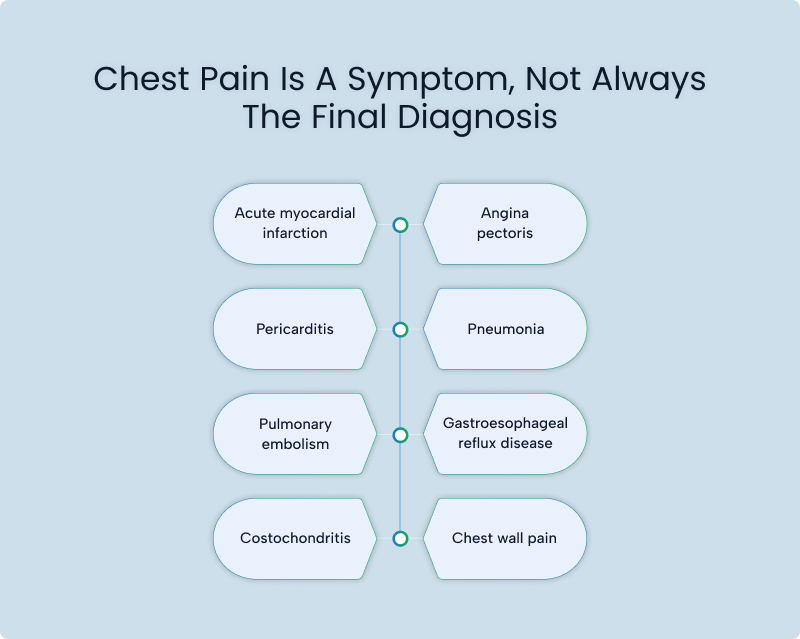
Chest Pain Is a Symptom, Not Always the Final Diagnosis
This point deserves special attention.
A patient may arrive with chest pain.
The physician may perform an ECG, laboratory testing, imaging, or other evaluation.
The workup may identify the actual cause.
For example, the provider may diagnose:
- Acute myocardial infarction
- Angina pectoris
- Pericarditis
- Pneumonia
- Pulmonary embolism
- Gastroesophageal reflux disease
- Costochondritis
- Chest wall pain
The final diagnosis can change the coding approach.
A coder should not automatically report R07.9 when the provider establishes a definitive condition responsible for the symptom.
The symptom and disease can coexist in the clinical record. Whether both should appear on the claim depends on the setting, documentation, and applicable ICD 10 CM reporting guidelines.
Chest Pain vs Angina
Chest pain and angina are not interchangeable terms.
Angina describes chest discomfort caused by myocardial ischemia.
If the provider documents angina, the coder should review the applicable I20 category rather than automatically selecting R07.9.
CMS’s cardiology coding material lists several angina codes alongside the R07 chest pain codes, including I20.0, I20.1, I20.8, and I20.9.
Consider this documentation:
“Chest pain during exertion. Assessment: stable angina.”
The final diagnosis does more than describe a symptom.
Now compare:
“Chest pain during exertion. Cardiac etiology not established.”
The coding situation differs.
The coder should follow the provider’s final documented diagnosis.
Do not infer angina simply because the pain sounds cardiac.
Chest Pain vs Myocardial Infarction
A patient with chest pain may have an acute myocardial infarction.
If the physician confirms an MI, the coder needs to review the applicable myocardial infarction code rather than treating chest pain as the primary diagnosis.
The symptom often triggers the evaluation.
The confirmed disease explains the symptom.
For example:
“Patient presents with crushing substernal chest pain. ECG and cardiac biomarkers support acute myocardial infarction.”
That record requires a different coding review from:
“Patient presents with chest pain. MI ruled out after evaluation. No definitive cause identified.”
The second scenario may leave the coder with a symptom-based diagnosis, depending on the final provider documentation and care setting.
Can You Code R07.9 When the Patient Has a Negative Cardiac Workup?
Yes, in appropriate circumstances.
A negative cardiac workup does not mean the patient did not experience chest pain.
It may mean that the evaluation did not establish a cardiac cause.
If the provider’s final diagnosis remains chest pain and does not establish another cause, R07.9 may remain appropriate.
For example:
“Chest pain. ECG negative for acute ischemic changes. Troponins negative. No definitive etiology identified.”
The coder should review the final assessment and applicable guidelines.
Do not replace the provider’s documented symptom with a disease that the workup failed to establish.
Chest Pain With GERD
Chest discomfort can originate from the gastrointestinal system.
A patient may report burning substernal discomfort after meals.
The provider may diagnose gastroesophageal reflux disease.
If GERD becomes the established diagnosis, the coder should review the applicable K21 category rather than automatically using R07.9.
The record should support the diagnosis.
The coder should not independently decide that all burning chest pain represents reflux.
The same principle applies to other possible causes.
Coding follows the provider’s documented diagnosis.
Chest Pain From Costochondritis
Costochondritis can cause chest wall pain.
The patient may describe tenderness near the sternum or pain that increases with certain movements.
If the provider diagnoses costochondritis, review the applicable musculoskeletal code rather than automatically assigning R07.9.
This distinction matters because the record contains an established condition rather than an unexplained symptom.
The provider’s final assessment remains the key.
Chest Pain and Pleuritic Pain
Pleuritic pain often changes with breathing.
The clinical description may include sharp pain that becomes worse when the patient takes a deep breath.
The provider may document “pleuritic chest pain.”
The coder should review the exact diagnosis and the applicable code set rather than automatically treating every pleuritic complaint as R07.1.
If the provider establishes pneumonia, pulmonary embolism, pleurisy, or another underlying condition, that diagnosis may change the coding decision.
Clinical language alone should not replace the final provider diagnosis.
Chest Pain With Shortness of Breath
Chest pain and shortness of breath often appear together.
That does not mean they represent one diagnosis.
The provider may document:
“Chest pain with dyspnea.”
Depending on the encounter, both symptoms may require review.
R07.9 addresses unspecified chest pain.
R06.02 addresses shortness of breath.
But if the provider establishes a disease responsible for both symptoms, the disease may become the more important coding consideration.
For example, a confirmed pulmonary embolism creates a different coding situation from unexplained chest pain with dyspnea.
Chest Pain in Cardiology Coding
Cardiology practices frequently see chest pain patients.
The patient may arrive for:
- New onset chest discomfort
- Exertional pain
- Follow up after emergency evaluation
- Abnormal ECG with chest symptoms
- Evaluation of suspected coronary disease
- Follow up after a cardiac procedure
The coder needs to distinguish the presenting symptom from the established cardiac diagnosis.
CMS includes R07.1, R07.2, R07.81, R07.82, R07.89, and R07.9 in its cardiology clinical concepts material. The same CMS material also lists several angina diagnoses.
That makes one thing clear.
The R07 category does not represent every cardiac cause of chest discomfort.
It represents specific pain and symptom descriptions.
Chest Pain ICD 10 Code for Emergency Department Visits
Chest pain frequently appears as an emergency department complaint.
The ED provider may investigate serious causes first.
The final diagnosis may remain chest pain if the workup does not establish a specific disease.
In that situation, R07.9 can play an important role.
The coder should review:
- The chief complaint
- History and physical
- Diagnostic testing
- Provider assessment
- Final diagnosis
- Discharge diagnosis
- Any confirmed condition
- Do not code solely from the triage note.
The final provider documentation carries greater weight for the diagnosis assigned to the encounter.
Chest Pain ICD 10 Coding for Outpatient Visits
Outpatient coding requires careful attention to what the provider establishes during the encounter.
A provider may document:
“Chest pain, unspecified.”
R07.9 can fit.
Another provider may document:
“Precordial pain.”
R07.2 may fit.
Another may document:
“Anterior chest wall pain.”
R07.89 may fit.
If the provider diagnoses coronary artery disease with angina, the coder should review the applicable combination code structure rather than automatically adding an unspecified chest pain code.
The diagnosis should reflect what the provider evaluated and managed.
Chest Pain ICD 10 Code and Medical Necessity
Chest pain frequently serves as the diagnosis supporting cardiac testing.
Examples include:
- Electrocardiography
- Cardiac monitoring
- Stress testing
- Echocardiography
- Cardiac imaging
- Laboratory testing
CMS Medicare billing articles list R07.1, R07.2, R07.82, R07.89, and R07.9 among diagnoses used in coverage and billing contexts for cardiovascular diagnostic services.
That does not mean every payer automatically covers every service when you submit R07.9.
Coverage depends on the payer policy, service, medical necessity requirements, documentation, and other claim details.
A diagnosis code supports the medical story.
It does not guarantee payment.
Chest Pain Documentation: What Should Providers Include?
Good documentation makes coding easier.
The provider can describe:
- Where the pain occurs
- Whether the pain occurs at rest or during activity
- Whether breathing changes the pain
- Whether movement changes the pain
- Whether the pain involves the chest wall
- Whether the pain feels pressure like, sharp, burning, or aching
- Whether the pain radiates
- How long the episode lasts
- What triggers it
- What relieves it
Whether the provider established an underlying cause
The final assessment matters more than a long symptom description when selecting the diagnosis.
For example, this documentation gives the coder a clear direction:
“Localized anterior chest wall pain, reproducible with palpation. Cardiac workup negative.”
This provides more coding information than:
“Chest pain.”
Common Chest Pain Coding Mistakes
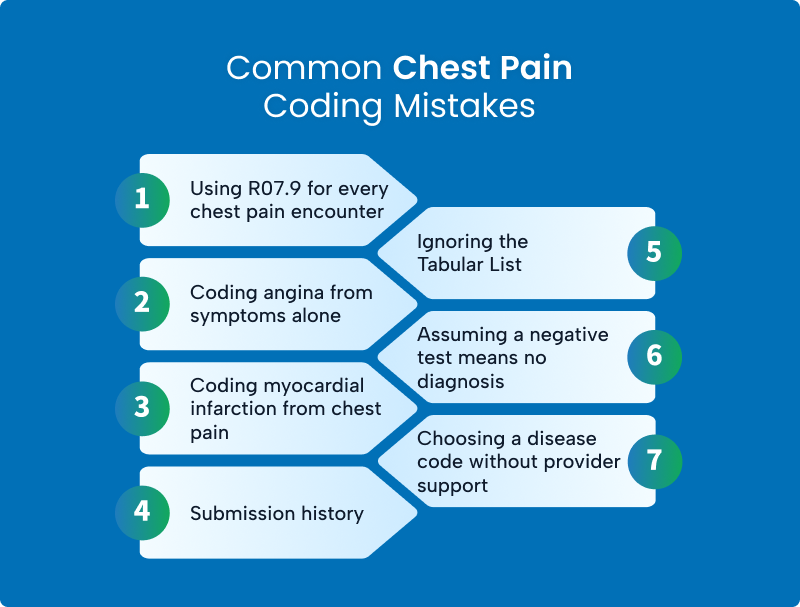
Using R07.9 for every chest pain encounter
R07.9 works for unspecified chest pain.
It should not replace a more specific documented diagnosis.
If the provider documents intercostal pain, review R07.82.
If the provider documents precordial pain, review R07.2.
If the provider documents other specified chest pain, review R07.89.
Coding angina from symptoms alone
A patient may describe pressure or pain during exercise.
That does not allow the coder to independently diagnose angina.
The provider needs to establish the diagnosis.
Coding myocardial infarction from chest pain
Chest pain can occur during an MI.
It can also occur without an MI.
The coder should follow the provider’s documented diagnosis and supporting record.
Ignoring the Tabular List
A code search result does not provide the entire coding instruction set.
Review:
- Excludes notes
- Code first notes
- Use additional code notes
- Additional instructions
- Applicable conventions
The pleurodynia example demonstrates why this step matters. R07.81 contains an Excludes 1 instruction for epidemic pleurodynia.
Assuming a negative test means no diagnosis
A patient can have genuine chest pain even when testing does not reveal a serious underlying disease.
The final diagnosis may remain a symptom.
Choosing a disease code without provider support
Coders should not diagnose GERD, angina, costochondritis, pulmonary embolism, or coronary disease from symptoms alone.
Conclusion
Accurate chest pain coding starts with the provider’s documentation. R07.9 remains appropriate when the record supports unspecified chest pain and no more specific diagnosis applies. However, coders should review R07.1, R07.2, R07.81, R07.82, and R07.89 when the documentation provides greater specificity. When the evaluation establishes angina, myocardial infarction, GERD, pulmonary disease, or another condition, the underlying diagnosis can change the coding approach. Careful review of the final assessment and Tabular List helps practices reduce coding errors, claim rework, and avoidable payment issues.
Improving Your Medical Billing and Coding Workflow
Chest pain claims require more than selecting R07.9 from a code search.
Medivantek helps healthcare providers and organizations review documentation, coding accuracy, claim submission, denial patterns, and reimbursement workflows.
If your practice sees recurring chest pain related denials or coding inconsistencies, a focused revenue cycle review can identify where claims are losing revenue.
Contact Medivantek for a billing review
Frequently Asked Questions
What is the ICD 10 code for chest pain?
R07.9 is the ICD 10 CM code for chest pain, unspecified. Use it when the provider documents chest pain but does not establish enough detail to assign a more specific chest pain code. If the provider documents a specific type of pain or confirms an underlying condition, the coder should review the appropriate code instead.
What is the difference between R07.9 and R07.89?
R07.9 means the documentation leaves the type of chest pain unspecified. R07.89 applies when the provider describes a specific form of chest pain that does not have its own dedicated code within the R07 category. For example, documented anterior chest wall pain may support R07.89. The distinction depends on what the provider actually documents.
Can R07.9 be used when the cardiac workup is negative?
Yes, when appropriate. A negative ECG, negative cardiac biomarkers, or another negative cardiac evaluation does not automatically eliminate chest pain as a documented symptom. If the provider completes the evaluation without establishing another cause and the final diagnosis remains unspecified chest pain, R07.9 may be appropriate. The coder should rely on the final provider assessment and applicable coding rules rather than creating a different diagnosis from test results alone.
Should you code R07.9 when the provider diagnoses angina or another underlying condition?
Not automatically. Chest pain describes a symptom, while angina represents a clinical diagnosis that belongs to the I20 category. If the provider establishes angina, myocardial infarction, GERD, costochondritis, pulmonary embolism, or another condition as the cause of the symptoms, the coder should review the applicable disease code and coding rules. A coder should never assign a disease diagnosis based only on the patient’s description of chest pain.
What documentation helps support accurate chest pain coding?
Providers should document the location and character of the pain, triggers, duration, radiation, relationship to breathing or movement, and the final clinical assessment. Documentation such as “localized anterior chest wall pain, reproducible with palpation” gives the coder more information than simply stating “chest pain.” The final assessment remains especially important because the provider may identify an underlying condition after completing the evaluation.
What is the most common mistake when coding chest pain?
The most common mistake is treating R07.9 as the default code for every chest pain encounter. Coders should review the complete record for a more specific R07 code or an established underlying diagnosis. They should also review the Tabular List for Excludes notes, Code First instructions, Use Additional Code instructions, and other applicable conventions before finalizing the claim.
