

A claim can leave your practice without ever reaching the insurance company.
That usually happens before adjudication, often because something in the electronic claim doesn’t meet the required format. The clearinghouse sits between the provider and payer to catch, format, route, and exchange electronic healthcare transactions.
For a medical practice, the clearinghouse is more than a technical middleman. It can affect how quickly claims reach payers, how many submissions get rejected, and how easily the billing team can track what happened after submission.
But there’s an important distinction:
A clearinghouse does not decide whether an insurer should pay your claim. The payer does that.
The clearinghouse helps get the transaction into a form the payer can receive and process.
What Is a Healthcare Clearinghouse?
A healthcare clearinghouse is an electronic data exchange service that receives healthcare transactions from providers, checks them against required formats and data rules, and sends them to the appropriate payer or other destination.
Instead of building a separate electronic connection to every insurance company, a provider can use a clearinghouse to exchange standardized transactions with multiple payers through one system.
The concept becomes easier to understand with a simple example.
A physician’s office submits a claim to its practice management system.
The claim contains information about:
- The patient
- The provider
- Diagnosis codes
- Procedure codes
- Dates of service
- Charges
- Place of service
- Insurance information
- Billing details
The practice sends that electronic claim to its clearinghouse.
The clearinghouse checks the transaction.
If the claim contains a problem that prevents electronic processing, the clearinghouse may reject it back to the provider.
If it passes the clearinghouse’s checks, the system routes it toward the appropriate payer.
The payer then performs its own processing and adjudication.
The return path matters just as much as the initial submission because electronic healthcare transactions can generate several types of responses.
Why Do Medical Practices Use Clearinghouses?
Healthcare billing involves many different payers, each with its own electronic connectivity arrangements and processing requirements.
A practice that submits claims manually or maintains separate connections for every payer would face unnecessary administrative work.
A clearinghouse provides one electronic connection that can support transactions across many payer relationships.
It can also help the billing team identify certain problems before claims reach the payer.
That can reduce avoidable rework.
For example, imagine a practice submits 500 claims on Monday.
Without useful electronic validation, the billing staff may discover later that some claims contained missing or invalid information.
With a clearinghouse, certain errors may surface before the claims reach the payer.
The staff can correct those claims and resubmit them.
That doesn’t guarantee payment, but it can prevent some avoidable submission problems from becoming payer denials.
How Does a Healthcare Clearinghouse Work?
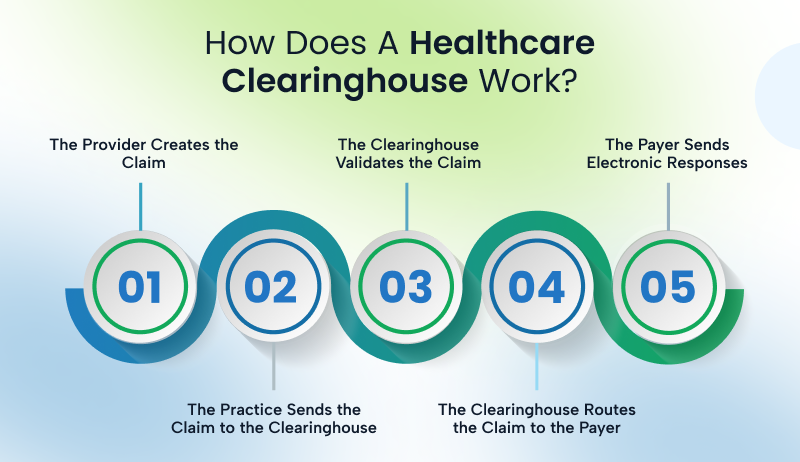
The process generally follows several stages.
1. The Provider Creates the Claim
The process begins in the practice’s EHR or practice management system.
After the clinician documents the encounter, the billing team or automated workflow creates a claim.
The claim contains coded and administrative information needed for electronic submission.
For professional claims, the electronic format commonly uses the ASC X12 837P transaction.
Institutional claims use the 837I transaction.
These standards allow different healthcare systems to exchange structured information electronically.
2. The Practice Sends the Claim to the Clearinghouse
The practice submits the electronic claim through its billing system.
The clearinghouse receives the transaction and begins its validation process.
At this point, the claim hasn’t been adjudicated.
The clearinghouse isn’t deciding whether the service qualifies for reimbursement.
It’s checking whether the transaction can move through the electronic system successfully.
3. The Clearinghouse Validates the Claim
The clearinghouse may run edits that identify missing, invalid, or inconsistent information.
Examples can include:
- Invalid payer identification
- Missing required data
- Incorrect formatting
- Invalid provider information
- Subscriber information problems
- Incompatible code combinations
- Missing claim elements
The exact edits vary by clearinghouse and payer connection.
If the claim fails a clearinghouse edit, the system can return it to the provider for correction.
- A rejection generally means the claim didn’t successfully enter the payer’s adjudication process because an electronic or data issue prevented processing.
- A denial occurs after the payer processes the claim and determines that it won’t pay the claim as submitted, either fully or partially.
The two terms often get mixed in billing conversations.
They shouldn’t.
If a claim gets rejected before adjudication, appealing medical necessity usually makes no sense.
Fix the submission problem first.
If the payer denies a properly submitted claim, the billing team needs to investigate the payer’s reason and determine whether correction, reconsideration, or appeal makes sense.
4. The Clearinghouse Routes the Claim to the Payer
Once the transaction passes the applicable checks, the clearinghouse routes it to the appropriate payer.
The payer receives the electronic claim and begins its own processing.
This can include checking:
- Member eligibility
- Benefit coverage
- Provider participation
- Authorization requirements
- Coding
- Medical necessity
- Contract terms
- Claim history
- Other payer-specific rules
The clearinghouse doesn’t replace this process.
The payer owns the adjudication decision.
5. The Payer Sends Electronic Responses
The payer can send several types of electronic responses during the claim lifecycle.
One important transaction is the 277CA, or claim acknowledgment, which can communicate whether a claim passed certain front end processing requirements.
The 835, or Electronic Remittance Advice, communicates payment and adjustment information.
The practice can use this information to post payments, identify adjustments, and work unpaid or denied claims.
The clearinghouse may deliver these transactions back into the provider’s system.
That creates an electronic trail from submission to payment.
| A Simple ExampleLet’s say an urgent care center sees a patient for a respiratory complaint.The practice creates a claim and sends it through its clearinghouse.The clearinghouse detects that the payer information doesn’t match the required format.The claim comes back as a rejection.The billing team corrects the payer information and resubmits it.The payer receives the corrected claim.Later, the payer adjudicates the claim and sends an electronic remittance.The practice posts the payment.Now imagine a different situation.The claim reaches the payer successfully, but the payer denies a service because the plan doesn’t cover it.That’s not a clearinghouse rejection.The payer adjudicated the claim and made a coverage decision.The billing team needs to review the denial and determine what action, if any, it can take.Understanding that difference saves time. |
What Transactions Does a Healthcare Clearinghouse Handle?
Healthcare clearinghouses can support several standard electronic transactions.
837, Healthcare Claim
Providers use the 837 transaction to submit electronic claims.
The two major versions relevant to medical billing include:
- 837P: Professional claims
- 837I: Institutional claims
270, Eligibility Inquiry
A provider can use a 270 transaction to request eligibility and benefit information.
271, Eligibility Response
The payer returns a 271 response with available eligibility and benefit information.
276, Claim Status Inquiry
A provider can use a 276 transaction to ask about the status of a previously submitted claim.
277, Claim Status Response
The corresponding response provides claim status information.
835, Electronic Remittance Advice
The 835 communicates payment, adjustment, and remittance information electronically.
These transactions form part of the broader electronic healthcare transaction system governed by standards and administrative requirements.
The HIPAA Administrative Simplification provisions establish standards for certain electronic healthcare transactions.
What Happens When a Clearinghouse Rejects a Claim?
The first step isn’t to resubmit the exact same claim.
Find out why it rejected.
The rejection report should provide information about the issue, depending on the transaction and clearinghouse.
A billing specialist may need to investigate:
- Patient demographics
- Subscriber information
- Payer ID
- Provider identifiers
- Billing entity information
- Diagnosis codes
- Procedure codes
- Claim formatting
- Required fields
Once the error gets corrected, the claim can be resubmitted.
Keep the original rejection information.
It provides a useful record of what went wrong and can help identify recurring workflow problems.
How Clearinghouses Can Help Reduce Billing Friction
A well configured clearinghouse can provide useful checks before claims reach payers.
For example, the system may flag certain missing or invalid data elements.
That allows the billing team to correct the claim before payer adjudication.
But don’t expect the clearinghouse to catch everything.
A claim can pass electronic validation and still receive a denial.
Why?
Because electronic validity doesn’t equal payment eligibility.
A claim may contain perfectly formatted information and still fail because:
- The patient’s benefit excludes the service.
- The provider lacks the required authorization.
- The payer determines the service doesn’t meet its coverage criteria.
- The claim contains a coding issue that the payer evaluates during adjudication.
- The payer applies contract or benefit rules.
A clean electronic submission is a starting point, not a payment guarantee.
Choosing a Healthcare Clearinghouse
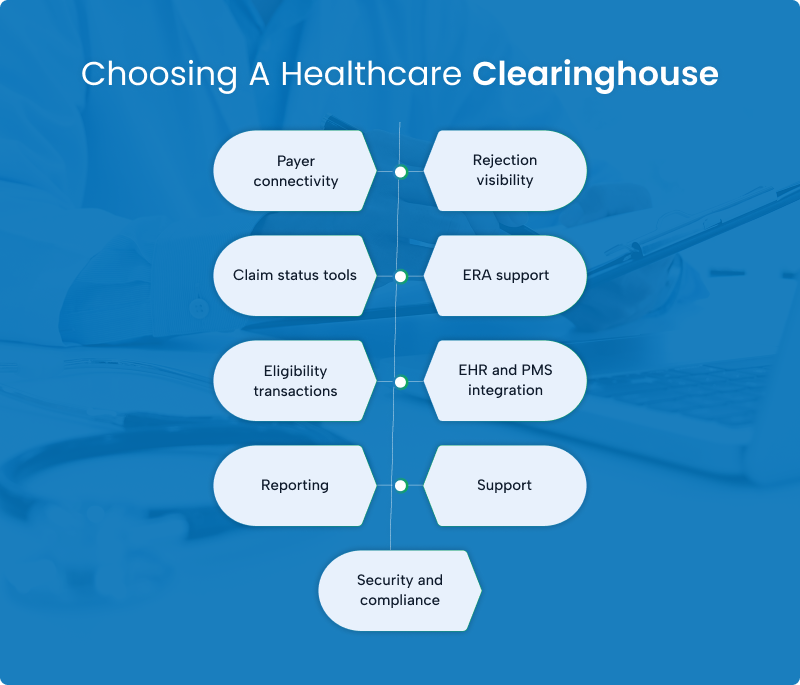
Not every practice needs the same clearinghouse setup.
When evaluating one, look beyond the number of payer connections.
Consider:
Payer connectivity
Does the clearinghouse connect with the payers your practice actually uses?
Rejection visibility
Can your team clearly see why claims failed?
Claim status tools
Can staff track claims after submission?
ERA support
Can the system receive and process electronic remittance information?
Eligibility transactions
Can it support electronic eligibility verification where appropriate?
EHR and PMS integration
Does it connect cleanly with your current systems?
Reporting
Can management identify recurring rejection and transaction problems?
Support
Can your billing team get help when a transaction behaves unexpectedly?
Security and compliance
Does the vendor maintain appropriate safeguards and meet applicable regulatory and contractual requirements?
A long payer list looks impressive.
A system that your staff can actually use effectively matters more.
Final Thoughts
A healthcare clearinghouse sits in an important part of the medical billing process, but it doesn’t replace the payer and it doesn’t guarantee reimbursement.
Its main job involves facilitating electronic healthcare transactions between providers and payers, validating transactions against certain requirements, routing them to the appropriate destination, and returning electronic responses.
For providers, the real value comes from understanding what happens at each stage.
A claim can fail before it reaches the payer.
It can reach the payer and still get denied.
It can get paid and still be underpaid.
Those are three different revenue cycle problems.
Your clearinghouse can help with the first and provide information related to the others. Your billing team still needs to understand the entire claim lifecycle.
When that workflow works properly, the billing office spends less time wondering where a claim went and more time working the issues that actually affect reimbursement.
Keep Claims Moving. Keep Revenue Coming In.
A claim that never reaches the payer can’t get paid. Medivantek Billing helps your practice manage the path from eligibility and claim submission to rejection handling, denials, payment posting, and A/R follow up.
Request Your Free Billing Review Today
Frequently Asked Questions
What does a healthcare clearinghouse do?
A healthcare clearinghouse facilitates electronic healthcare transactions between providers and payers. It can validate certain transaction data, route claims and other transactions, and return electronic responses such as claim acknowledgments and remittance information.
Is a clearinghouse an insurance company?
No. A clearinghouse and insurance payer perform different functions. The clearinghouse facilitates the exchange of electronic transactions, while the payer evaluates claims and determines coverage, payment, adjustments, and patient responsibility.
What is the difference between a claim rejection and denial?
A rejection generally occurs before the payer completes claim adjudication because the transaction has a data, format, or processing problem. A denial occurs when the payer adjudicates the claim and decides not to pay all or part of the submitted service.
What is an 837 claim?
An 837 is a standardized electronic healthcare claim transaction. Providers use different versions for professional and institutional claims. The 837P applies to professional claims, while the 837I applies to institutional claims.
What is an 835 in medical billing?
An 835 is the standard electronic remittance advice transaction. It communicates payment and adjustment information from a payer to a provider or other healthcare entity.
Can a clearinghouse prevent claim denials?
It can help prevent certain submission errors by identifying problems before claims reach the payer. It cannot prevent every denial because payers make coverage, medical necessity, authorization, coding, and payment decisions during adjudication.
How should a practice handle clearinghouse rejections?
Review the rejection reason, correct the underlying problem, and resubmit the claim when appropriate. Track recurring rejection categories because repeated errors often indicate a registration, coding, integration, or configuration problem.
Does every medical practice need a clearinghouse?
Practices that submit electronic healthcare transactions often use clearinghouse services or another electronic connectivity arrangement. The appropriate setup depends on the practice’s systems, payer relationships, transaction volume, and operational requirements.
